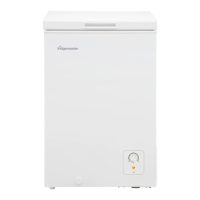
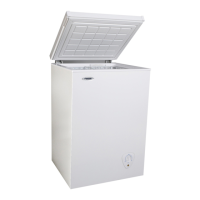
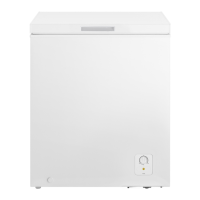
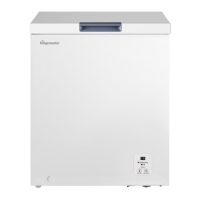
This document is a user manual for Fridgemaster chest freezers, covering models MCF142E, MCF142EB, MCF198E, MCF198EB, and MCF297E. It provides comprehensive information on safety, usage, installation, maintenance, and troubleshooting for these appliances.
Function Description:
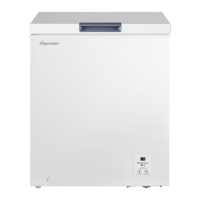
The Fridgemaster chest freezer is designed for household and similar applications, including staff kitchen areas, farmhouses, hotels, motels, bed and breakfast establishments, and catering. Its primary function is to store frozen food and beverages, maintaining them at low temperatures. The appliance features "Winter Guard" technology, allowing it to operate effectively in environments where temperatures can drop as low as -15°C, making it suitable for outbuildings like garages and sheds. The freezer includes a control panel for temperature adjustment and mode selection, such as quick-freezing. It is equipped with a magnetic door seal to ensure efficient temperature retention.
Important Technical Specifications:
- Models Covered: MCF142E, MCF142EB, MCF198E, MCF198EB, MCF297E.
- Power Supply: Single-phase alternating current of 220~240 V/50Hz. A special power socket with ground wire is required.
- Refrigerant: Isobutene (R600a), a natural gas with high environmental compatibility, which is flammable.
- Climate Class: Performs well within the SN-T climate class.
- Ambient Operating Temperature (Winter Guard): -15°C to +43°C.
- Temperature Control Range: Adjustable from -14°C to -24°C.
- Fuse Requirement: Must be connected via a three-pin socket, suitably grounded, and protected by a 13 amp fuse (approved to BS1363/A standards).
- LED Light: If equipped, the LED light must be replaced by a service agent, not the user.
- Energy Efficiency: Designed for optimal energy efficiency when shelves and drawers are placed in their original positions.
Usage Features:
- Temperature Adjustment: The control panel allows users to set the target temperature. Each press of the "Temperature setting key" cycles through settings from -14°C to -24°C. The setting takes effect after approximately 2 seconds.
- Quick-Freezing Mode: Activated by pressing the "Quick-freezing mode key." This mode provides rapid refrigeration but increases power consumption. The display shows "-25" when active. The mode exits automatically after a period of continuous forced freezing.
- Locking Function: The keys automatically lock after approximately 20 seconds of inactivity (or 60 seconds for the indicator to turn off). To unlock, press and hold the freezing and quick-freezing keys for about 3 seconds.
- Food Storage Guidelines:
- Hot food should be cooled to room temperature before placing it in the freezer.
- Frozen food should be stored in sealed, non-toxic, tasteless, impermeable, and waterproof materials to prevent moisture loss and odor transfer.
- Pre-packed frozen food should be stored according to the manufacturer's instructions.
- Carbonated or fizzy drinks should not be placed in the freezer compartment to prevent container explosion.
- Raw meat and fish should be stored in suitable containers to avoid contact with or dripping onto other foods.
- Two-star frozen-food compartments are suitable for storing pre-frozen food, making ice cream, and ice cubes. One-, two-, and three-star compartments are not suitable for freezing fresh food.
- Power Failure Memory: The refrigerator automatically remembers its state before a power off and resumes operation accordingly, except for the quick-freezing mode.
- Installation: The appliance should be installed in a well-ventilated location, with at least 75mm clearance from the back to the wall and 100mm on the sides and top to ensure proper heat dissipation and efficiency. It should be level to eliminate vibration.
- First Use: Before first use, remove all packaging, clean the interior, and allow the unit to operate for about 1 hour to cool down before placing items inside. Wait at least four hours after delivery before connecting the appliance to allow oil to flow back into the compressor.
Maintenance Features:
- Defrosting: Recommended two or three times a year when ice thickness reaches about 4mm.
- Set the thermostat to "MAX" at least 12 hours before defrosting.
- Switch off the freezer by unplugging it.
- Remove all food, wrap it, and store it in a cold place. Leave the door open.
- Clean and wipe the compartment dry after defrosting.
- Switch the appliance back on, set the thermostat to "MAX," wait at least one hour before replacing foodstuffs, then reset the thermostat to the original position after a few hours.
- Cleaning:
- Disconnect the power cord before cleaning.
- Wipe the exterior with a soft, dry cloth, or a cloth moistened with detergent, followed by a clean, damp cloth.
- Do not splash water directly onto the freezer or wash with water to avoid short circuits or electrical shocks.
- Do not use polishing powder, soap powder, benzine, oil, or hot water, as these can damage painted and plastic components.
- Use a plastic scraper to remove frost; do not use sharp objects.
- Keep ventilation openings clear of obstruction.
- Troubleshooting: The manual provides a table of common problems and their solutions, such as power failure, power cord issues, inadequate refrigeration, and excessive noise.
- Service: Any electrical work or servicing must be carried out by a qualified electrician or competent person. The product should be serviced by an authorized service center using genuine spare parts.
- Disposal: The appliance must not be disposed of with domestic household waste. It should be taken to an appropriate waste collection point for recycling electrical and electronic equipment. Packaging materials are recyclable. Before disposal, disconnect the main plug and cut off the main cable.
- Alarm System: If "E1" is displayed, it indicates a temperature sensing head malfunction. Contact a maintenance point for repair.

 Need help?
 General

 To Next Page