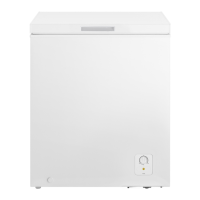
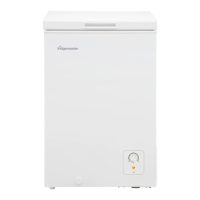
This document is a user manual for Fridgemaster Chest Freezers, covering models MCF96, MCF142, MCF198, MCF96B, MCF142B, MCF198B, MCF297, and MCF306. It provides comprehensive information on safety, usage, maintenance, and troubleshooting.
Function Description:
The Fridgemaster Chest Freezer is designed for household and similar applications, including staff kitchen areas, farmhouses, hotels, motels, bed and breakfast environments, and catering. Its primary function is to store food at freezing temperatures, with specific compartments suitable for different types of frozen food and storage durations. The appliance features "Winter Guard" technology, allowing it to operate effectively in environments where temperatures can drop as low as -15°C, such as garages, sheds, or outbuildings. It is not intended to be used as a built-in appliance.
Important Technical Specifications:
- Power Supply: Single-phase alternating current of 220~240 V/50Hz. A special power socket with a ground wire is required, and its plug must match the socket.
- Refrigerant: Isobutene (R600a), a natural gas with high environmental compatibility, which is flammable.
- Fuse: Protected by a 13 amp fuse approved to BS1363/A standards.
- Temperature Control: Adjustable dial on the front-bottom side of the chest freezer, with settings from MIN to MAX and a "0" position to temporarily stop operation.
- Ambient Temperature Range: Safe working ambient temperature is -15°C to +43°C.
- Storage Compartment Temperatures:
- Fridge: +2°C to +6°C (not suitable for freezing)
- (**)-Freezer: <-18°C (recommended for 3 months for seafood, freshwater aquatic products, and meat products)
- ***-Freezer: <-18°C (not suitable for freezing fresh food)
- **-Freezer: <-12°C (recommended for 2 months for seafood, freshwater aquatic products, and meat products)
- *-Freezer: <-6°C (recommended for 1 month for seafood, freshwater aquatic products, and meat products)
Usage Features:
- Temperature Adjustment: The temperature control dial allows users to set the desired temperature. "MID" is the normal setting. Turning towards "MAX" increases cooling performance, while turning towards "MIN" reduces it. The "0" setting stops the unit temporarily.
- Food Storage:
- Hot food should be cooled to room temperature before placing it in the freezer to avoid affecting other foods and increasing power consumption.
- Different food types should be stored in sealed, non-toxic, tasteless, impermeable, waterproof materials to prevent moisture loss and odor transfer.
- Pre-packed frozen food should be stored according to the manufacturer's instructions.
- Carbonated or fizzy drinks should not be placed in the freezer compartment as they can create pressure and explode.
- Raw meat and fish should be stored in suitable containers to prevent contact or dripping onto other food.
- Energy Efficiency:
- Open and close the door quickly and keep it open for the shortest possible time to prevent cold air from escaping.
- Install the unit in a well-ventilated location.
- Do not use the unit to store water or food that requires water as a storage medium.
- Initial Setup:
- Remove all packaging and tape.
- Clean the interior before first use.
- Insert the power supply plug into a grounded single-phase 220-240 V wall outlet.
- Allow the unit to operate for about 1 hour to cool down before placing items inside.
- Wait at least 5 minutes before restarting the unit after it has been turned off to prevent damage.
Maintenance Features:
- Cleaning:
- Before cleaning, switch off the appliance and disconnect the mains plug.
- Do not use metal objects, steam cleaners, ethereal oils, organic solvents, or abrasive cleansers.
- Wipe the exterior with a soft, dry cloth; for heavy soiling, use a cloth moistened with detergent, then wipe with a cloth dipped in clean water. Do not splash water directly onto the freezer.
- Clean the cooler regularly.
- Keep ventilation openings clear of obstruction.
- The interior and all internal accessories should be washed with lukewarm water and neutral soap before first use.
- Defrosting:
- Defrost the freezer compartment two or three times a year, or when the ice layer is about 4 mm thick.
- Set the thermostat to "Colder" at least 12 hours before defrosting.
- Switch off the freezer by removing the plug from the main power supply.
- Remove all food, wrap it, and store it in a cold place. Leave the door open.
- Clean and wipe the compartment dry after defrosting.
- Switch the appliance back on with the thermostat set to "Colder" and wait at least one hour before replacing foodstuffs.
- After a few hours, the thermostat can be set back to its original position.
- Do not use mechanical devices or other artificial means to accelerate defrosting, other than those recommended by the manufacturer.
- Installation:
- Ensure adequate air circulation around the appliance to prevent overheating. Follow installation instructions for sufficient ventilation.
- The back of the product should not be close to a wall to avoid touching or catching warm parts (compressor, condenser).
- Do not locate the appliance close to radiators or cookers.
- Ensure the mains plug is accessible after installation.
- It is advisable to wait at least four hours before connecting the appliance to allow oil to flow back into the compressor.
- The appliance should be level to eliminate vibration. Adjust the level by unscrewing the appropriate level adjusters in the front.
- Troubleshooting:
- The manual provides a table of common problems (e.g., no refrigeration, power cord issues, excessive noise, condensation) and their solutions.
- If problems persist, disconnect the power cord and contact the dealer or customer service.
- Disposal:
- Do not dispose of the appliance with domestic household waste.
- Packaging materials are recyclable and should be disposed of in a suitable waste collection container.
- Before disposing of the appliance, disconnect the main plug, cut off the main cable, and discard it.
- The product should be taken to an appropriate waste collection point for the recycling of electrical and electronic equipment.
- Children and Vulnerable Persons:
- Children aged 8 years and above, and persons with reduced physical, sensory, or mental capabilities or lack of experience, can use the appliance if supervised or instructed and understand the hazards.
- Children should not play with the appliance or perform cleaning/maintenance without supervision.
- Keep all packaging away from children due to the risk of suffocation.
- If discarding the appliance, pull the plug, cut the connection cable, and remove the door to prevent children from getting trapped or suffering electric shock.
- If replacing an older appliance with a spring lock, make the lock unusable before discarding.
- General Safety:
- Do not store explosive substances (e.g., aerosol cans with flammable propellant).
- If the supply cord is damaged, it must be replaced by the manufacturer, service agent, or similarly qualified persons.
- Keep ventilation openings clear of obstruction.
- Do not use mechanical devices or other means to accelerate defrosting other than those recommended by the manufacturer.
- Do not damage the refrigerant circuit.
- Do not use electrical appliances inside food storage compartments unless recommended by the manufacturer.
- The refrigerant (R600a) and insulation are flammable; dispose of the appliance at an authorized waste disposal center and do not expose to flame.
- Ensure the supply cord is not trapped or damaged when positioning the appliance.
- Do not locate multiple portable socket-outlets or power supplies at the rear of the appliance.
- Damaged supply cords must be replaced by a special cord or assembly from the manufacturer or service agent.
- The LED light must not be replaced by the user; contact customer helpline if damaged.
- Avoid naked flames and sources of ignition if the refrigerant circuit is damaged.
- Thoroughly ventilate the room if the appliance is situated in a room where the refrigerant circuit is damaged.
- Do not alter specifications or modify the product.
- Ensure the power plug is not crushed or damaged and is accessible.
- Do not pull the main cable to unplug.
- Do not use a loose power plug socket.
- Do not operate without the interior lighting lamp cover.
- The fridge requires a 220-240 V/50Hz power supply; use an AC automatic voltage regulator if voltage fluctuates significantly.
- Do not store flammable gas or liquids.
- Do not operate other electrical appliances inside the freezer.
- Always pull the plug from the mains socket when unplugging, not the cable.
- Do not place hot items near plastic components.
- Do not place food products directly against the air outlet on the rear wall.
- Do not remove or touch items from the freezer with damp/wet hands to avoid skin abrasions or frost/freezer burns.
- Never use the base, drawers, or doors to stand on or as supports.
- Frozen food must not be refrozen once thawed.
- Do not consume ice popsicles or ice cubes straight from the freezer to avoid freezer burn.
- Do not overload door racks or crisper drawers to prevent items from falling and causing injury or damage.
- Keep burning candles, lamps, and other naked flames away from the appliance.
- The appliance is heavy; take care when moving it.
- Do not place the appliance in direct sunlight.
- For electrical connection, follow instructions carefully and ensure grounding.
- Do not bend, stretch, or pull the supply cable.
- Ensure the power socket is suitable for the maximum power of the machine (13 amp fuse).
- The appliance should be grounded and comply with applicable laws.
- The power socket must be within easy reach when installed.
- Do not disconnect the power cord plug with wet hands.
- Do not store the unused chest freezer in a location where children play.

 Need help?
 General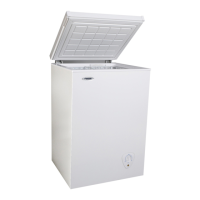


 To Next Page
