This document is a user manual for the Fridgemaster MBC54228F Fridge Freezer, providing comprehensive information on its installation, operation, maintenance, and safety.
Function Description
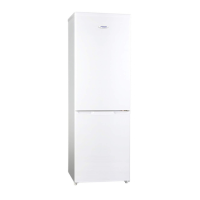
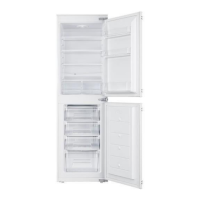
The Fridgemaster MBC54228F is a fridge freezer designed for household and similar applications. It features separate compartments for refrigeration and freezing, allowing for the storage of fresh and frozen foods. The appliance is intended for keeping foodstuffs and/or beverages in normal household settings. It includes a temperature controller (thermostat) to switch the device on/off and set the desired cooling temperature. The freezer compartment is suitable for storing pre-frozen food, making ice cream, and ice cubes, with specific recommendations for different star-rated compartments regarding storage times and food types. The refrigerator compartment is designed for fresh foods, dairy, fruits, and vegetables.
Important Technical Specifications
- Model: MBC54228F
- Power Supply: Single phase alternating current of 220~240V/50Hz. An A.C. Automatic voltage regulator of more than 350W is recommended if voltage fluctuation is large.
- Refrigerant: Isobutene (R600a), a natural gas with high environmental compatibility, which is flammable.
- Insulation Blowing Gas: Flammable.
- Climate Category: The appliance is designed for specific room temperatures:
- SN: +10°C to +32°C
- N: +16°C to +32°C
- ST: +16°C to +38°C
- T: +16°C to +43°C
- Storage Time in Emergency: The insulation of the appliance's walls provides 11 hours of storage time for frozen foods after a power failure.
- Lighting: Contains a light source of energy efficiency class G. LED lights should only be replaced by a qualified specialist.
- Freezing Capacity: Indicated on the rating plate (XX kg/24h).
Usage Features
- Temperature Control: A temperature dial (thermostat) allows users to switch the appliance on/off and set the cooling temperature from 1 (warmest) to 7 (coldest/quick cool/freeze setting). Setting 7 is recommended for quick cooling/freezing large amounts of food, to be reset to 6 after 2 hours.
- Door Reversal: The door hinges can be reversed, allowing for flexible installation to open from either the left or right side.
- Storage Compartments:
- Refrigerator: Includes adjustable shelves, a wine rack (optional), a drainage hole, a non-adjustable shelf, and crispers for vegetables and fruits. Door balconies provide additional storage.
- Freezer: Features multiple drawers for organized storage of frozen food.
- Food Storage Guidelines: Detailed recommendations are provided for storing various fresh and frozen foods, including suitable packaging (polyethylene freezer bags, aluminum foil, plastic containers, glass containers) and approximate storage times in months for freezer compartments at -18°C. Specific guidelines are given for different star-rated freezer compartments (0-star, -Freezer, **-Freezer, -Freezer, ()-Freezer) and a "Chill" compartment, specifying appropriate foods and recommended storage temperatures and durations.
- Energy Saving Advice: Recommendations include avoiding installation near heat sources, ensuring good ventilation, minimizing door opening times, maintaining clean and intact door seals, proper food placement, and allowing hot food to cool before storage.
- Safety Features: Magnetic door seals, warnings against storing explosive or flammable substances, and instructions for safe disposal of the appliance.
Maintenance Features
- Cleaning:
- Regular external cleaning with furniture polish or enamel protecting product.
- Door seals should be cleaned with warm water.
- Internal parts should be washed by hand with warm water and a little washing-up liquid.
- Avoid using metal objects, steam cleaners, ethereal oils, organic solvents, abrasive cleansers, or sharp objects.
- Clean the drain hole in the fridge regularly with cotton buds.
- If equipped, the heat exchanger (condenser) on the back should be cleaned regularly with a soft brush or duster to remove dust.
- Defrosting (for non-NO FROST devices):
- The freezer compartment should be defrosted once or twice a year.
- Instructions include removing food, scraping ice with a plastic or wood scraper, and cleaning the interior.
- The fridge compartment defrosts automatically.
- Troubleshooting Guide: A section dedicated to common issues and their possible causes and solutions, such as the appliance not functioning, insufficient cooling, or unusual noises.
- Service and Repair: Any electrical work or servicing must be carried out by a qualified electrician or authorized Service Center using genuine spare parts. Users are advised not to attempt repairs themselves.
- Disposal: The appliance and its packaging materials are recyclable. It must not be disposed of as household waste but taken to an appropriate waste collection point for recycling electrical and electronic equipment. The refrigerant circuit must not be damaged during disposal.

 Need help?
 General


 To Next Page