Chapter 1
Page 11
1.5 Narrow Areas And Narrow Passes
The minimum distance for an effective narrow pass is 5.5 feet (1.7 m) between perimeter wires.
Figures 1.6, 1.7 and 1.8.
1.6 Defining Obstacles-Perimeter Islands
Many obstacles can be left in the lawn without consideration to excluding them using the perimeter
wire. The basic rule of thumb is that the obstacle must be at least 6 inches (15 cm) high from the
ground and the obstacle must be relatively rigid. Good examples of these kinds of obstacles include
many trees, phone poles, power poles and flag poles.
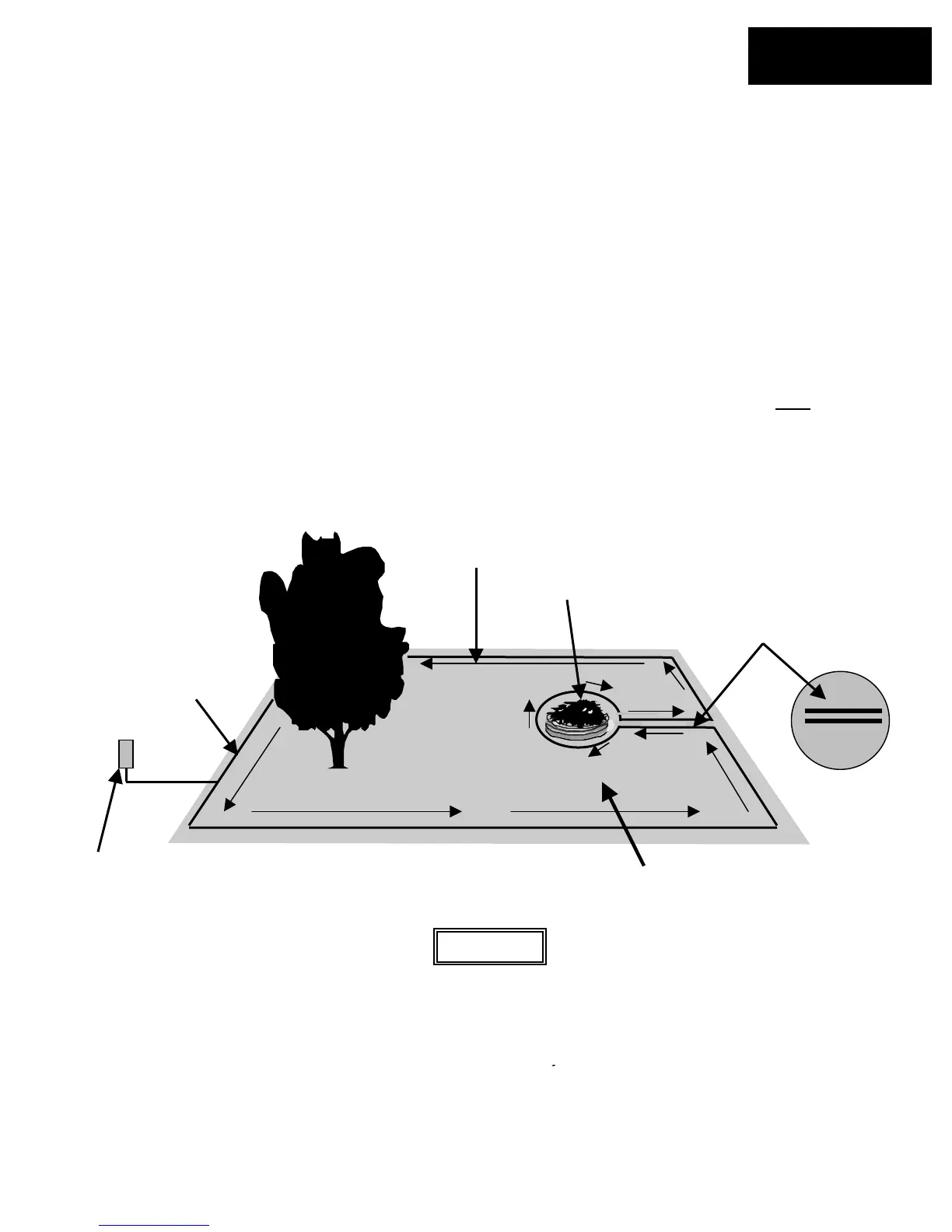
To create a perimeter island, take the wire from the perimeter section closest to the obstacle and peg
the wire around the obstacle, returning back to the same spot of the perimeter. There are two keys
to installing the perimeter wire to exclude an obstacle; 1) the two wires going to and from
the
obstacle should be placed under the same peg (touching) and 2) follow the direction of installation as
shown in Figure 1.6.
Perimeter
wire
Perimeter switch placed at least 5 feet
(1.5 m) from perimeter. Wires to
perimeter switch should be placed
adjacent, the same as wires leading to
an obstacle.
Figure 1.6
Flower bed
Direction of
installation followed
around obstacle
While the picture shows two
wires separate, they should
be adjacent and no more than
1/8 inch (3 mm) from one
another
Direction of
installation







 To Next Page