Need help?
Do you have a question about the FUTABA R6308SBT and is the answer not in the manual?
Changes or modification not approved by the compliance party can void user authority. Protect from vibration and moisture.
Do not cut or bundle antenna wire. Do not bend coaxial cable. Mount antennas to ensure strain relief.
Keep antennas away from noise sources and place them at 90 degrees to each other for diversity.
Leave 30mm of antenna tip exposed and secure it to prevent movement within the aircraft.
Device complies with FCC Part 15. Operation subject to two conditions regarding interference and user authority.
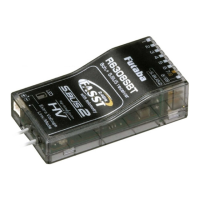
FASST-2.4GHz system, dual antenna diversity, size 0.98x1.86x0.56 in, weight 0.38 oz.
Power requirement 3.7V to 7.4V. Battery F/S voltage 3.8V for NiCd/NiMH. Extra Voltage port 0-70V DC.
Extends S.BUS, supports bidirectional communication. Connect sensors to S.BUS2 port for telemetry.
Standard S.Bus servos/gyros not for S.BUS2 port. S.BUS output supports conventional servos.
Procedure to link receiver to transmitter via Link/Mode switch, including F/S position adjustment.
Toggle between Normal and High Speed modes. High speed mode disables sensors, only shows battery voltage.
Guide to changing channel allocations using the Link/Mode button and observing LED status.
Process to put R6308SBT into ID transmitting mode to link with telemetry receiver unit.
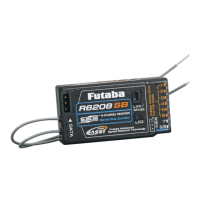
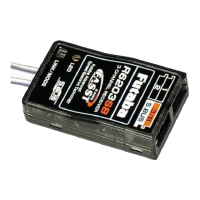
The Futaba R6308SBT is a FASST-2.4GHz compatible receiver designed for use with Futaba FASST-2.4GHz (7ch/8ch/10ch/Multi-ch) system transmitters. This receiver incorporates S.BUS2/S.BUS port functionality and provides 8 channels for conventional system receivers, making it suitable for a wide range of RC applications. A key feature of the R6308SBT is its bi-directional communication capability with an optional telemetry receiver unit via the S.BUS2 port. This allows for the integration of various telemetry sensors, providing real-time data feedback to the user. The receiver automatically distinguishes between FASST-2.4GHz 7ch, Multi-ch/10ch, or 8ch modes during the linking process with a transmitter and supports a high-speed mode for enhanced response.
The R6308SBT serves as the central receiving unit for control signals from a Futaba FASST-2.4GHz transmitter. It translates these signals into commands for servos and other components in an RC model. The S.BUS2 port is a significant enhancement, enabling a serial data bus system that simplifies wiring and allows for the connection of multiple S.BUS2-compatible devices, including telemetry sensors. These sensors can transmit data such as battery voltage, temperature, RPM, and altitude back to the transmitter (when an optional telemetry receiver unit is used), providing critical information for monitoring the model's status during operation. The receiver also features standard PWM output ports for conventional servos, offering flexibility in setup.
The dual antenna diversity system is a crucial design element for maximizing signal reception and promoting safe modeling. With two antennas, the receiver can obtain RF signals from both, reducing the risk of signal loss due, for example, to antenna orientation or shielding by the model's structure. The receiver's ability to operate in both normal and high-speed modes allows users to choose between telemetry functionality (normal mode) or faster response times (high-speed mode, which only transmits receiver battery voltage telemetry).
The R6308SBT supports various channel modes (Mode A, B, C, D) to accommodate different transmitter configurations and channel allocations. This flexibility ensures compatibility with a broad spectrum of Futaba FASST transmitters and allows users to customize the channel assignments to suit their specific model requirements. The linking process is straightforward, involving pressing and holding the Link/Mode switch on the receiver while powering it on, then linking with the transmitter. The LED indicator provides visual feedback on the receiver's status, including signal reception, ID disagreement, and error conditions.

 To Next Page
 General