Page
Creating the Virtual Training Paddock (VTP)
• Familiarize yourself with the Important Information p. 3 before setting up the Virtual Training Paddock (VTP).
• Ensure the VTP is situated within a well-maintained physical fenced area with ample pasture and water for the 7-0 day
training period.
• Set up the virtual paddock line as straight as possible across the physical paddock to maintain low complexity and
high predictability for the animals.
• Provide accessible watering points and easily recognizable shelter within the VTP for the animals.
• Ideally, choose a relatively flat terrain with minimal obstructions, such as dense scrub.
• Ensure that watering points, feeding points, and shelter are positioned at least 5 meters away from any virtual
boundary fence.
Activating the Virtual Training Paddock (VTP)
• Animals must be calmly grazing, walking or resting in the Inclusion Zone (IZ) before activating the VTP, as some may take
up to 48 hours to acclimate.
• Allow animals to approach the VTP naturally, without applying pressure or force.
• It may take 7 days for all animals to interact with the VTP and demonstrate understanding.
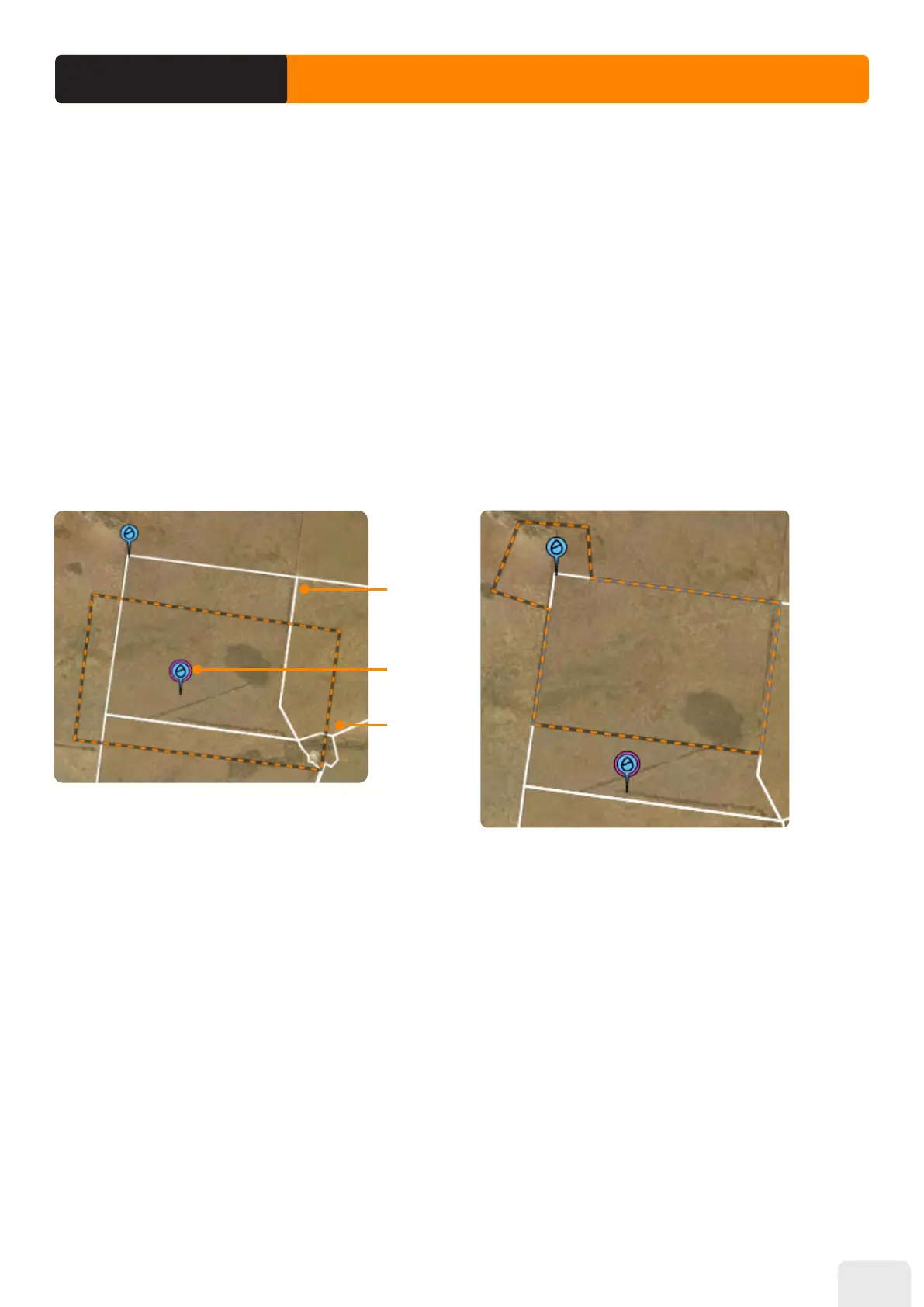
Example
• The VTP is designed to encourage animal interaction within
a single segment.
• The VTP has a central watering source.
• Additional feed is available allowing the VTP to be moved
forward to allow for more feed.
• After 2-3 days of training, edit the VTP so that the virtual
fence sits on top of the physical fence line.
Example
• This VTP can be used after the initial training period. The
virtual fence starts outside the physical fence and after 2-3
days edit the virtual fence to sit on top of the physical fence.
• The water source is in the corner of the paddock. Ensure
the VTP boundary allows access to the water source
without the animals receiving an audio cue.
The eShepherd neckbands produce a sequence of audio cues to warn the animal when it is close to a virtual fence. If the
animal continues toward the fence and breaches the virtual boundary, a pulse will be delivered. Animals typically learn to
avoid the pulse by responding to the audio cues alone within 7-0 days of training.
Ensure all animals have been correctly fitted with neckbands.
Physical
fence
Virtual
Training
Paddock
Water
source
Inclusion Zone
(IZ)
Exclusion Zone
(EZ)
Introducing Animals to eShepherd SECTION



 To Next Page