RG66025045
All copying, even partial, of this manual is strictly forbidden 5
1 VLS SERIE
1.1 FIELD OF APPLICATION
The VLS range units are designed for heating and cooling the
water to be used in ari-conditioning or process system, for resi-
dential, commercial or industrial. The VLS range units are intend-
ed for outdoor installation (IP24 protection degree), in a position
not accessible to the public.
If protection grids are not provided (accessory) and if the ma-
chine can be reached by non-specialised personnel, access to
the nned coil must be prohibited using appropriate barriers.
A
WARNING: Do not install the unit in environments with gas
or ammable dusts.(ATEX zone)
1.2 MAIN FEATURES
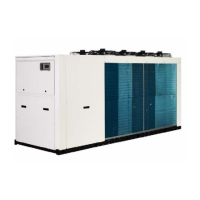
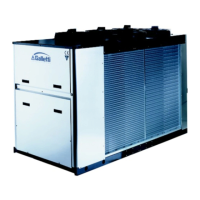
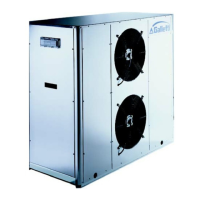
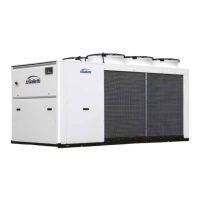
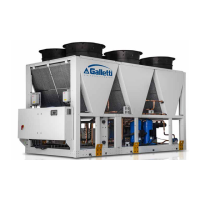
VLS is Galletti's new range of air-cooled packaged chillers and
heat pumps for outdoor installation featuring R454B refriger-
ant. R454B is a next generation A2L refrigerant with a GWP of
only 467, one of the lowest on the market. This GWP value en-
sures that the VLS range complies with the gradual reduction
of greenhouse gas emissions required by the F-GAS regulation,
down to the stricter limits foreseen for 2030.
The range consists of 11 models with cooling capacities ranging
from 160 a 590 kW, available in cooling only or reversible heat
pump versions. The range's main strength is its high season-
al eciency, which is designed to permanently reduce annual
energy consumption as well as meet the minimum eciency
requirements established by ErP 2021. In order to increase the
eciency at partial loads, all VLS models are provided with tan-
dem or trio solutions (2 or 3 compressors on a single circuit) and
equipped with electronic expansion valve as standard.
The use of top quality components at the cutting edge of tech-
nology in the cooling, hydraulic, and electrical systems makes
VLS chillers state of the art in terms of eciency, reliability, and
operating limits.
In fact, the ability to produce water from -10 °C to 57 °C and op-
erate at full load with outdoor air temperatures from -15 °C to 46
°C is guaranteed. The range provides high congurability from
the point of view of acoustics, with a wide range of accessories
designed to reduce noise emissions. Advanced control, which is
always provided across the entire range, allows continuous mon-
itoring of operating parameters, advanced regulation logics, and
connectivity. Lastly, the modular structure with V-shaped coils is
designed to optimize heat exchange on the air side, guarantee
structural strength with a reduced footprint, and maintain maxi-
mum accessibility of the key components.
1.3 R454B A2L REFRIGERANT FLUID
FEATURES
A2L gases are low ammability refrigerants with a ame prop-
agation speed that is always less than 10 cm/sec (ASHRAE 34,
ISO5149). By following the important precautions described in
this manual and entrusting the operation of the units to qual-
ied personnel only, installation and maintenance operations
can be carried out in maximum safety, just like for class A1 HFCs.
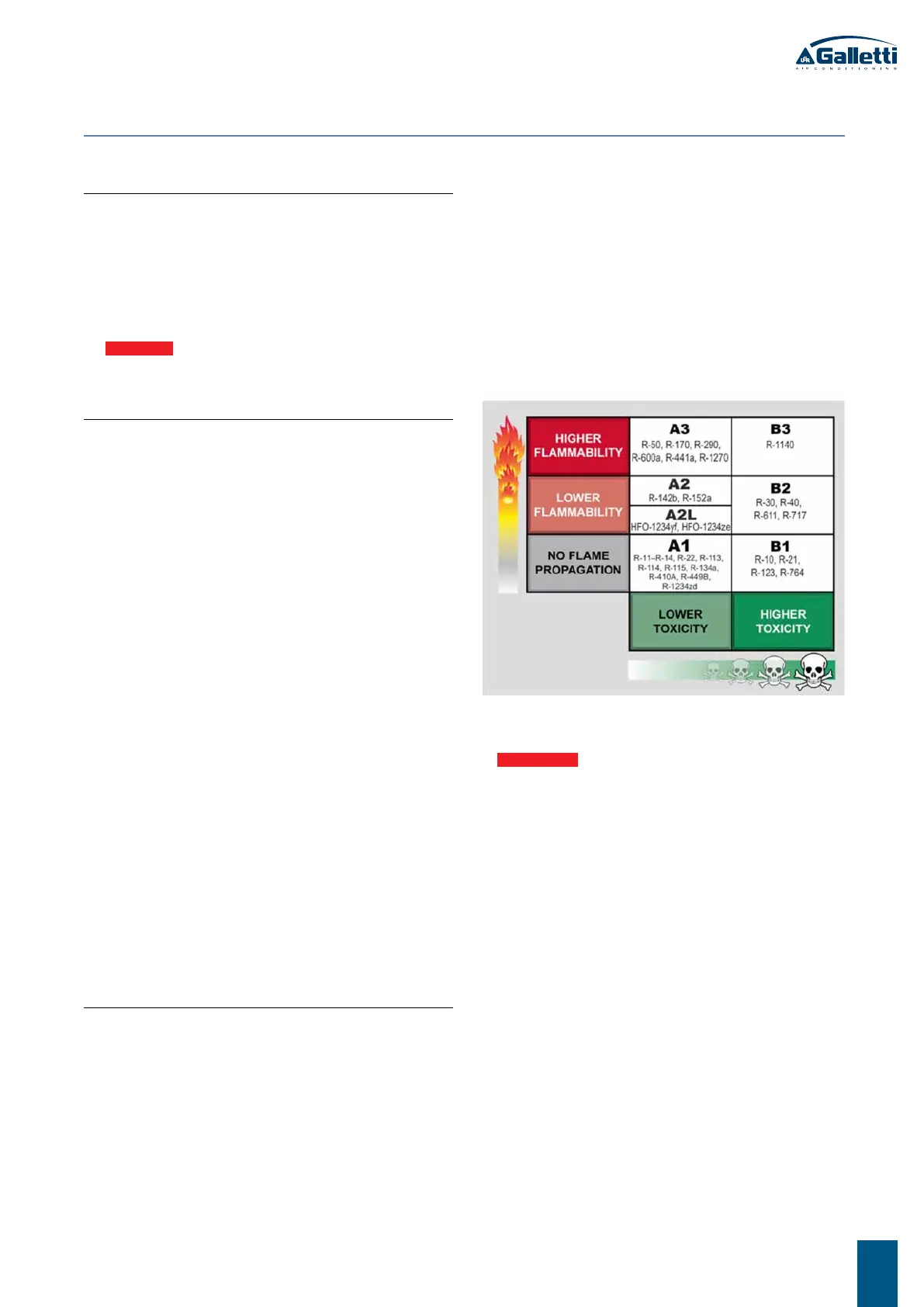
Refrigerant uids are classied (under ASHRAE 34 and ISO5149
standards) according to their toxicity and ammability. They are
classied according to a code consisting of a letter (indicating
toxicity) and a number (indicating ammability), (e.g. A1). Initial-
ly, the classication is as follows:
Ū Toxicity:
A = refrigerants with an occupational exposure limit greater
than or equal to 400 ppm
B = refrigerants with a limit lower than 400 ppm
Ū Flammability:
1 = no ame propagation under test conditions specied by the
standard
2L = ame propagation with combustion speed ≤ 10 cm/s and
caloric value < 19,000 kJ/kg
2 = ame propagation with combustion speed > 10 cm/s and
caloric value < 19,000 kJ/kg
3 = ame propagation with combustion speed > 10 cm/s and
caloric value >= 19,000 kJ/kg
A
IMPORTANT: Since R454B gas refrigerant is heavier than air,
one of the biggest dangers is its possible accumulation in
conned spaces (manholes, storm drains, various recesses,
underground spaces, etc.) and consequently the creation of
an area with a potentially ammable atmosphere. Sources
of ignition (sparks, high-temperature surfaces, open ames,
etc.) may cause the ignition and spread of ames.
For other information refer to refrigerant uid safety sheet.


 To Next Page