45
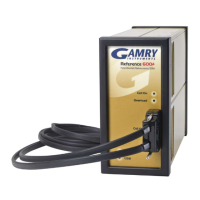
Cell On LED
The Cell On LED glows yellow whenever the
Reference 600+ is actively applying voltage or
current to the electrochemical cell attached to the
Cell Cable. Avoid touching the cell cable leads
whenever the Cell On LED is lit, because the quality
of the data being collected in your experiment may
be compromised.
If you need to make changes to your cell leads, you
normally do so between experiments, when the Cell
On LED is off and the potentiostat is inactive.
In a typical experimental sequence, the Cell On LED
is off between experiments and during any open
circuit potential measurements. It glows yellow
whenever the cell is polarized.
Overload LED
The Overload LED is normally unlit. When it glows
red, some circuit in the Reference 600+ has
exceeded its normal operating limit. Conditions that
generate Overloads include:
• The absolute value of the differential
electrometer output voltage (the difference in
voltage between the Working and Reference leads) exceeds 10 V. This condition is known as an E
Overload.
• The control amplifier has lost control of the cell. The absolute value of the cell current may be trying to
exceed 600 mA, or the absolute value of the counter electrode voltage may be trying to exceed
22 V. Either condition is called a Control Overload.
• The absolute value of the cell current has exceeded full scale on the current range presently in use.
This condition is known as an I Overload.
Transient (temporary) overloads during an experiment in which the cell voltage or current is being stepped
or swept are often normal. In most cases, they do not indicate a system or instrument malfunction.
Consider the case of an infinitely fast voltage step into a perfect capacitor. In theory, charging the capacitor
requires an infinite current. The current spike seen at each step in a stepped voltage waveform can easily
illuminate the Overload LED. The current spike normally decays to near zero before the actual current and
voltage readings are taken.


 To Next Page