62
Cell Cable Length and Construction
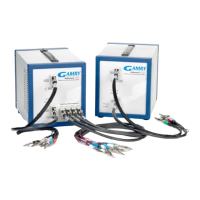
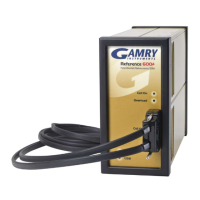
The Reference 600+ is shipped with a 60 cm shielded cell cable. We also offer extended length cables
and unshielded cables as options at extra cost.
Cell cables longer than 1 meter will result in degraded instrument performance. Increased noise and
decreased stability both can occur. However, with most cells, the instrument will work acceptably with an
extended cell cable, so our advice is to try it. As a rule, do not attempt to use current-interrupt IR-
compensation with cell cables longer than 5 m.
We do not recommend that you use the Reference 600+ with any cables not supplied by Gamry
Instruments. The Reference 600+ cable is not a simple cable like a typical computer cable. The Reference
600+ cable includes a number of individually shielded wires contained within an overall shield. We pay
careful attention to issues such as shield isolation, isolation resistance, and capacitance.
If you do need a special cable, contact us with your requirements.
Lead Placement
Many experiments with the Reference 600+ involve cells with small capacitances, the value of which may
be important.
In these cases, the capacitance between the Reference 600+’s cell leads can result in an error. The
Reference 600+ alligator clips can have 10 pF or more of mutual capacitance if they are run alongside
each other.
If you wish to avoid excessive capacitance:
• Place the leads as far apart as possible. Pay special attention to physical separation between
the working electrode/working sense leads and the counter/counter sense/reference electrode
leads.
• Have the leads approach the cell from different directions.
• Remove the alligator clips from the leads. In extreme cases you can replace the banana plugs
and pin jack with smaller connectors. If you do so, be careful not to compromise the isolation
between the center conductor and the shield.
The cell leads must not be moved during an experiment measuring small currents. Both microphonic and
triboelectric effects can create spurious results when the cell cables are moved.
Cell Construction
If you need to measure small currents or high impedances, make sure that your cell construction does not
limit your response.
A cell where the resistance between the electrodes is only 10
10
Ω cannot be used to measure 10
13
Ω
impedances. In general, glass and PTFE are the preferred construction materials for cells. Even glass may be
a problem when it is wet.
You also must consider C
shunt
. Make the “inactive” portion of your electrodes as small as possible. Avoid
placing electrodes close together or parallel with each other if you are measuring high impedances.
Reference Electrode
Keep your reference electrode impedance as low as possible. High-impedance reference electrodes can
cause potentiostat instability and excessive pickup of voltage-noise.


 To Next Page