20
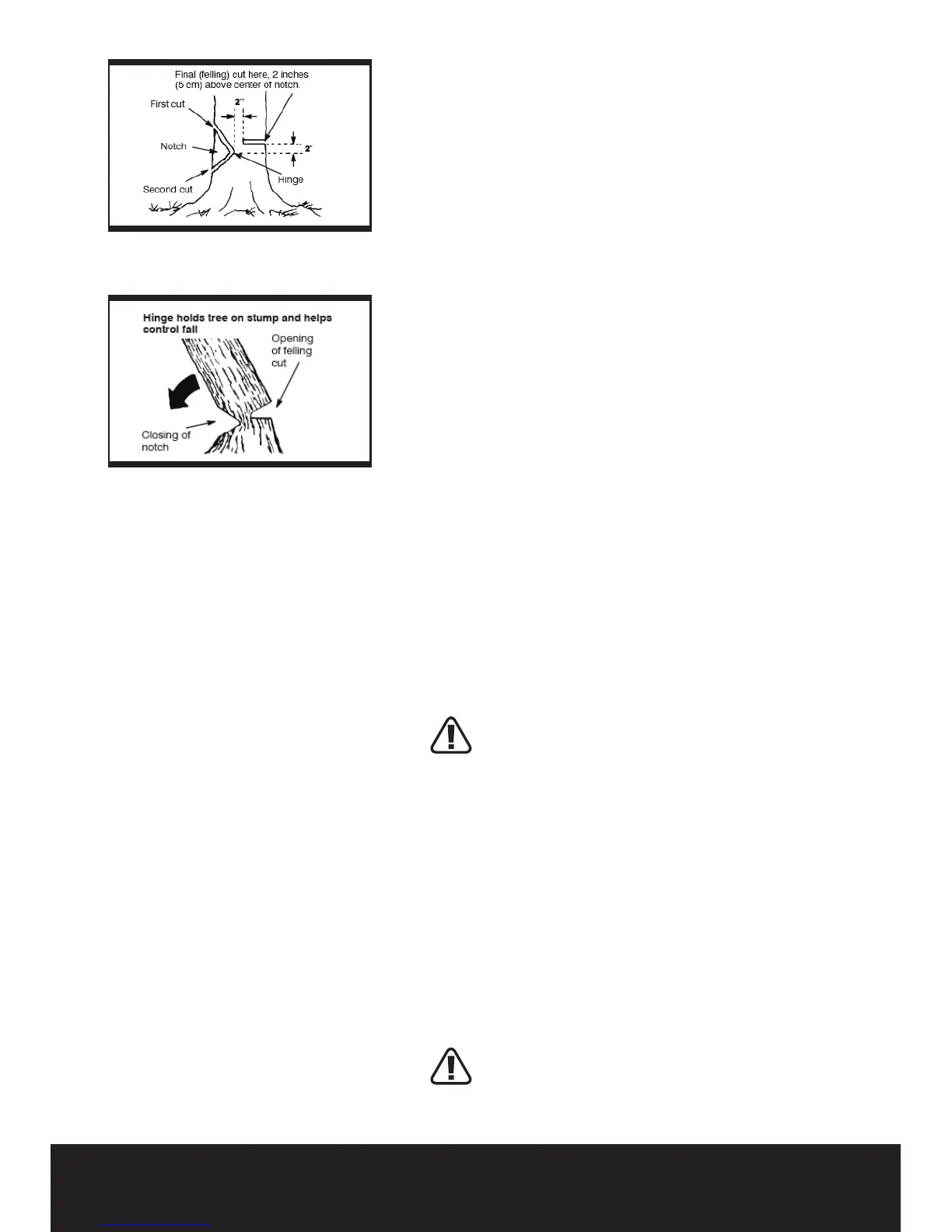
12. NOTCH CUT AND FELLING THE TREE (Fig. R
& S)
• Make notch cut by cutting the top of the notch first.
Cut through 1/3 of the diameter of the tree. Next
complete the notch by cutting the bottom of the notch.
See illustration. Once the notch is cut remove the notch
of wood from the tree.
• After removing the wood from the notch, make the
felling cut on the opposite side of the notch. This is
done by making a cut about two inches (5 cm) higher
than the center of the notch. This will leave enough
uncut wood between the felling cut and the notch to
form a hinge. This hinge will help prevent the tree from
falling in the wrong direction.
NOTE: Before felling cut is complete, use wedges to
open the cut if necessary to control the direction of
fall. To avoid kickback and chain damage, use wood or
plastic wedges, but never steel or iron wedges.
• Be alert to signs that the tree is ready to fall: cracking
sounds, widening of the felling cut, or movement in the
upper branches.
• As tree starts to fall, stop saw, put it down, and get
away quickly on your planned retreat path.
• DO NOT cut down a partially fallen tree with your
saw. Be extremely cautious with partially fallen trees
that may be poorly supported. When a tree doesn’t fall
completely, set the saw aside and pull down the tree
with a cable winch, block and tackle, or tractor.
13. CUTTING A FALLEN TREE (BUCKING)
Bucking is the term used for cutting a fallen tree to the
desired log size.
WARNING: Do not stand on the log being cut.
Any portion can roll causing loss of footing and
control. Do not stand downhill of the log being cut.
IMPORTANT POINTS
• Cut only one log at a time.
• Cut shattered wood very carefully; sharp pieces of
wood could be flung toward operator.
• Use a sawhorse to cut small logs. Never allow
another person to hold the log while cutting and never
hold the log with your leg or foot.
• Do not cut in an area where logs, limbs, and roots are
tangled such as in a blown down area. Drag the logs
into a clear area before cutting by pulling out exposed
and cleared logs first.
14. TYPES OF CUTTING USED FOR BUCKING
WARNING: If saw becomes pinched or hung
in a log, don’t try to force it out. You can lose
Fig.R
Fig.S


 To Next Page