3
Good footing is most important in chain saw
work.
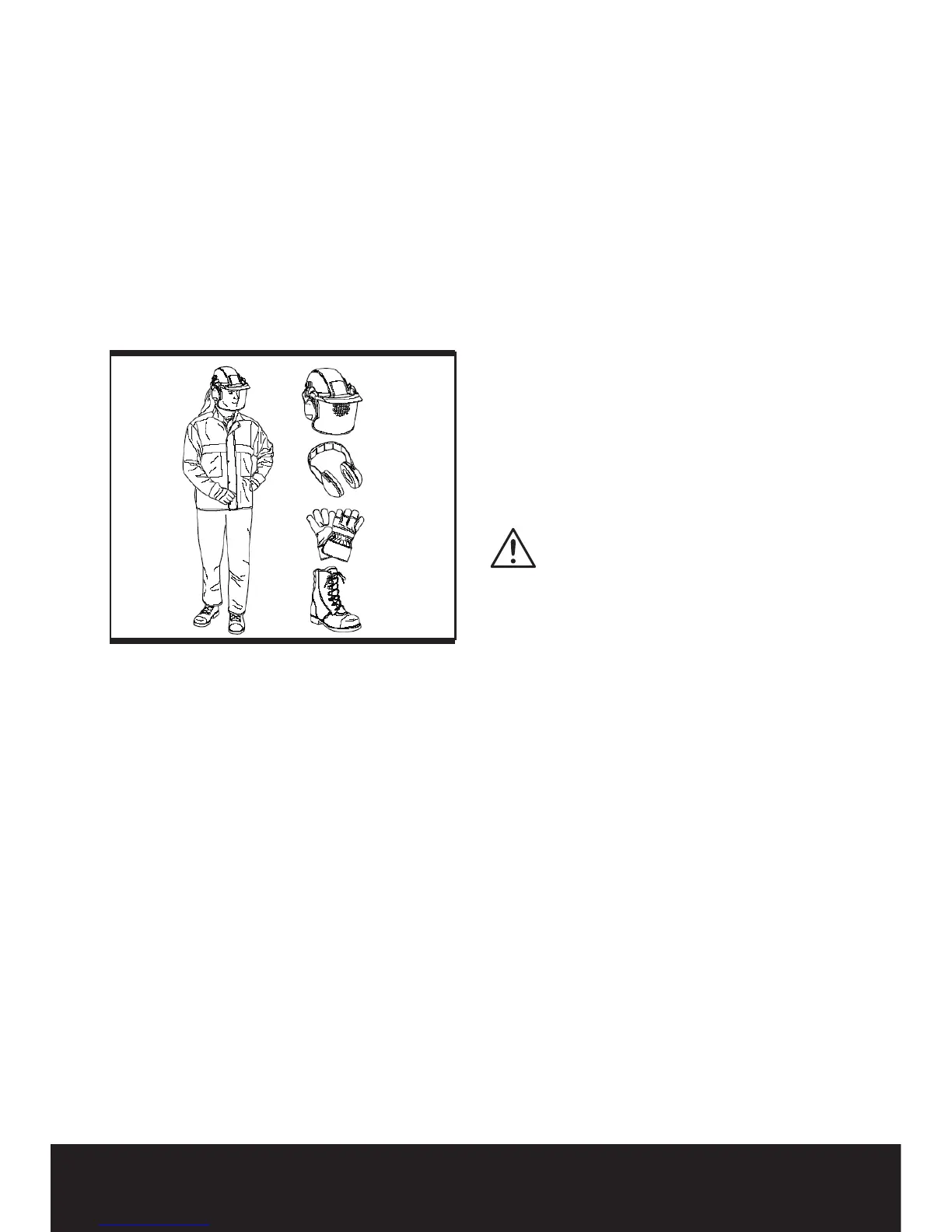
Wear sturdy boots with nonslip soles. Steel-toed
safety boots are recommended.
Proper eye protection is a must. Non-
fogging, vented goggles and a face screen is
recommended. Their use reduces the risk of eye
and facial injury.
Wear an approved safety hard hat to protect
your head. Chain saw noise may damage your
hearing.
Always wear noise protection equipment (ear
plugs or ear muffs) to protect your hearing.
Continual and regular users should have their
hearing checked regularly.
A
MAINTAIN THE SAW IN GOOD WORKING
ORDER
1. Have all chain saw service performed by a
qualified service dealer with the exception of
the items listed in the maintenance section of
this manual. For example, if improper tools
are used to remove or hold the flywheel when
servicing the clutch, structural damage to the
flywheel can occur and cause the flywheel to
burst.
2. Make certain the saw chain stops moving
when the throttle trigger is released. For
correction, refer to:
CARBURETOR ADJUSTMENT.
1. Never modify your saw in any way.
2. Keep the handles dry, clean, and free of oil or
fuel mixture.
3. Keep fuel and oil caps, screws, and fasteners
securely tightened.
4. Use only qualified accessories and
replacement parts as recommended.
HANDLE FUEL WITH CAUTION
1. Do not smoke while handling fuel or while
operating the saw.
2. Eliminate all sources of sparks or flame in the
areas where fuel is mixed or poured. There
should be no smoking, open flames, or work
that could cause sparks. Allow engine to cool
before refueling.
3. Mix and pour fuel in an outdoor area on
bare ground; store fuel in a cool, dry, well
ventilated place; and use an approved,
marked container for all fuel purposes. Wipe
up all fuel spills before starting saw.
4. Move at least 3 meters from fueling site
before starting engine.
5. Turn the engine off and let saw cool in a non-
combustible area, not on dry leaves, straw,
paper, etc. Slowly remove fuel cap and refuel
unit.
6. Store the unit and fuel in an area where
fuel vapors cannot reach sparks or open
flames from water heaters, electric motors or
switches, furnaces, etc.
KICKBACK SAFETY PRECAUTIONS
WARNING! Kickback may occur when
the moving saw chain near the upper
quadrant of the bar nose contacts a solid object
or is pinched.
The reaction of the cutting force of the chain
causes a rotational force on the chainsaw in the
direction opposite to the chain movement. This
may fling the bar up and back in an uncontrolled
arc mainly in the plane of the bar. Under some
cutting circumstances the bar moves towards
the operator, who may suffer severe or fatal
injury.
Kickback may occur when the nose of the guide
bar is pinched unexpectedly, unintentionally
contacts solid material in the wood or is
incorrectly used to begin a plunge or boring cut.
It may also occur during limbing. The greater the
force of the kickback reaction, the more difficult
it becomes for the operator to control the saw.
Many factors influence the occurrence and force
of the kickback reaction. These include chain
speed, the speed at which the bar and chain
contact the object, the angle of contact, the
condition of the chain and other factors.
Pull-in occurs when the chain on the bottom of
the bar is suddenly stopped when it is pinched,
caught or encounters a foreign object in the
wood. The reaction of the chain pulls the saw
forward and may cause the operator to lose
control.
Pull-in frequently occurs when the bumper spike



 To Next Page