8. Insert the conduit in the shoe groove marked with the number
matching the size conduit being bent. The conduit must set in
the shoe and in the jaw. The end of the conduit must extend
a minimum of 2" beyond the jaw. See Figure 3. Refer to table
A or B on page 5 for bending data.
9. Each time a different size and type of conduit is being bent,
three facts must be determined and set into the bender
shoe control system. The required settings are: conduit size,
material and desired bend angle. Prior to setting, be sure the
desired size indicator scale is toward the operator and the
correct shoe grooves are also toward the operator.
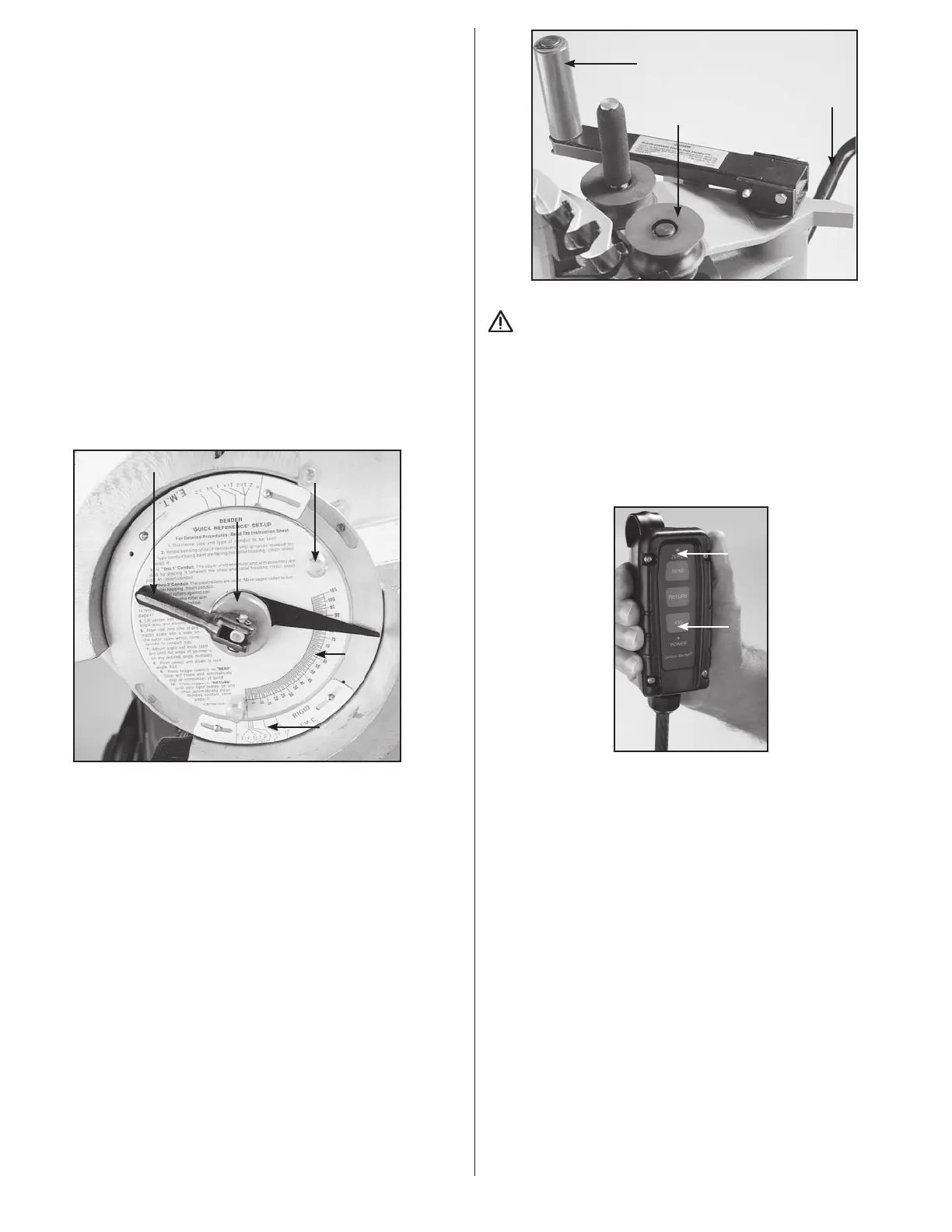
a. Lift the locking handle. See Figure 6. Use the two small
pins to rotate the angle disc, clockwise, until the red zero
line is directly in line with the zero line on the size scale.
b. Set the bender for specific conduit size by turning the
angle disc until the red line is on the size indicator mark
which matches the size conduit being bent. Be sure the
correct size scale is being used (EMT, lMC, or Rigid).
c. Move the bend angle set knob (See Figure 6) until
the flat edge of the pointer is on a line indicating the
exact degree of bend desired. Lower the center arm to
lock the pointer and scale and to prevent inadvertent
movement during bending.
Type Scale
Roller Support Arm
Locking Handle
Upper Urethane Roller
EMT Size Scale
Locking Handle
Angle
Disk
Size Scale
Angle Set Knob
Rotating Pins
Figure 6. Set Angle Scale
10. Activate the bending shoe by holding the pendant control
Bend button. The shoe will rotate until the angle set on the
pointer is reached.
11. To remove the conduit, hold the “Return” button. The shoe
will return to the start position and stop automatically. The
zero set light will come on. Bending more conduit of the
same type and size is accomplished by loading conduit and
pressing the bend button.
4.2 Bending 1
1
⁄4", 1
1
⁄2" and 2" Conduit
NOTE: All operations referring to “toward the operator” are viewed
from the lifting handle end of the bender frame.
1. Bending 1
1
⁄4" through 2" requires using one of the three sets
of nylon rollers and one of the grooves on the lower half of the
bending shoe.
2. Move the roller housing against the frame stop. See Figure
11. The upper urethane roller must be on the outside (toward
frame handle) of the roller housing. See Figure 7. If it’s not,
pull the ring pin. Lift the roller support arm, swing it over the
roller housing, lower the handle into the bracket and insert the
ring pin.
Type Scale
Roller Support Arm
Locking Handle
Upper Urethane Roller
EMT Size Scale
Nylon Rollers
Frame Handle
Upper Urethane Roller
Figure 7. Position Roller Support
CAUTION: To avoid damage to the bending shoe, always
place the roller housing against the frame stop, prior to
activating the bending shoe.
3. Check the bending shoe to be sure the correct grooves for
the conduit being bent are facing toward the operator. If the
shoe must be rotated, hold the pendant control Return button
and press the jog button until the zero light goes out. The
shoe will rotate 180° then stop in the load position. See Figure
8. The zero light will come on.
Zero
Light
Jog
Button
Figure 8. Pendant Control
4. When bending 1
1
⁄4" - 2" conduit, position roller housing and
upper arm. Then push the conduit between the shoe groove
and the 2" nylon rollers until the bend mark on the conduit is
in line with the outside edge of the clamp jaw.
5. Grasp the upper urethane roller and move the support arm
counterclockwise until it contacts the roller housing. The two
nylon rollers should have moved against the conduit and
should firmly hold the conduit in the shoe. See Figure 9.
4


 To Next Page
 Loading...