
 Need help?
Do you have a question about the Garmin iQue and is the answer not in the manual?
Provides cautions and guidelines for safely handling and using the lithium-ion battery.
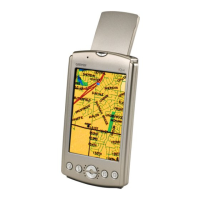
Identifies and describes the physical components of the iQue M3 device.
Explains the function of each physical button on the iQue M3 device.
Describes the meaning of the Charging/Notification LED light colors and states.
Details how to use the stylus for interaction, selection, and navigation on the device.
Explains how to perform soft and hard resets on the iQue M3 device.
Describes the initial screen displayed upon turning on the device and its interactive elements.
Details how to launch applications from the Start menu and other locations on the iQue M3.
Explains the function and components of the Navigation Bar and Command Bar.
Describes how to access and interpret information in the System Status window.
Details various methods like soft keyboard, Letter Recognizer, Block Recognizer, and Transcriber for data input.
Explains how to select, cut, copy, and paste text within applications.
Describes the process for entering dates using the on-screen calendar interface.
Explains how to use the Find program to locate files and text on the device.
Details how to use File Explorer for managing files and folders, including moving and copying.
Guides on selecting information types and limiting data volume for synchronization with a desktop.
Explains how to configure the frequency and timing of data synchronization.
Describes how to move files between the iQue M3 and a desktop computer without synchronization.
Provides step-by-step instructions for installing new programs from a desktop or the internet.
Explains how to add program shortcuts to the Start menu using ActiveSync or the device.
Guides on uninstalling programs from the iQue M3 using ActiveSync or the device itself.
Details the process for creating backups of files, folders, and settings using ActiveSync.
Explains how to restore the device from a previously saved backup file.
Explains how to synchronize data with a Microsoft Exchange Server.
Describes how to perform remote synchronization using the device's Infrared port.
Details how to schedule appointments, meetings, and events using the Calendar application.
Explains how to view and edit appointment details from the summary screen.
Guides on setting up meetings and sending invitations to contacts.
Describes the types of notifications the iQue M3 provides for appointments and tasks.
Explains how to store, share, and manage contact information for friends and colleagues.
Details how to send and receive email messages using the Messaging application.
Guides on creating and using custom email signatures.
Explains how to save vCard attachments from emails directly to the Contacts database.
Describes the synchronization of email messages with desktop applications or servers.
Guides on setting up and connecting to an email server for direct email access.
Explains how to create and manage tasks and to-do lists within the Tasks application.
Describes how to view and edit individual task details from the summary screen.
Details how to create and manage notes, including text, drawings, and voice recordings.
Explains how to use the stylus for writing and drawing directly on the device screen.
Provides instructions for creating and editing drawings on the device screen.
Guides on how to record audio messages and embed them in notes or other applications.
Introduces Pocket Word for creating and editing documents, synchronized with desktop Word.
Details on creating new documents, saving, and managing files within Pocket Word.
Explains different input modes (Typing, Writing, Drawing, Recording) for Pocket Word.
Introduces Pocket Excel for creating and editing spreadsheets, synchronized with desktop Excel.
Guides on creating, saving, and using spreadsheets with Pocket Excel.
Introduces Pocket Internet Explorer for browsing the web and managing mobile favorites.
Explains how to browse the web using Pocket Internet Explorer, including favorites and channels.
Discusses how to control image display in web pages for data saving.
Details settings for home page, history, cached files, and security.
Introduces MSN Messenger for instant messaging and communication.
Guides on setting up an account and using MSN Messenger for instant messaging.
Explains how to add, chat with, and manage contacts within MSN Messenger.
Describes how to use predefined text phrases for faster messaging.
Offers advice and tips for effective instant messaging conversations.
Explains how to play audio and video files using Windows Media Player.
Details how to view, manage, and set pictures as wallpaper.
Covers rotating, cropping, zooming, and saving image changes.
Guides on setting up a modem connection to an Internet Service Provider (ISP).
Explains how to manually initiate an ISP connection.
Details how to configure dialing rules for modem connections based on location.
Explains how to connect to private networks, such as corporate networks.
Guides on securely connecting to a corporate network via a VPN.
Explains how to manually connect to a configured VPN server.
Details how to configure proxy server settings for network access.
Guides on setting up a wireless Ethernet connection using a compatible card.
Explains methods for transferring data between the iQue M3 and other mobile devices.
Explains how to transfer files between devices using the Infrared port.
Details how to adjust settings like sounds, passwords, and menus for personalization.
Guides on customizing the Start menu and entering personal owner information.
Explains how to set, change, or delete device passwords for security.
Details how to configure system sounds and event notifications.
Guides on adjusting screen backlight and power management settings to save battery life.
Explains how to configure system-wide settings like audio, time, and regional formats.
Details how to adjust audio settings (bass, microphone) and manage device time.
Explains how to set and customize alarms for the iQue M3.
Guides on customizing regional display formats for currency, dates, and numbers.
Explains how to uninstall programs from the device.
Covers screen alignment, orientation, and display feature adjustments.
Guides on aligning the screen, changing orientation, and adjusting display features like ClearType and text size.
Provides information on the QueGPS application, displaying GPS status and satellite data.
Offers tips and suggestions for resolving issues with acquiring GPS satellites.
Directs users to a website for more information on GPS and WAAS technology.
Provides instructions for cleaning and maintaining the iQue M3 device.
Offers guidance on proper storage conditions to prevent damage.
Provides detailed technical specifications for the device hardware and software.
Lists the physical dimensions, weight, display, and antenna specifications.
Details GPS receiver, acquisition times, accuracy, and interface specifications.
Outlines battery source, life, and sleep/suspend information.
Lists operating system, embedded capabilities, audio, processor, and memory details.
Presents the terms and conditions of the end-user license agreement for the software.
Presents the terms and conditions of the end-user license agreement for the software.


 To Next Page
 General