Need help?
Do you have a question about the Geemarc Viso 10 and is the answer not in the manual?
Labels for LCD display elements including day, time, month, date, and year.
Identification and function labels for the unit's control buttons.
Labels for the physical structure of the unit, such as the stand and battery door.
Steps to manually adjust the clock's time, date, language, and other settings.
Information on automatic time synchronization via MSF radio signals and corresponding LCD indicators.
The Geemarc VISO10-MSF (UK) is a radio-controlled clock designed for ease of use and clear time display, incorporating a perpetual calendar and multi-language support. Its primary function is to provide accurate time and date information, automatically synchronized with the MSF radio signal for precise timekeeping.
The VISO10-MSF (UK) serves as a digital clock with an "Easy to Read and Understand Time display." It features a "Perpetual Calendar Up to Year 2099," ensuring that the date information remains current for many decades. The device displays the "Day of week & Month in 8 languages user selectable," offering flexibility for users from different linguistic backgrounds. This multi-language support enhances its usability across various regions. The clock's core functionality revolves around its ability to receive and process the MSF radio signal, which allows it to automatically set and maintain accurate time, eliminating the need for manual adjustments for daylight saving or time drift.
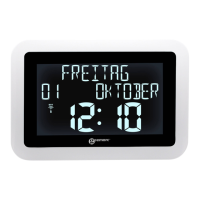
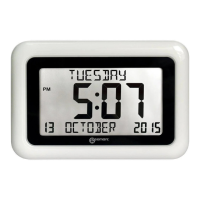
The device's user interface is designed for straightforward operation. The front panel features an LCD display (Part A) that clearly shows the "Day Of Week" (A1), "Radio Control Icon" (A2), "Time" (A3), "Month" (A4), "Date" (A5), and "Year" (A6). This comprehensive display ensures all relevant time and date information is visible at a glance.
Below the display, a set of buttons (Part B) provides control over the clock's settings. These include the "MODE/" button (B1), "V" button (B2), "RESET" button (B3), "" button (B4), and "WAVE/" button (B5).
To begin using the clock, users need to "Open battery Cover (C2)" located on the back of the unit. Then, "Insert 2 x AA size batteries observing polarity." A "click" sound upon battery insertion confirms correct placement. After inserting the batteries, "Replace battery compartment cover" and "Place the unit onto flat surface; the unit is ready for use now."
For manual adjustments, the clock offers a dedicated setting mode. In time display, holding the "MODE/" button (B1) for 3 seconds allows entry into the "Clock/Calendar setting Mode." Once in this mode, the "V" button (B2) or "" button (B4) can be pressed to adjust the current setting. Each adjustment is confirmed by pressing the "MODE" button (B1). For faster adjustments, keeping the "V" (B2) or "" (B4) button pressed will accelerate the value change. The setting sequence covers "Weekday & Month Language, 12/24 Hr, RCC (Radio Clock) ON/OFF, Time Zone, Hour, Minute, Year, Month, Day." As mentioned, there are 8 languages available for the day-of-week and month display: English, German, French, Spanish, Italian, Dutch, Polish, and Swedish.
A key feature of the VISO10-MSF (UK) is its radio-controlled time synchronization. Upon startup, the clock automatically initiates a scan for the MSF time signal. During this process, the "Radio Control Icon" (A2) flashes on the LCD. If the icon flashes, it indicates that the unit is "now receiving MSF signal." If the icon turns on steadily, it signifies that the "signal received successfully." Conversely, if the icon disappears, it means "signal reception failed."
The clock is programmed to automatically synchronize with the MSF radio signal daily at 2:00 AM to maintain accurate timekeeping. If this daily synchronization fails, the radio control icon disappears from the LCD. The clock will then attempt to synchronize again at 3:00 AM and 4:00 AM.
Users can also manually initiate a scan for the radio signal by holding the "WAVE/" button (B5) for 3 seconds. Each reception attempt takes several minutes. If reception fails, the scanning stops, and the radio control icon disappears. The clock will then repeat the scan at the next full hour (e.g., if a scan fails at 8:20 AM, it will scan again at 9:00 AM). To stop an ongoing MSF radio signal scan, hold the "WAVE/" button (B5) for 3 seconds.
The device also indicates "DST" on the LCD when it is in Daylight Saving Time Mode, providing an additional layer of information to the user. All setting modes automatically exit after approximately 15 seconds of inactivity, preventing accidental changes.
To prevent unintended button presses, the clock includes a button lock feature. Holding the "V" (B2) and "" (B4) buttons simultaneously for 5 seconds will lock all other buttons. When locked, an icon "" is displayed. To unlock, simply hold the "V" (B2) and "" (B4) buttons again for 5 seconds.
The VISO10-MSF (UK) is designed for minimal maintenance, but certain precautions are advised to ensure its longevity and proper functioning.
It is important to note that "the clock loses its time information when the battery is removed." Therefore, if the batteries are replaced, the time and date settings may need to be re-established, either manually or through radio synchronization.
If the unit malfunctions, users are advised to "use a pin to press the reset button" (B3). This can often resolve minor operational issues.
To protect the device, users should "not expose it to direct sunlight, heavy heat, cold, high humidity or wet areas." Extreme environmental conditions can damage the internal components and affect performance.
For cleaning, it is crucial to "never clean the device using abrasive or corrosive materials or products." Such agents can scratch plastic parts and corrode electronic circuits. Gentle cleaning with a soft, dry cloth is recommended.
The device's structure (Part C) includes a "Hanging Hole" (C1) for wall mounting, a "Battery Door" (C2) for easy battery access, and a "Stand" (C3) for tabletop placement, offering versatile display options.
The radio-controlled time reception range extends "Up to 1200KM from MSF transmitter," ensuring reliable signal reception across a wide geographical area.
In line with environmental responsibility, the manual provides "Recycling directives" for the WEEE (Waste Electrical and Electronic Equipment). When the product reaches its end of life, it should not be disposed of in domestic waste. Users are instructed to "Remove the batteries and deposit them in an appropriate WEEE skip" and to "Deposit the product in an appropriate WEEE skip." Alternatively, the "old product" can be handed "to the retailer" if a new one is purchased, as they should accept it for proper recycling.
 General
| Type | Digital Clock |
|---|---|
| Display | LCD |
| Alarm | Yes |
| Color | Black |
| Power Source | Mains |
| Battery | Backup battery |


 To Next Page