Edificio Genebre. Av. de Joan Carles I, 46-48
08908 L'Hospitalet de Llobregat. Barcelona (Spain)
genebre@genebre.es - www.genebre.es
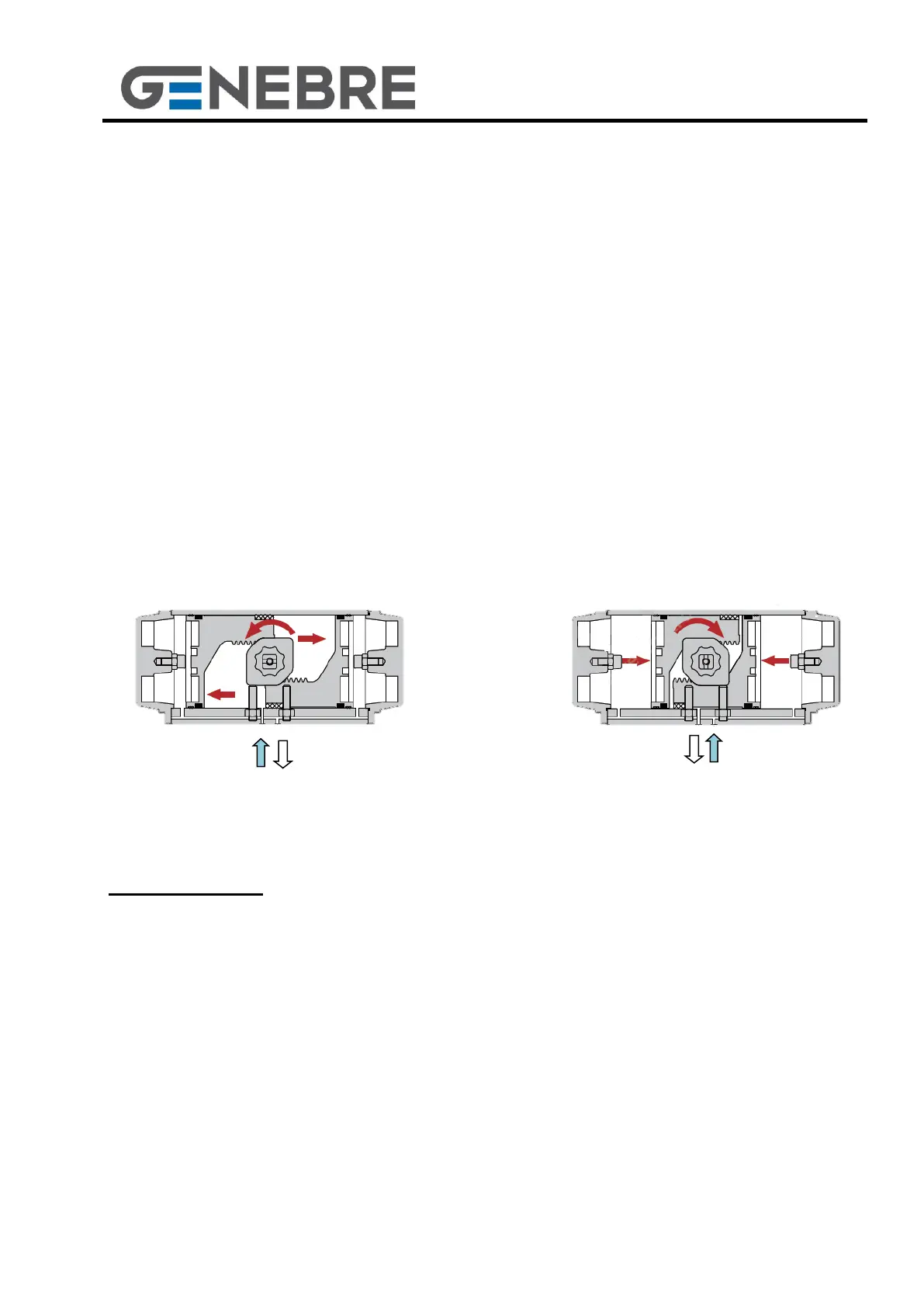
Rotation occurs when compressed air is supplied to the actuator through Port A,
connected to the interior cavity between the pistons (ref. 16), or through Port B,
connected to the end cap area (ref. 24 & 25).
• Pressure to Port A, as shown in Figure Standard rotation, fills the inboard cavity
pushing both pistons (ref. 16) outward and exhausting air through Port B. As the pistons
extend they rotate the pinion (ref. 10) counter clockwise (when viewed from the top of the
actuator).
• As shown in Figure Standard rotation, pressure to Port B fills the outboard cavities
pushing both pistons (ref. 16) inward and exhausting air through Port A. As the pistons
retract they rotate the pinion (ref. 10) clockwise (when viewed from the top of the
actuator).
Standard Rotation
SPRING RETURN
Note: The bracketed numbers refer to the actuator exploded view – page 9.
In this configuration the closed position occurs with spring cartridges (ref. 13), which are
located between the pistons and end caps.
• Pressure to Port A, see Figure Standard rotation, fills the inboard cavity pushing both
pistons outward and exhausting air through Port B. As the pistons (ref. 16) extend they
rotate the pinion (ref. 10) counter clockwise (when viewed from the top of the actuator)
and compress all the spring cartridges (ref. 13).


 To Next Page