16
should be washed thoroughly with a germicidal soap. It is also recommended that technicians
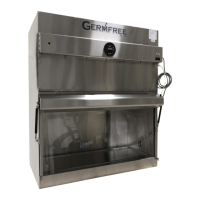
working in the BENCHTOP BIOFLOW CHAMBER wear long-sleeved gowns with knit cuffs and
rubber gloves. This minimizes the shedding of skin flora into the work area and protects the hands
and arms from contamination with viable agents. Conventional laboratory coats with open cuffs
allow the entrapment of contaminated air around the technician’s arms inside the sleeves. The hands
and arms should be inserted into and withdrawn from the work area slowly to prevent “dragging” of
contaminants from the room into the work area or from the work area into the room. Abrupt
movements of the arms and hands should be avoided. Excessive activity in the room may also create
disruptive air currents. This should be held to a minimum or eliminated when work is being
performed in the unit. The viewing panel should never be opened while work is in progress. When
the work has been completed, cover the tray for the discarded supplies with a towel or paper towels
soaked in an appropriate germicide. The outside of the tray and other equipment (glassware, etc.)
can be wiped or sprayed with the appropriate solution. Wait approximately five minutes before
removing any item from the chamber.
For loop sterilizing, a LP (liquid petroleum) burner is recommended because it does not block the
laminar flow pattern. If a flame is necessary, a micro burner with a pilot light can be utilized. The
burner should be placed toward the back of the work area. Do not use a flame of such magnitude
that it will damage the filter. Make sure that the flame is extinguished and the gas turned off at the
stopcock when not needed. An electric element type of loop sterilizer may also be used.
Exposure to airborne micro-organisms is one of the most common sources of laboratory infections.
Through biomedical engineering and advance technology, we have provided the BENCHTOP
BIOFLOW CHAMBER as one of the key elements to safe handling of viable biological materials
and other materials that must be contained. By utilizing good sterile technique and following the
outlined procedures you can protect yourself, the environment and the integrity of your research.
YOU ARE THE KEY.
Biological Safety Cabinet Operation “Don’ts”
1) DON’T ever cover the air intake area in front of the Chamber with papers,
notebooks, equipment, etc. Movement of air into the negative pressure
section must not be impeded!
2) DON’T “turn up the air” under the impression that the faster the air flow the
better the unit is operating. A flow of about 80 linear feet a minute is the
recommended velocity for most conditions (at this speed smoke introduced
into the chamber should gently and evenly float down without breaking up


 To Next Page