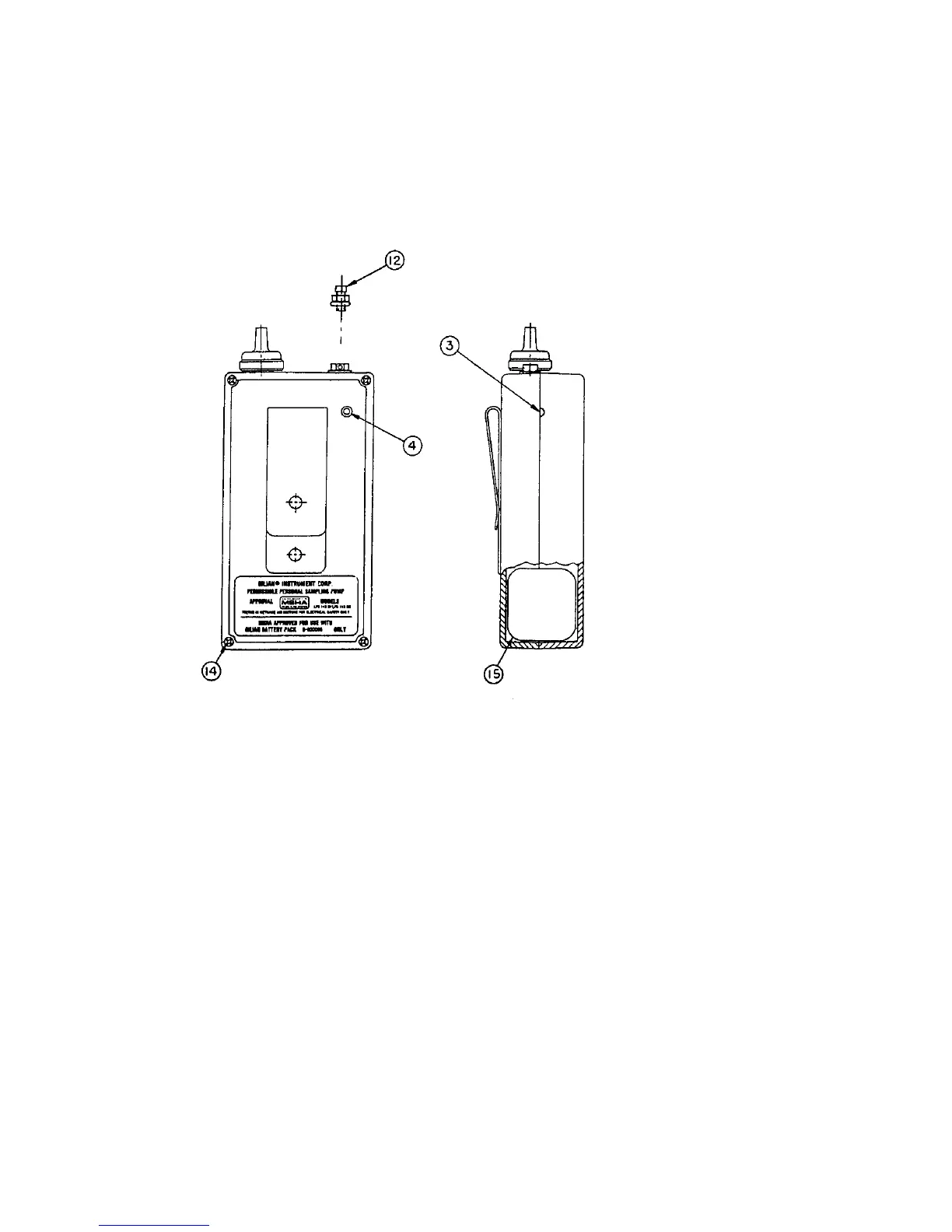
Figure 3
LFS-113 Air Sampler
General Description, back & side
page 8
3. Mode Position Indicator
4. Mode Selector Switch
12. Bag Sampling Boss
14. Case Screws (4)
15. Battery Pack
page 13
4.1.3 Battery Performance Check:
Allow the unit to run down until the pump shuts off. Monitor the flow periodically, either
visually or by means of an electronic flow recorder with chart readout.The flow should not
change by more than 5% prior to fault activation and automatic pump shutdown due to low
battery voltage.
As an alternate means of checking the pump low battery performance, remove the battery
pack from the battery connection receptacle of the control board electronics. Provide an external
DC voltage supply to the Control Board battery receptacle. Slowly decrease the voltage from
4.8 volts to 4.4 volts. The flow should not change by more than 5% prior to fault activation and
automatic pump shutdown due to low battery.
4.2 Constant Pressure:
4.2.1 Constant Pressure Check:
Switch the sampler into the "Constant-pressure" mode,( see Section 3.1 for complete
indexing procedure). Attach the pump into the test set-up as shown in figure 6. If you are using
the Gilian LIHCP calibrator: close the shut off valve (V1). Close Load Valve (V2). Observe the
pressure on the magnehelic gauge (P1). That pressure should be 18" H
2
O, ± 2%". Slowly open
the Load Valve (V2) until the flow is approximately 400 cc/min. The pressure on Magnehelic
gauge (P1) should change by no more than 2 inches.(If a greater pressure change is indicated,
it is possible that the sampler's external filter assembly is contaminated and needs replacement.)
5.0 PUMP MAINTENANCE (see figures 1 & 5)
Your LFS sampler has been designed to require minimum maintenance. However, the
following sections cover the basic procedures to maintain trouble free operation and optimum
performance.
5.1 Battery Charging and Storage Maintenance:
A proper battery maintenance program is essential to insure maximum battery life and
performance. Specific charging and discharging procedures will vary with the users needs and/
or applications.The following is a list of general recommendations which will help to extend
efficient battery life and serviceability.
1. Do not short the battery connectors. This may result in severe damage to the battery pack.
2.Do not overcharge the battery pack.You should not charge battery packs at the "Normal"
(constant current) rate for more than 24 hours.Repeated overcharging will eventually lead to
deterioration in the performance level of the battery pack.If you must have batteries charging
for more than 24 hours, we recommend that you switch the charger into "Trickle" (pulse current)
mode. This feature is available on all Gilian DRC and ATR version chargers.
3.The long term storage of pumps will require some special handling.If pumps are not


 To Next Page