5
SPECIFICATIONS
5 - WAYS CONVERTIBLE
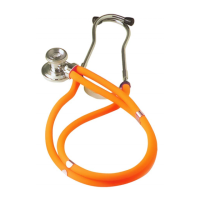
Converting in 5 different ways, this instrument takes the places of all other stethoscopes
and actually functions as 5 stethoscopes for 5 specic purposes in one unit.
Designed for all purposes, 3 different sizes of bell type chestpieces are furnished in addi-
tion to the original 2 diaphragms, large and small, making up one complete set. Therefore
each diaphragm or bell, suits any specic purpose.
1 LARGE DIAPHRAGM
Generally, this chestpiece is used to detect heart sounds of low frequency, diastolic and
third heart sounds, as well as rst and second heart sounds.
The high pitched murmurs emitting from the heart is also detectable.
2 SMALL DIAPHRAGM
This is designed to hear infant heart sounds of high pitched nature.
3 ADULT SIZE BELL
To pinpoint low and medium pitched sounds and murmurs, this bell is very useful.
4 MEDIUM SIZE BELL
Concentrates on narrow spots such as between ribs or any other small places to detect low
and medium pitched sounds or murmurs.
5 INFANT SIZE BELL
Best suits the examination of infants and small children, low and medium pitched sound
and murmurs emitting from infant heart are best sensed by this bell.
You will nd all these combinations are astonishingly well designed and their high sensi-
tivities will enable you to clearly discern low and high frequencies and to hear the faintest
murmurs with ease.
Also spare eartips of 3 different sizes are furnished enabling the user to choose a pair that
best ts him for comfortable use. They are packed in a compact small case put with 3 bell
type chestpieces, and 2 spare transparent plastic diaphragms, large and small.
HOW TO USE
Please, see the included documentation before use.
JOTARAP must be used only by specialized medical or paramedical staff.
The JOTARAP is dual headed and readily furnished with large and small size diaphragms
tted on revolvable twin head drum which contains leakage free stem valve made in hair
thin precision.
A First, put the binaural tips into ears.
B A soft tapping of the diaphragm by your nger will let the sounds come through and you
can tell if it is in working position.
C If you don’t hear the tapping sound, rotate the head by 180° where it clicks settle in the
ready position, facing opposite side.
D Then, tap again and you will hear the tapping sounds which means the instrument is
correctly set for use.
E Now you can diagnose the examinee with the stethoscope.
ENGLISH


 To Next Page