volt converter, supplies power to the exterior an
d
interior lights, the range hood fan and light, th
e
furnace blower, water pump and porch light
. Th
e
12-volt energy is supplied by the automotive battery
,
RV battery or the power converter
.
The automotive battery and alternator suppl
y
12-volt power to the engine ignition system, th
e
dashboard lights and accessories, headlights, tail
-
lights, backup lights, clearance lights, turn signal
s
and warning flasher lights. The automotive alternato
r
also will charge the RV battery, although an isolato
r
prevents the RV system from drawing power fro
m
the automotive battery
.
The RV battery supplies power to the furnac
e
blower, water pump, power vent, range hood fa
n
and light, interior 12-volt receptacles, interior lights
,
refrigerator and monitoring panel
. The 12-vol
t
receptacles can be used only for appliances specif-
ically designed for that type of energy
. The R
V
battery also is charged by the power converte
r
whenever you are using a Shoreline connectio
n
or generator
.
AUXILIARY BATTERY — Check the liquid leve
l
at least once a month
. It must be above the plates
.
The battery manufacturer approves using a goo
d
grade of drinking water, excluding mineral water
.
Keep terminals free of dirt and corrosion
. Use
a
hydrometer to check battery charge
. When specifi
c
gravity is below 1
.255, recharge the battery unti
l
1
.260 is indicated
.
CAUTION
: If the battery must be "Quic
k
Charged", turn off the refrigerator
.
CONVERTER — The power converter transform
s
120-volt AC into 12-volt DC and supplies powe
r
to all of the 12-volt systems except the refrigerato
r
when it is supplied by a 120-volt source
. Each 12-vol
t
circuit is protected by a fuse in the Distributio
n
Panel which is wired to the converter
. Raise th
e
Distribution Panel door to expose the fuses
. A listin
g
of the circuits is next to each fuse
. Some fuse
s
protect circuits with more than one function, other
s
may be for specific appliances
. If a fuse breaks
,
turn off or unplug all appliances on that circuit
.
Replace the broken fuse with one of the same amper
e
rating
. If the fuse continues to break, contact you
r
GMC dealer
.
GENERATO
R
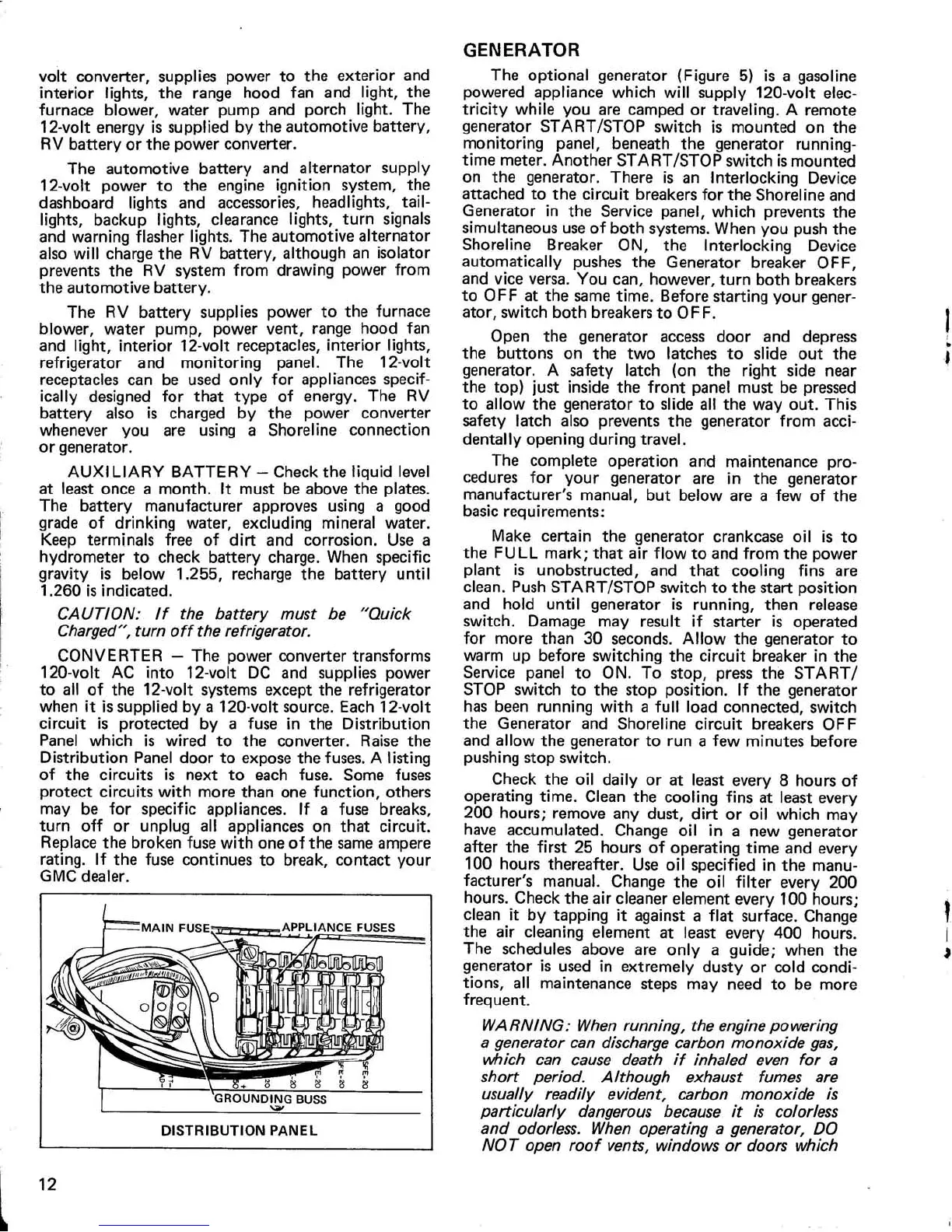
The optional generator (Figure 5) is a gasolin
e
powered appliance which will supply 120-volt elec-
tricity while you are camped or traveling
. A remot
e
generator START/STOP switch is mounted on th
e
monitoring panel, beneath the generator running
-
time meter
. Another START/STOP switch is mounte
d
on the generator
. There is an Interlocking Devic
e
attached to the circuit breakers for the Shoreline an
d
Generator in the Service panel, which prevents th
e
simultaneous use of both systems
. When you push th
e
Shoreline Breaker ON, the Interlocking Devic
e
automatically pushes the Generator breaker OFF
,
and vice versa
. You can, however, turn both breaker
s
to OFF at the same time
. Before starting your gener-
ator, switch both breakers to OFF
.
Open the generator access door and depres
s
the buttons on the two latches to slide out th
e
generator
. A safety latch (on the right side nea
r
the top) just inside the front panel must be presse
d
to allow the generator to slide all the way out
. Thi
s
safety latch also prevents the generator from acci-
dentally opening during travel
.
The complete operation and maintenance pro-
cedures for your generator are in the generato
r
manufacturer's manual, but below are a few of th
e
basic requirements
:
Make certain the generator crankcase oil is t
o
the FULL mark
; that air flow to and from the powe
r
plant is unobstructed, and that cooling fins ar
e
clean
. Push START/STOP switch to the start positio
n
and hold until generator is running, then releas
e
switch
. Damage may result if starter is operate
d
for more than 30 seconds
. Allow the generator t
o
warm up before switching the circuit breaker in th
e
Service panel to ON
. To stop, press the START
/
STOP switch to the stop position. If the generato
r
has been running with a full load connected, switc
h
the Generator and Shoreline circuit breakers OF
F
and allow the generator to run a few minutes befor
e
pushing stop switch
.
Check the oil daily or at least every 8 hours o
f
operating time
. Clean the cooling fins at least ever
y
200 hours
; remove any dust, dirt or
oil
which ma
y
have accumulated
. Change oil in a new generato
r
after the first 25 hours of operating time and ever
y
100 hours thereafter
. Use oil specified in the manu-
facturer's manual
. Change the oil filter every 20
0
hours
. Check the air cleaner element every 100 hours
;
clean it by tapping it against a flat surface
. Chang
e
the air cleaning element at least every 400 hours
.
The schedules above are only a guide
; when th
e
generator is used in extremely dusty or cold condi-
tions, all maintenance steps may need to be mor
e
frequent
.
WARNING
: When running, the engine powerin
g
a generator can discharge carbon monoxide gas
,
which can cause death if inhaled even for
a
short period
. Although exhaust fumes ar
e
usually readily evident, carbon monoxide i
s
particularly dangerous because it is colorles
s
and odorless. When operating a generator, D
O
NOT open roof vents, windows or doors which


 To Next Page
 Loading...