station (they are listed in the yellow pages of you
r
telephone directory)
. The small fee involved ma
y
save you considerable trouble and expense later
.
Be certain to weigh the motor home with all pas-
sengers, cargo, LP gas and water aboard
.
WEIGHIN
G
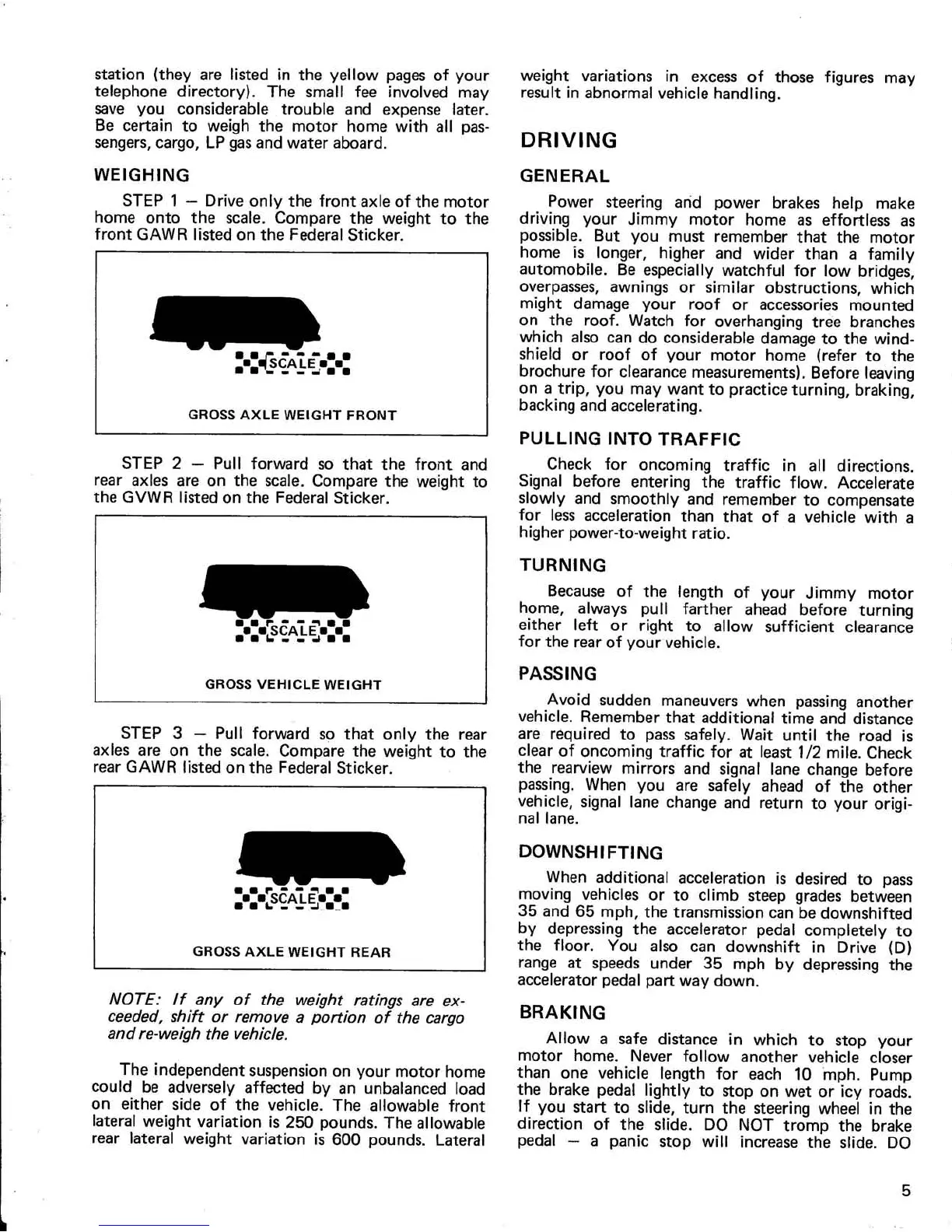
STEP 1 — Drive only the front axle of the moto
r
home onto the scale
. Compare the weight to th
e
front GAWR listed on the Federal Sticker
.
STEP 2 — Pull forward so that the front an
d
rear axles are on the scale
. Compare the weight t
o
the GVWR listed on the Federal Sticker
.
STEP 3 — Pull forward so that only the rea
r
axles are on the scale
. Compare the weight to th
e
rear GAWR listed on the Federal Sticker
.
NOTE
: If any of the weight ratings are ex-
ceeded, shift or remove a portion of the carg
o
and re-weigh the vehicle
.
The independent suspension on your motor hom
e
could be adversely affected by an unbalanced loa
d
on either side of the vehicle
. The allowable fron
t
lateral weight variation is 250 pounds
. The allowabl
e
rear lateral weight variation is 600 pounds
. Lateral
weight variations in excess of those figures ma
y
result in abnormal vehicle handling
.
DRIVIN
G
GENERA
L
Power steering and power brakes help mak
e
driving your Jimmy motor home as effortless a
s
possible
. But you must remember that the moto
r
home is longer, higher and wider than a famil
y
automobile
. Be especially watchful for low bridges
,
overpasses, awnings or similar obstructions, whic
h
might damage your roof or accessories mounte
d
on the roof
. Watch for overhanging tree branche
s
which also can do considerable damage to the wind
-
shield or roof of your motor home (refer to th
e
brochure for clearance measurements)
. Before leavin
g
on a trip, you may want to practice turning, braking
,
backing and accelerating
.
PULLING
INTO TRAFFI
C
Check for oncoming traffic in all directions
.
Signal before entering the traffic flow
. Accelerat
e
slowly and smoothly and remember to compensat
e
for less acceleration than that of a vehicle with
a
higher power-to-weight ratio
.
TURNIN
G
Because of the length of your Jimmy moto
r
home, always pull farther ahead before turnin
g
either left or right to allow sufficient clearanc
e
for the rear of your vehicle
.
PASSIN
G
Avoid sudden maneuvers when passing anothe
r
vehicle
. Remember that additional time and distanc
e
are required to pass safely
. Wait until the road i
s
clear of oncoming traffic for at least 1/2 mile
. Chec
k
the rearview mirrors and signal lane change befor
e
passing
. When you are safely ahead of the othe
r
vehicle, signal lane change and return to your origi-
nal lane
.
DOWNSHIFTIN
G
When additional acceleration is desired to pas
s
moving vehicles or to climb steep grades betwee
n
35 and 65 mph, the transmission can be downshifte
d
by depressing the accelerator pedal completely t
o
the floor
. You also can downshift in Drive (D
)
range at speeds under 35 mph by depressing th
e
accelerator pedal part way down
.
BRAKIN
G
Allow a safe distance in which to stop you
r
motor home
. Never follow another vehicle close
r
than one vehicle length for each 10 mph
. Pum
p
the brake pedal lightly to stop on wet or icy roads
.
If you start to slide, turn the steering wheel in th
e
direction of the slide
. DO NOT tromp the brak
e
pedal — a panic stop will increase the slide
. DO
5


 To Next Page