Receiving Group Calls
Receiving a Group Call is identical to receiving a normal
Selcall except that the alarm sound is a LOW tone beep
instead of the normal HIGH tone beep. The Callers Ident or
ALPHA Name appears on the display in the usual way.
lIstenIng channels
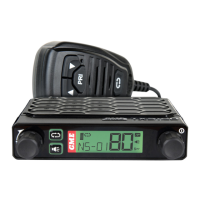
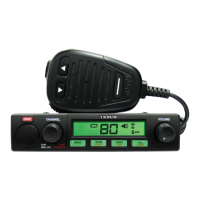
The TX3440 has provision for adding additional 59 user
programmable ‘listening channels’ covering the frequency
range between 403 MHz and 520 MHz. These channels can
be programmed by you using the front panel keys, making
the TX3440 a useful UHF scanning receiver.
SETTING THE FREQUENCY STEP
The listening channels can be programmed in 12.5 kHz or
25 kHz steps. To toggle the current frequency step:
1. Switch the radio OFF.
2
. Press and
hold the SCAN key while switching the
radio ON.
3.
12.5 k or 25.0 k will be displayed briefly, indicating the
current selected frequency step.
ACTIVATING THE LISTENING CHANNELS
By default, the listening channels are disabled and only the
standard 40 UHF channels can be accessed. Later, once
programmed, the listening channels will show up as CH41-
CH99 and can be accessed and freely edited. However,
to enable a channel for programming that has not been
programmed yet (and therefore it can not be selected for
editing using the or keys) the initial programming of
the listening channel(s) has to be performed.
To perform the Initial Programming
of the listening channels
1. Switch the radio OFF.
2. Press and
hold the PRI key while switching the radio
ON again.
T
he radio is now in the ‘All Visible’ mode. In this mode
all channels are visible, including the currently inactive
ones, allowing you to select any listening channel
between 41 and 99 for subsequent editing.
3. Using the
or keys, select a listening channel that
you wish to activate. At this stage, the display will show
‘-OFF-’ indicating that the current listening channel is
turned OFF.
4. Program a desired frequency into the selected listening
channel, as described in the next section.
5.
Repeat steps 3-4 to activate all the desired listening
channels.
6. Once you have enabled and programmed your additional
listening channels, switch the radio OFF to end the
initial programming operation. When you switch it ON
again, normal operation will be restored and only the
listening channels you have enabled will be available
above channel 40.
PROGRAMMING THE LISTENING CHANNELS
The display can show the frequency of the listening channel
when the radio is in NUMERIC mode, or an associated
alpha tag in ALPHA mode. Before programming the channel
frequencies, make sure the radio is in NUMERIC mode by
pressing F (Function) followed by ALPHA until ‘NUMER’
is displayed.
To program a frequency
into a listening channel
1. Press the or keys to select the required listening
channel to edit (41-99).
2. Press and
hold the M
ENU key until a beep is
heard. The current frequency assigned to the listening
channel will be displayed, or ‘OFF’ if the channel is
currently inactive.
3. Press
or keys to select the desired frequency.
4. A quick press of the
PRI key will toggle the frequency
step between 1
2.5 kHz/25 kHz and 1 MHz. The
corresponding digit will be flashing, indicating the
current frequency step.
5. Once you have the correct frequency displayed, press
and hold the M
ENU button to store the frequency and
exit the menu, or alternatively, press and hold the PRI
key to store the frequency, but stay in the frequency edit
menu for further editing of the same listening channel.
Please note however the menu will time out after 20
seconds of inactivity.
Notes:
•
The display only indicates to 10 kHz resolution. The ‘kHz’
digit is not displayed, e.g.. 468.425 MHz will display as
• While you are selecting the frequency, the receiver is live
and will receive signals on the frequency being displayed.
You can use this feature to manually identify active
frequencies and store them.
100 Radios Ident Sent: 123AA Idents called: 12300 -> 12399
1000 Radios Ident Sent: 12AAA Idents called: 12000 -> 12999
4 6 8 4 2
10 kHz
100 kHz
1 MHz
10 MHz
100 MHz



 To Next Page