Need help?
Do you have a question about the GME TX3420 and is the answer not in the manual?
Information on dedicated channels for emergency use and repeater operation.
Details on channels reserved for telemetry use, with transmit inhibit.
Highlights microprocessor control, permanent memory, and programmable scan function.
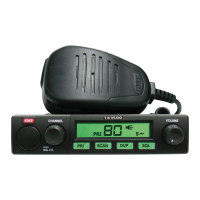
Describes the primary and secondary functions of the four keys below the display.
Details how to turn the radio on/off and adjust volume using the rotary control.
Explains how to lock the unit's keys to prevent accidental presses.
Describes how to adjust squelch sensitivity settings for optimal performance.
How to store and recall a specific channel for quick access.
Explains duplex mode for repeater communication and channel frequency differences.
How to temporarily open the squelch to listen for other users.
Information on the two available CTCSS tone sets.
Guidance on pre-selecting CTCSS tones via menu settings.
Explanation of the two scan groups: Open Scan and Group Scan.
Steps to add or remove channels from scan memory.
How to initiate the scanning process.
How to cancel the scanning function.
Specifics on pausing, skipping, and exiting scan in Open Scan mode.
Steps for configuring Group Scan mode with Priority Channel.
How scanning behaves within the Group Scan mode, including priority channel interaction.
Information about the unique Selcall Ident and its role in identifying calls.
How to assign 5-letter names to Selcall Idents for easier identification.
Details on the radio's Call memory and 10 Selcall Ident memories.
Step-by-step instructions for entering a Selcall Ident.
How to transmit a Selcall Ident.
Procedure to enable Quiet mode for tagged channels.
Procedure to disable Quiet mode.
How signals are handled when Quiet mode is active.
Steps for entering and sending Group Call Idents.
How to enable and access the additional listening channels.
Steps for initial activation of listening channels.
How to program frequencies into the listening channels.
Prerequisites and preparation for using Seek mode.
Procedures for setting and modifying frequency limits.
How to remove a set frequency limit point.
How to use set limits to scan specific frequency bands.
How to adjust channel frequencies or edit ALPHA labels for listening channels.
How to adjust the squelch sensitivity level through the menu.
Steps to select a specific CTCSS tone frequency.
Instructions for mounting the remote head bracket.
Details on connecting the radio's power, including ignition switch options.
Steps for submitting a warranty claim.
Information on after-sales support and service availability.
 General
| Type | UHF CB Radio |
|---|---|
| Channels | 80 |
| Power Output | 5W |
| Display | LCD |
| Microphone | Built-in |
| IP Rating | IP67 |
| Waterproof Rating | IP67 |
| Power Supply | Battery |
| Operating Voltage | 7.4V |
| Battery | Li-ion 2000mAh |

 To Next Page