Need help?
Do you have a question about the GME TX3345 and is the answer not in the manual?
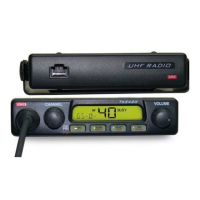
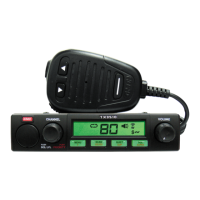
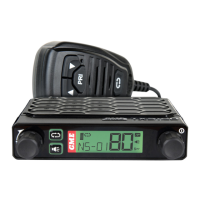
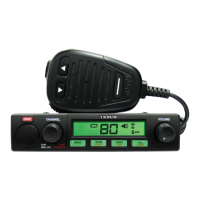
Lists the main radio unit as an included accessory.
Lists the mounting cradle as an included accessory.
Lists the instruction manual as an included accessory.
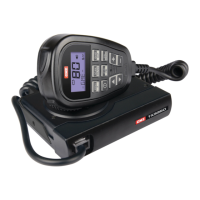
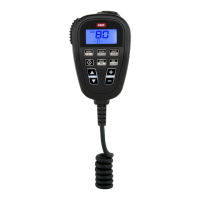
Lists the MC524B LCD Microphone as an included accessory.
Lists the microphone clip as an included accessory.
Lists the DC lead as an included accessory.
Lists the screw pack as an included accessory.
Explains the 80 channel UHF CB radio spectrum allocation and narrowband usage.
Details potential issues and performance differences between narrowband and wideband radios.
Describes the programmable scan features, including Open and Group scan.
Describes DVC for automatic audio level compensation.
Details the Selective Calling system with 5-digit ANI and user-adjustable Selcall Ident.
Describes CTCSS and DCS for quiet channel operation.
Details the overvoltage detection circuitry for radio protection.
Explains the function of the Push-To-Talk button.
Explains how to use channel and volume up/down buttons.
Details accessing settings and secondary functions via Menu/F key.
Explains how to access primary and secondary functions using the keys.
Explains how to use the volume keys to increase or decrease volume.
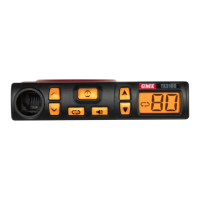
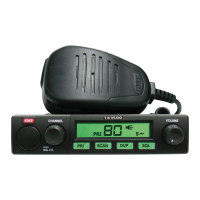
Lists and describes various elements shown on the radio's LCD display.
Explains how to step through or hold the channel selection buttons.
Details the steps for transmitting, including microphone distance and voice level.
Describes how to open and close the squelch for noise reduction.
Explains how to adjust the squelch sensitivity from SQL-1 to SQL-9.
Lists the available menu items like SQL, CTCSS, LIGHT, COLOR, WHITE, S-METER/BATT, BEEP, DVC.
Explains the general procedure for navigating and using the menu.
Details how to adjust squelch sensitivity using the menu.
Provides steps to adjust brightness, colour, and saturation of the backlight.
Explains how to adjust the volume level of key press confirmation beeps.
Explains the procedure to store a channel as the Priority Channel.
Details how to instantly recall the stored Priority Channel.
Describes how to enable Duplex operation on specific channels.
Explains how to disable Duplex operation on a channel.
Details how to activate or deactivate the Dynamic Volume Control feature.
Explains the purpose of CTCSS/DCS as squelch quieting systems.
Guides on selecting appropriate CTCSS/DCS tones based on communication needs.
Describes how to enable CTCSS/DCS on individual channels.
Explains how to disable CTCSS/DCS on individual channels.
Details how to temporarily open the squelch to listen for other users.
Introduces the two scan groups: Open Scan and Group Scan.
Explains how to toggle between Open and Group scan modes.
Describes adding/removing channels from Open or Group scan memory.
Details procedures for initiating and cancelling the scanning function.
Explains how to temporarily or permanently skip nuisance channels during scanning.
Describes how to quickly review or edit channels in scan memory.
Explains the unique Selcall Identification Number for radio identification.
Details how to add labels for easier Selcall Ident identification.
Explains how the Quiet Mode mutes the receiver until your Selcall Ident is received.
Guides on how to enter and send a Selcall Ident.
Details the process of storing Selcall Idents in memory locations.
Describes how to retrieve stored Selcall Idents.
Explains how to change the radio's factory programmed Selcall Ident.
Guides on how to add 5-character labels to Selcall Idents.
Details the steps to enter and store an ALPHA label for a Selcall Ident.
Describes how the radio alerts the user to an incoming Selcall.
Explains how to respond to an incoming Selcall by returning the call.
Details how to cancel the Selcall alarm notification.
Explains how to tag individual channels for Quiet Mode.
Describes how to remove the Quiet Mode tag from channels.
Details how to activate the Quiet Mode for tagged channels.
Explains how to deactivate the Quiet Mode entirely.
Guides on how to send a Group Call using a special 'group code'.
Details how to mount the main radio unit using the cradle.
Explains how to attach the microphone to its clip.
Details wiring for the radio to stay powered when the ignition is off.
Explains wiring for the radio to operate with the vehicle's ignition.
Covers temperature range, voltage, current, sensitivity, and selectivity.
Includes compliance, channel spacing, dimensions, weight, and shock/vibration.
Details RF output, modulation, frequency response, and spurious emissions.
Outlines consumer rights under Australian Consumer Law.
Details the warranty terms for materials, workmanship, and coverage exclusions.
Specifies the warranty duration for the product type.
Provides the head office contact details in Sydney.
Lists contact information for various GME branch offices.
 General
| Type | UHF CB Radio |
|---|---|
| Channels | 80 |
| Frequency Range | 476.425 – 477.4125 MHz |
| Power Output | 5W |
| Modulation | FM |
| Dimensions | 60mm (W) x 128mm (H) x 37mm (D) |
| Weight | 270g (with battery pack & antenna) |
| Battery | 2200mAh Lithium Ion |

 To Next Page