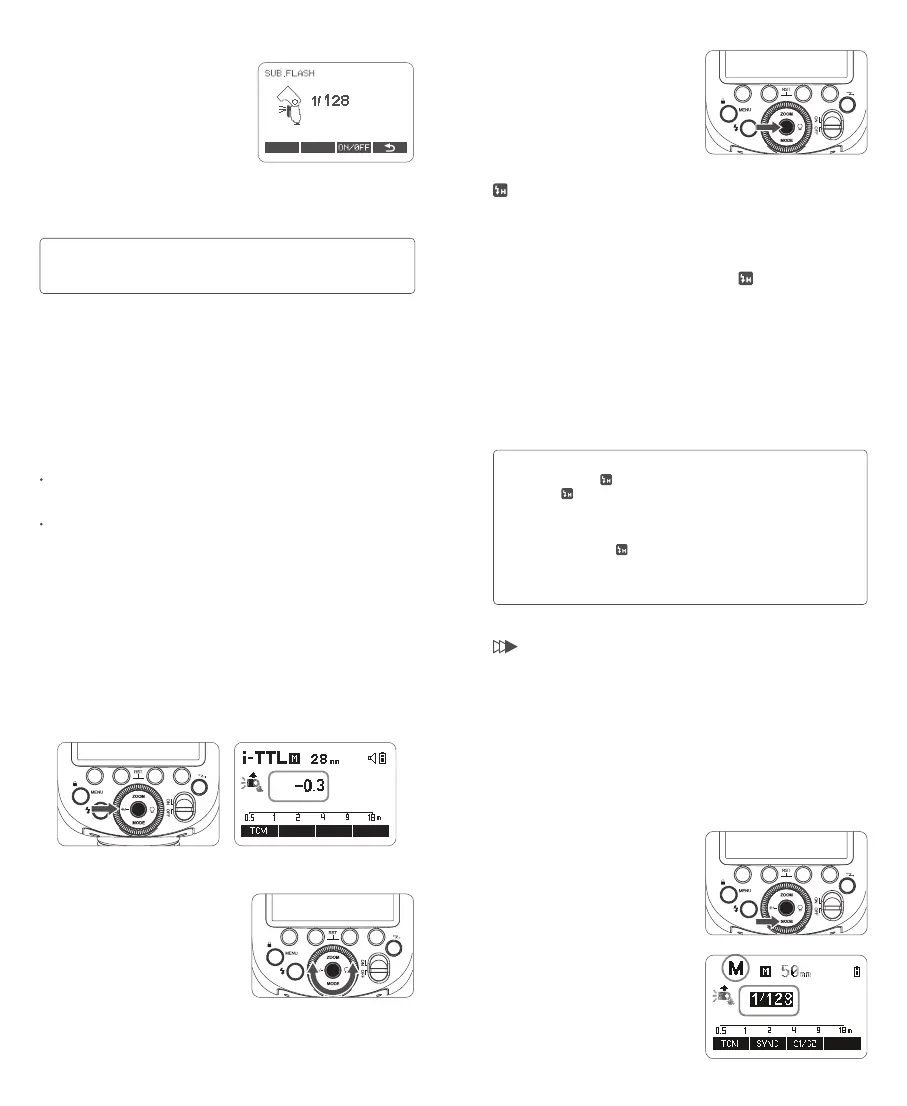
32 33
Flash Mode — i-TTL Auto Flash
In i-TTL mode, the camera's metering system detects the flash reflected
from the subject and automatically adjusts the flash output so that
the subject and background are evenly exposed. In this mode, multiple
functions are available: FEC, HSS, second curtain sync, etc.
Press < MODE > mode button to enter i-TTL mode, the LCD panel will display
<i-TTL>.
Press the camera shutter halfway to focus. The aperture value and
effective flash range will be displayed in the LCD panel.
When the shutter is fully pressed, the flash will fi re a pre-flash that the
camera will use to calculate exposure and flash output the instant before
the photo is taken.
FEC (Flash Exposure Compensation)
With FEC function, this flash can adjust from -3 to +3 with 1/3 increment each
step. It is useful in situations where minor adjustment of the TTL system is
needed based on the environment.
1. Press the <+/-> button, FEC amount will be highlighted on the LCD panel.
Setting FEC Amount
2. Turn the select dial to set the
FEC amount.“0.3”means 1/3 step,
“0.7”means 2/3 step.To cancel the
FEC, set the amount to “0”.
3. Press set button again to confi rm
the setting.
High-Speed Sync
High speed sync (FP flash) enables the flash to synchronize with all camera
shutter speeds. This is convenient when you want to use aperture priority for
fi ll-flash portraits.
1. Set the flash sync speed to 1/320s (auto FP) or 1/250s (auto FP) in Nikon
camera setting. Half press the shutter button and <
> will be displayed on
the LCD panel. Now the high-speed sync function gets started.
2. Turn the camera dial and the shutter speed can be set to or more than
1/250s.
3. Check the shutter speed through the camera viewfi nder to confi rm whether
the FP high-speed function is used. If the shutter speed is or over 1/250s, it
means the high-speed function is booted up.
1. If setting the flash sync speed to 1/320s (auto FP) or 1/250s (auto FP) in Nikon
camera setting, <
> will be displayed on the panel shutter speed of 1/320s or
above, <
> will disappear at a shutter speed of 1/250s or below.
2. With high-speed sync, the faster the shutter speed, the shorter the effective flash
range.
3. Set the flash sync speed to Non auto FP in Nikon camera setting. When half
pressing the shutter, <
> will disappear.
4. Multi flash mode cannot be set in high-speed sync mode.
5. Over-temperature protection may be activated after 60 consecutive high-speed
sync flashes.
Note:
Second-Curtain Sync
With a slow shutter speed and second-curtain sync, you can create a light
train following the subject. The flash fi res right before the shutter closes.
Choose REAR flash mode in Sony camera setting.
Flash Mode — M: Manual Flash
The flash output is adjustable from 1/1 full power to 1/256 power with 1/10
increment each step. To obtain a correct flash exposure, use a hand-held
flash meter to determine the required flash output.
1. Press <MODE> mode button so that
<M> is displayed on the LCD panel.
2 Press the <+/-> button to select flash
output amount, then turn the select dial
to adjust it. Press the set button again
to confi rm the setting.
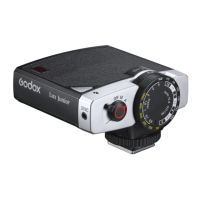
1. SU-1 is not useable in wireless transmission shooting.
2. SU-1 is not useable in high-speed sync.
3. The flash head need to be uplifted in order to use SU-1 properly.
Note
:
Instructions for Using
Mount SU-1 directly to the external flash
interface of V1Pro N, press the function
button 1<MODEL> to set the flash to M
(manual) flash/TTL auto flash mode,
then press function button 4 <SUB> to
enter sub flash settings interface, and
press function button 3 <ON/OFF> to
turn on/off.
When the sub flash is turned on, turn the
select dial can adjust flash output of the
sub flash from 1/128 to 1/1 in 22 flash
steps, with +1/3 increment each step.



 To Next Page