H
IGt.I
SPE[3
t 10P
-..:.,:._
Li
.? €a.
E'VEHNOR
"- c&t',lTtr0l
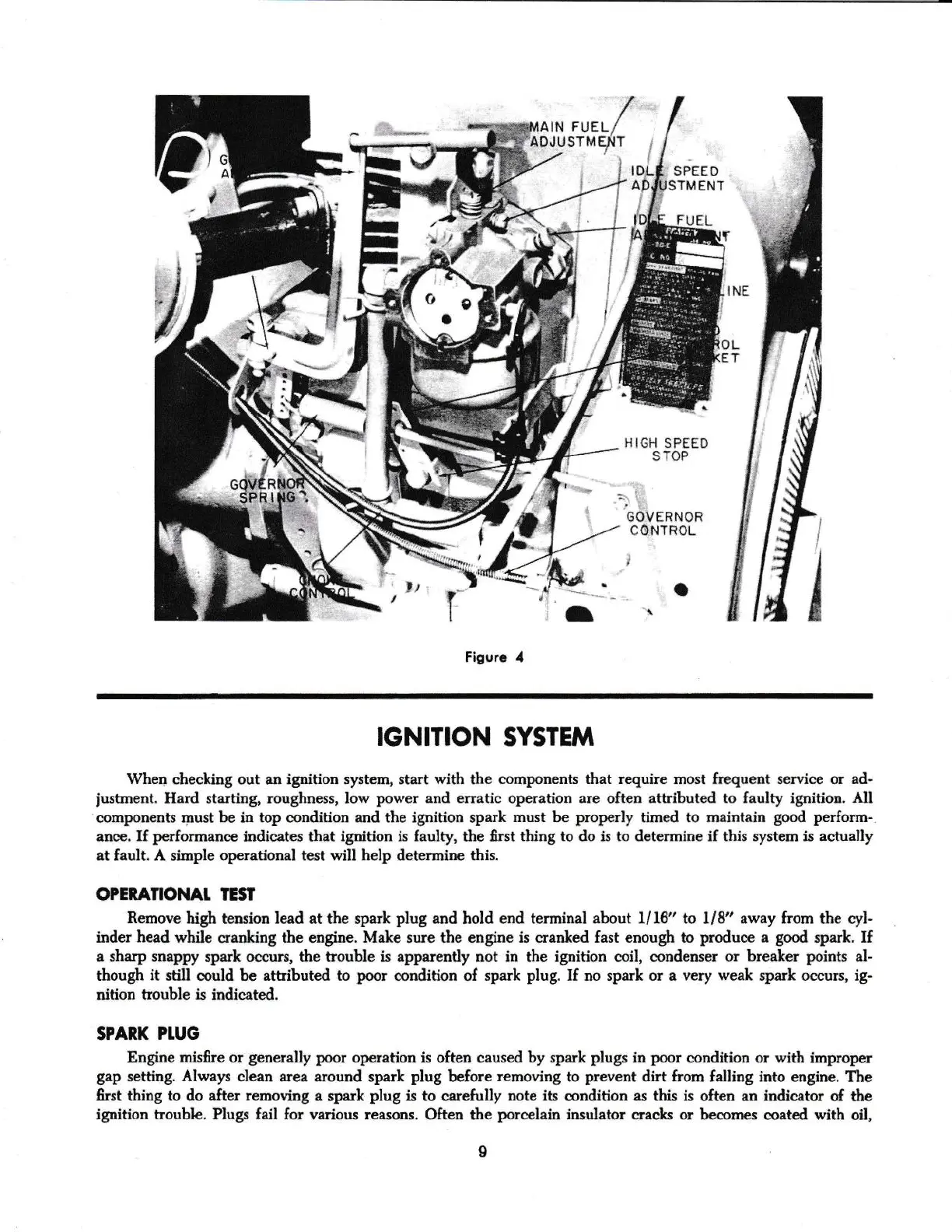
Figura 4
IGNITION
SYSTE{Iil
Wherr
checking out
an igaition
systenl start with the
components that reguire
most ,requerrt senrice
or ad-
iustrneat.
Ilard
starting, roughness,
1or*
trlo$'er
and
erratic operation
are
ofter:
attributed to faulty
ignition, ,{11
components must
be
in
top condition and the ignition
spark
must be properly
tilrred to maintain
good perform-
aace.
If
performance
indicates that
ignition is faulfy,
the f,rst rhing
to do is to detsrmine if this
sy*em is actually
at fault. A simple
operational
test will
help
determine
this.
OPERATIOilAL IETT
Remova
lrigh tensior lead at
the spark
plug
and
hold
end terminal about
U18"
ls ]/$"
away from the
cyl-
inder head
while cranking &e engine. Male sure the engine
is
cranked
fast enougl to
produce
a
good
spark.
If
a
sharp snappy
spark
occux,
the trouble is apparendy
nst i:r
the
ignition
coil, condenser
or
breater
points
al-
though
it
still
eould be
atnibuted to
poor
confitioa of
spark
plug.
If ao rpark o,
a
very
weak
spark occurs, ig-
nition
trouble is
indicated,
SPANK
PIUG
Elgine
mis&e or
generally
poor
operation is often caused
by
spark
plugr
in
poor
condition or
witb improper
gap
settiag.
Always
clean area arormi
spark
plug
befora
removing
to
prevent
di* hom falling into
engine. Tlre
Srst
thing to do
after removing
a
qark plug
is to
carefully
note
its
condition
es this is
oftaa
ar:
iadicator
of the
ignition trouble, Plugs
fail
for
variou rerlsors. Ofter the
porcelain
insulator cracks or bemmes coated udth
oil,
/
rlAlN
FUEL/
I}JUSTMEllT
!
,
t
&,
rjE



 To Next Page