PHASE
I
BREADBOARD
tn this
phase,you
will
have an opportunity
to
construct
an
experimental
breadboard
similar to that
used
by engineers
and
technicians
in
industry.
A
breadboard
is
a
layout of
electronic
parts,
wired
in such a
way that
the
parts
may be easily
added or
removed
during
experimental
work.
DISCUSSION
Your Model
803
solid-state
Power Supply
consists
of
four
stages of
circuitry:
power
transformer
circuit,
rectifier
circuit,
filter circuit,
and
voltage
control
circuit.
ln this
phase
you
will study
the operation
of
your
power
supply
by bread-
boarding
one
stage at a
time.
TRANSFORMER
EXPERIENCE
DISCUSSION
A
transformer
is an alternating
current
(AC)
device
that
transfers electrical
energy
from one
circuit to
another.
lt is
usually used
to STEP UP
or to
STEP
DOWN an
AC
voltage.
ln its
basic
form, the
transformer
consists
of two
coils of
wire wound
around
an iron core.
One
coil
is connected
to
the
AC
source
voltage and
is
called
the
PRIMARY
winding;
the
other
coil
is called the
SECONDARY
winding
and
pro-
vides the
proper
supply
voltage.
The
transformer
used
in
this
power
supply
is a step-down
transformer
with a
center-tap
on the
secondary
winding,
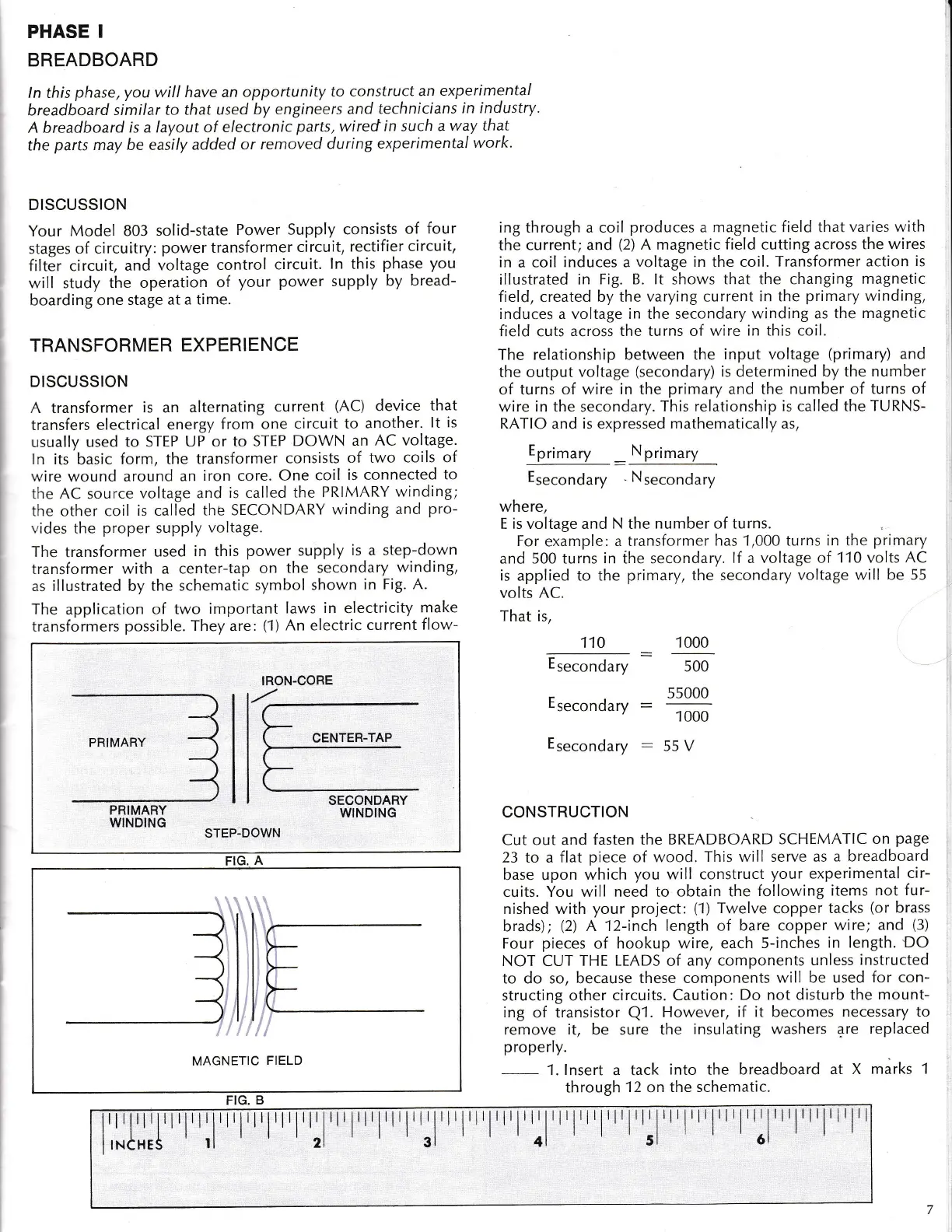
as illustrated by the
schematic
symbol
shown
in Fig. A.
The application of
two
important
laws
in
electricity
make
transformers
possible. They
are:
(1)
An electric
current
flow-
MAGNETIC
FIELD
ing through a coil
produces
a magnetic
field that varies w'ith
the current; and
(2)
A magnetic
field cutting across the
wires
in
a
coil
induces
a
voltage in the coil.
Transformer action
is
illustrated in
Fig. B. It
shows
that the changing
magnetic
field, created by the
varying current
in
the
primary winding,
induces a voltage in the secondary
winding as
the magnetic
field
cuts
across the turns of
wire in this coil.
The relationship between the
input voltage
(primary)
and
the output
voltage
(secondary)
is
determined
by the number
of
turns of wire
in
the
primary
and
the number of turns
of
wire in
the secondary.
This
relationship is called the TURNS-
RATIO and is expressed mathematically as,
Eprimary
_
N
primary
Esecondary
"
N
secondary
where,
E
is
voltage and
N
the
number of turns.
For
example:
a transformer
has 1,000 turns
in
the
primary
and 500 turns
in
the secondary.
lf
a voltage
of
1-10
volts
AC
is
applied to the
primary,
the secondary
voltage will be 55
volts AC.
That is,
110
'1000
tsecondary
500
Esecondary
:
-ry
1000
Esecondary
:
55 V
CONSTRUCTION
Cut out
and fasten the
BREADBOARD
SCHEMATIC
on
page
23 to a
flat
piece
of wood.
This will serve
as a breadboard
base
upon
which
you
will construct
your
experimental
cir-
cuits. You will
need
to
obtain the
following
items
not fur-
nished with
your project:
(1)
Twelve copper tacks
(or
brass
brads);
(2)
A 12-inch
length of bare copper
wire;
and
(3)
Four
pieces
of
hookup wire, each
5-inches
in length.
'DO
NOT CUT
THE LEADS
of
any components
unless
instructed
to do so,
because these components
will be used
for con-
structing other
circuits. Caution:
Do not disturb the
mount-
ing
of transistor
Q1
.
However, if it becomes
necessary to
remove it, be sure the
insulating washers
are
replaced
properly.
--
1. Insert a tack
into
the
breadboard
at X
marks 1
through
12 on the schematic.
FIG.
,ll,tlll|llll,ll,lllllll,l,]ll|l|lill,t,:l|llIl|lllllll|
CENTER-TAP
PRIMARY
WINDING
SECONDARY
WINDING
STEP-DOWN
FIG.
A



 To Next Page
 Loading...