Need help?
Do you have a question about the Grindex Maxi 8107.011 and is the answer not in the manual?
Provides an overview of the manual's purpose and guidance on reading and keeping it.
Explains hazard levels, terminology, and symbols used to communicate safety information.
Details essential safety practices for the site, qualified personnel, and protective equipment.
Outlines safety requirements for MSHA permissibility, covering general safety and service.
Addresses specific hazards like those in temporary installations and biological hazards encountered.
Covers emissions and waste disposal guidelines, and actions for exceptional sites.
Emphasizes using only original manufacturer's spare parts for safety and warranty.
Instructions for inspecting the package for damage or missing items upon delivery.
Guidance on inspecting the product for damage or missing parts after unpacking.
Covers precautions, positioning, fastening, and lifting procedures during transport.
Details temperature limits for handling and storing the product to prevent damage.
Specifies acceptable temperature ranges for units in their original factory condition.
Provides guidelines to prevent freezing damage when the unit is lifted out of liquid.
Outlines requirements for storage location and long-term storage procedures.
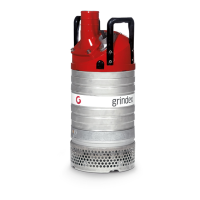
Lists pump models and their availability for Standard, EX, MSHA, Drainage, and Sludge.
Specifies the product's intended use for moving wastewater, sludge, and water.
Describes the pump as submersible and driven by an electric motor.
Indicates the pump can handle particles corresponding to strainer hole sizes.
Defines pressure classes (L, N, H, SH) and their corresponding head ratings.
Describes the impeller as wear-resistant, with Poly-Life® option for enhanced resistance.
Explains the stator's thermal contacts and their operating temperatures for overtemperature alarms.
Details the location and purpose of the data plate, listing key product specifications.
Lists product approvals for hazardous locations, specifically MSHA approval for Maxi 8107.590.
Provides initial safety checks and general instructions before installing the pump.
Details special rules for installations in explosive or flammable atmospheres.
Mentions the requirement to vent sewage station tanks according to local plumbing codes.
Explains how discharge line velocity prevents sedimentation and lists required velocities.
Specifies that the discharge line must be run vertically or horizontally without sharp bends.
Emphasizes using correct, corrosion-free fasteners and ensuring they are properly tightened.
Step-by-step guide for installing the pump, including cable routing and lowering.
Covers general precautions and requirements for making electrical connections.
Lists general requirements for electrical installation, including supply authority notification.
Details requirements for installing cables, including condition, bending radius, and sealing.
Explains grounding requirements and safety precautions for electrical grounding.
Covers short-circuit protection and requirements for pumps without built-in motor protection.
Provides recommendations for connecting the pump to a generator power source.
Instructions for preparing SUBCAB® cables with twisted-pair control cores.
Illustrates and describes the preparation of SUBCAB® cables and screened SUBCAB® cables.
Step-by-step guide for connecting the motor cable for specific pump versions.
Detailed instructions for connecting the motor cable for pump version code 590.
Provides connection locations, diagrams, and a color code standard for wiring.
Procedure to verify correct impeller rotation for pumps without built-in motor protection.
Procedure to check phase sequence for pumps equipped with rotation control SMART™.
Illustrates and explains how to connect the pump to power and check its start reaction.
Lists essential checks before operating the unit, including safety devices and cable integrity.
Addresses electrical hazards when operating near wet areas and swimming pools.
Discusses sound power levels and the importance of understanding noise requirements.
Provides steps for safely starting the pump, including impeller rotation check.
Instructions for cleaning the pump after operation in dirty water to prevent clogging.
General safety precautions for maintenance, including disconnecting power and hazard awareness.
States that a ground continuity test must always be performed after service.
Lists essential tasks for maintenance and reassembly, like cleaning and lubrication.
Provides torque values for screws and nuts for different property classes and materials.
Outlines regular inspection and service types, purposes, and intervals.
Details specific service items for inspection, including visible parts, pipes, and cable entry.
Lists tasks for a major overhaul, in addition to regular inspection items.
Provides instructions and recommendations for changing the pump oil.
Step-by-step guide on how to drain the oil from the pump housing.
Introduction to impeller replacement, mentioning to drain oil first.
Detailed steps for removing the impeller using alternative method 1.
Detailed steps for removing the impeller using alternative method 2.
Detailed steps for removing the impeller using alternative method 3.
Instructions for installing the impeller using alternative method 1.
Instructions for installing the impeller using alternative method 2.
Instructions for installing the impeller using alternative method 3.
Instructions for installing the impeller using alternative method 4.
Guidance on adjusting impeller clearance for optimal pump performance.
Steps for removing and installing the pump diffuser.
General guidelines and safety precautions for troubleshooting electrical issues.
Troubleshooting steps for when the pump fails to start, including alarm checks.
Specific troubleshooting for SMART™ pumps when they do not start.
Troubleshooting steps when the pump fails to stop due to level sensor issues.
Diagnosing and resolving issues where the pump cycles rapidly.
Troubleshooting steps when the motor protection trips during operation.
Troubleshooting causes and remedies for low or no water delivery.
Specifies operating limits for the pump, including temperature, pH, and density.
Details motor type, frequency, supply, starting method, and insulation class.
Provides detailed motor specifications for version code .011/.030/.300.
Provides detailed motor specifications for version code .590.
Presents dimensions and weights for various pump models.
Shows dimensions and weights for 8107.011 H and 8107.300 H pump models.
Shows dimensions and weights for 8107.011 N and 8107.030 L pump models.
Shows dimensions and weights for the 8107.590 H pump model.
Introduces performance curves, stating the test standard used.
Presents performance curves for the 8107.011 SH model at 50 Hz and 60 Hz.
Shows performance curves for 8107.011 N, H Open impeller at 50 Hz and 60 Hz.
Presents performance curves for the 8107.300 H Open impeller model at 50 Hz and 60 Hz.
Presents performance curves for the 8107.030 L model at 50 Hz and 60 Hz.
Presents performance curves for the 8107.590 H model at 60 Hz.
 General
| Brand | Grindex |
|---|---|
| Model | Maxi 8107.011 |
| Category | Water Pump |
| Language | English |

 To Next Page