2 F320 Instruction Manual
rev 03.26.13
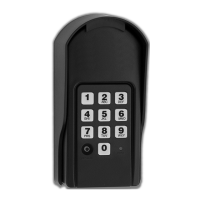
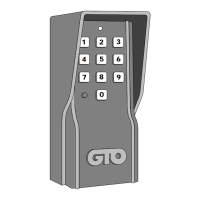
The F320 is a digital keyless entry system designed for
access control applications. The keypad is housed in a
rugged cast aluminum enclosure that can be mounted to a
pedestal or bolted directly to a wall. The die-cast keys have
bright, easy-to-read yellow graphics.
Up to 120 entry codes, from 1 to 6 digits in length, can be
programmed. They can activate either, or both, of the relay
outputs. Relay #1 has a 5 Amp capacity. Relay #2 has a 1
Amp capacity.
Two LED indicators show the status of the entry system. The
left LED lights red to indicate power, then turns green when
access is granted. The right LED lights yellow when the
keypad is in “lockout” condition (from too many incorrect
code entries). The keypad’s courtesy light can be always
o, always on or be programmed to illuminate from 1-4
minutes after any keypress (default 2 minutes). An internal
sounder beeps when each key is pressed.
The DOOR SENSE/INHIBIT input can be used two ways.
If programmed for “door sense”, a switch on the door
detects forced entry or door ajar situations. If programmed
for “inhibit”, the input can be wired to a “service” switch
or automatic timer that will disable the Relay #1 when
required.
The REQUEST-TO-ENTER input can be wired to a pushbutton
or re access keyswitch to provide codeless entry for
authorized personnel. The “anti-passback” feature prevents
using the same code twice before the programmed time
elapses.
The ALARM SHUNT output activates when access is granted.
This output can be wired to shunt alarm contacts on the
access door/gate to prevent triggering of an alarm when
authorized access occurs.
Two solid state outputs, capable of switching 100 mA to
common, are programmable to signal forced entry, door
ajar, lockout, alarm circuit shunting, request-to-enter, and
keypad active conditions.
The F320 is powered from a 12-24 Volt AC or DC source.
Power can be obtained from the access device or a separate
power supply. The EEPROM memory retains all entry codes
and programming, even without power.
MECHANICAL
Case dimensions: 4.00” W x 5.50” H x 3.00” D
ELECTRICAL
Voltage:12-24 Volts AC or DC
Current:10 mA typical, 150 mA maximum
Outputs:Relay #1
Form “C” 5 Amps @ 24 Volts maximum
Relay #2
Form “C” 1 Amp @ 24 Volts maximum
Solid state outputs (Outputs #3 & #4)
Short-to-common 100 mA
@ 24 VDC maximum
ENVIRONMENTAL
Temperature:-22°F to 149°F (-30°C to 65°C)
Humidity: 5% to 95% non-condensing
KEYPAD PROGRAMMABLE
120 ENTRY CODE CAPACITY
1-6 DIGIT ENTRY CODE LENGTH
4 INDEPENDENT OUTPUTS (TIMED/TOGGLED)
4 INDEPENDENT TIMERS
EACH ENTRY CODE CAN BE PROGRAMMED TO
ACTIVATE EITHER OR BOTH RELAYS
RELAY CONTACTS ARE FORM “C” (N.O. & N.C)
SOLID STATE OUTPUTS ARE OPEN COLLECTOR
SWITCH-TO-COMMON
TWO LED INDICATORS
COURTESY LAMP
PIEZO SOUNDER
TIMED ANTI-PASSBACK (LAST 3 VALID ENTRIES)
KEYPAD LOCKOUT
TACTILE KEY FEEL
DOOR SENSE INPUT
INHIBIT INPUT
REQUEST-TO-ENTER INPUT
INTRODUCTION ......................................................................2
SPECIFICATIONS ......................................................................2
FEATURES .................................................................................2
COMPONENT LOCATIONS .....................................................3
WIRING DIAGRAM ...................................................................3
INSTALLATION ......................................................................... 4
FACTORY DEFAULTS ...............................................................6
BASIC PROGRAMMING ......................................................... 6
PROGRAMMING OPTIONS ....................................................7
F320 OPERATION ..................................................................10
GTO/ACCESS LIMITED WARRANTY ....................................11
FCC NOTICE ............................................................................11
INTRODUCTION
CONTENTS SPECIFICATIONS
FEATURES


 To Next Page
 Loading...