Need help?
Do you have a question about the Guardian Fall Protection 00484 and is the answer not in the manual?
Specifies the required 1/4" x 3" steel hex head lag screws or 16d nails.
Defines acceptable roof pitch for installation (0/12 - vertical/sheer).
Steps for planning installation, including location, hazards, and compatibility.
Steps for installing the Bull Ring Anchor using specified fasteners.
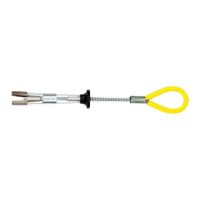
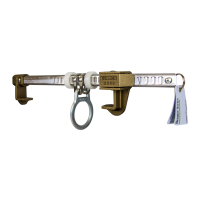
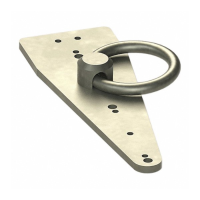
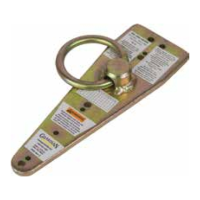
The Guardian Fall Protection Bull Ring Anchor is a versatile anchorage connector designed to provide a secure attachment point for personal fall arrest systems (PFAS) and restraint systems. Its primary function is to safeguard workers from fall hazards by offering a reliable connection to a suitable structure. This device is engineered to be a critical component in a comprehensive fall safety program, ensuring that workers can perform their duties at height with enhanced security.
The Bull Ring Anchor serves as a Type A anchorage connector, meaning it is designed to be a fixed point of attachment for fall protection equipment. When properly installed, it provides a robust connection capable of withstanding significant forces generated during a fall event. The anchor is intended for use with a single personal fall arrest system (PFAS) or restraint system at any given time, emphasizing its role as a dedicated individual attachment point.
In a personal fall arrest application, the Bull Ring Anchor is designed to support a maximum of one PFAS. The structure to which it is attached must be capable of withstanding loads of at least 5,000 lbs in the directions permitted by the system. This ensures that in the event of a fall, the anchor and the supporting structure can collectively absorb the impact forces. The anchor allows for a maximum free fall of 6 feet, or up to 12 feet when used in conjunction with other equipment explicitly certified for such extended free fall distances. For fall arrest, the dorsal D-ring of a harness is the applicable connection point.
For restraint applications, the Bull Ring Anchor is used to prevent workers from reaching a fall hazard's leading edge. In this mode, the structure must withstand loads of at least 1,000 lbs in the permitted directions, and no free fall is allowed. Restraint systems employing the Bull Ring Anchor are suitable for surfaces with slopes up to 4/12 (vertical/horizontal). Applicable D-rings for restraint include dorsal, chest, side, and shoulder.
The anchor is rated for loading in any direction, provided it is installed as prescribed in the instruction manual. This directional flexibility makes it adaptable to various work scenarios and structural configurations. It is also suitable for use in horizontal lifeline (HLL) applications, where the HLL must be installed perpendicular to the long side of the Bull Ring Anchor. This capability extends its utility beyond single-point attachment to more complex fall protection setups.
The Bull Ring Anchor is designed for installation on wood substrates with a minimum thickness of 3½ inches (total combined). It must never be installed on substrates other than wood. The installation process requires specific fasteners: either five 1/4" x 3" steel hex head lag screws (for the 00484 model) or five 1/4" x 3" stainless steel hex head lag screws (for the 00484-SS model), or six 16d nails with a minimum head diameter of 11/32". It is crucial that all fasteners are fully embedded into the substrate, and no torque should be applied to them during installation. Nail installation is compliant with OSHA regulations only, while screw installation is compliant with both OSHA and ANSI standards.
Before installation, a thorough planning process is essential. The installation location must be free of debris, rot, decay, cracking, and hazardous materials, and it must be a minimum of 2 feet from all leading edges. The anchor must lie flush with the substrate to ensure proper load distribution. If there is any doubt about a suitable installation location, a jobsite Qualified Person should be consulted.
A critical aspect of using the Bull Ring Anchor involves minimizing or eliminating swing fall hazards. Swing falls occur when the anchor point is not directly above the location of a fall, significantly increasing the risk of serious injury or death. Workers should always strive to work as close to in line with the anchor point as possible. The instruction manual provides a chart detailing allowable working zones to reduce the risk of swing falls and improper side loading, emphasizing adherence to these guidelines.
Compatibility with other fall protection components is paramount. When connecting to the Bull Ring Anchor, all possibility of roll-out must be eliminated. Roll-out can occur if interference between a hook and the attachment point causes the hook gate to unintentionally open. All connections must be selected and deemed compatible by a Competent Person, and all connector gates must be self-closing and self-locking, capable of withstanding minimum loads of 3,600 lbs. The manual illustrates examples of compatible and incompatible connections to guide users. For instance, connecting two connectors to the same D-ring, or connecting directly to webbing or a horizontal lifeline, are explicitly prohibited.
The Bull Ring Anchor is suitable for multiple installation applications, but new fasteners MUST be used for each new installation. Before each new installation, the anchor must be inspected for damage or warping. Any damaged or defective anchors must be immediately removed from service.
The worker weight capacity range for all applications, including clothing, tools, and equipment, is 130-420 lbs. This broad range accommodates a wide variety of users while maintaining safety.
Fall clearance is another critical usage feature. There must be sufficient clearance below the anchorage connector to arrest a fall before the user strikes the ground or an obstruction. When calculating fall clearance, users must account for a minimum 3-foot safety factor, deceleration distance, user height, lanyard/SRL length, harness stretch, and other applicable factors. The manual provides a diagram illustrating a fall clearance calculation, stressing that it is an example only and that potential swing falls and other hazards must always be considered.
Maintaining the Bull Ring Anchor is crucial for its safety and longevity. If the anchor fails inspection in any way, it must be immediately removed from service, and Guardian Fall Protection should be contacted for inquiries about return or repair. Field serviceability testing is not required and should not be performed by the end user.
Cleaning the Bull Ring Anchor after each use is an important maintenance step. All dirt, corrosives, and contaminants must be removed. If plain water is insufficient, a mild soap and water solution can be used, followed by rinsing and wiping dry. Corrosive substances must NEVER be used for cleaning, as they can degrade the material and compromise the anchor's integrity.
Proper storage is also vital for the equipment's longevity. When not in use, the Bull Ring Anchor should be stored in an environment where it will not be affected by heat, light, excessive moisture, chemicals, or other degrading elements. This helps prevent premature wear and maintains the anchor's structural integrity.
Regular inspection is a cornerstone of the Bull Ring Anchor's maintenance. Prior to EACH use, the anchor must be inspected for deficiencies such as corrosion, deformation, pits, burrs, rough surfaces, sharp edges, cracking, rust, paint buildup, excessive heating, alteration, and missing or illegible labels. Any defects or damage found, or if the anchor has been exposed to fall arrest forces, necessitate its IMMEDIATE removal from service.
In addition to pre-use inspections by the user, a Competent Person (other than the user) must conduct a formal inspection at least every 6 months. These Competent Person inspections must be recorded in an inspection log within the instruction manual and on the equipment's inspection grid label. The Competent Person must initial the box corresponding to the month and year of the inspection. This systematic record-keeping ensures accountability and a documented history of the anchor's condition. During these inspections, all applications and hazards the Bull Ring Anchor has been subjected to should be considered.
The product lifetime is indefinite as long as it passes both pre-use and Competent Person inspections. This emphasizes that consistent vigilance and adherence to inspection protocols are key to ensuring the anchor remains safe and functional throughout its service life.
 General
| Tensile Strength | 5, 000 lbs |
|---|---|
| D-Ring Locations | Back |
| Product Type | Harness |
| Model Number | 00484 |
| Brand | Guardian Fall Protection |
| Material | Polyester |
| Weight Capacity | 310 lbs |
| Standards | ANSI |
| Compliance | ANSI Z359.11 |

 To Next Page