EasyManua.ls Logo

Haier Novel Series - User Manual

Haier Novel Series
10 pages
Print Icon
To Next Page IconTo Next Page
Loading...
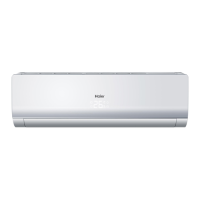
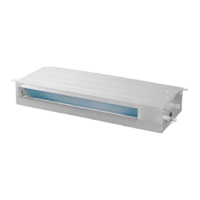
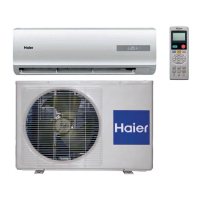
Ductless Split Air Conditioner
Indoor
HSU09VHG(DB)-W
HSU12VHG(DB)-W
HSU18VHH(DB)-W
HSU24VHG(DB)-W
Outdoor
HSU09VHG(DB)-G
HSU12VHG(DB)-G
HSU18VHH(DB)-G
HSU24VHG(DB)-G
Installation Manual
Step 1 - Preparation ...................................................................................................................... 2
Step 2 - Installation of the Indoor Unit ........................................................................................... 3
Step 3 - Installation of the Outdoor Unit ........................................................................................ 4
Step 4 - Interconnecting the Indoor and Outdoor Units ................................................................. 5
Step 5 - Leak Test and Evacuation .................................................................................................. 6
Step 6 - Charging ........................................................................................................................... 7
Section 7 - Explaining Operation to the End User ........................................................................... 8
.................................................................................................. 8
Section 9 - Seacoast Application ................................................................................................... 8
Table of Contents
0010586614

Questions and Answers

  • D
    Deborah RobertsAug 13, 2025
    Why is my Haier Air Conditioner cooling poorly?
    • N
      Nicholas RosarioAug 13, 2025
      Poor cooling in your Haier Air Conditioner can stem from several factors. Check if the air filter is dirty and clean it, ideally every 14 days. Ensure there are no obstructions blocking the inlet and outlet. Verify that the temperature is set correctly. Make sure all doors and windows are closed. Reduce direct sunlight by using curtains. Finally, consider whether there are too many heat sources or people in the room.
  • E
    elizabeth86Aug 17, 2025
    Why does my Haier Novel Air Conditioner not restart immediately?
    • J
      Jerry OdomAug 17, 2025
      If your Haier Air Conditioner doesn't restart immediately after being stopped, it's due to a built-in protection mechanism. The unit is designed to wait for 3 minutes before restarting to protect the system. This also applies if the electric plug is pulled out and reinserted; the protection circuit will activate for 3 minutes.
  • K
    kathryn89Aug 20, 2025
    How to change fan speed in dry mode on Haier Novel Air Conditioner?
    • P
      Paul ZimmermanAug 21, 2025
      In DRY mode, the fan speed of your Haier Air Conditioner cannot be manually adjusted. When the room temperature drops below the set temperature +2°C, the unit will run intermittently at LOW speed, regardless of the fan setting.
  • L
    Louis DoyleAug 25, 2025
    Why is my Haier Novel making noise?
    • T
      Thomas MartinezAug 25, 2025
      The swishing or gurgling noise you hear during or after operating your Haier Air Conditioner is the sound of refrigerant flowing through the system. It’s more noticeable in the first 2-3 minutes after starting the unit. However, a big noise from airflow during operation might indicate that the air filter is too dirty.
  • C
    crystalhuertaAug 28, 2025
    Why is my Haier Inverter cooling poorly?
    • D
      daniel60Aug 28, 2025
      Poor cooling in your Haier Inverter could stem from several factors. Check if the air filter is dirty and clean it every 15 days. Ensure there are no obstructions blocking the inlet and outlet. Verify that the temperature is set correctly and that all doors and windows are closed. Also, consider whether direct sunlight is entering through the window (use curtains) or if there are excessive heat sources or too many people in the room.
  • E
    Erik WhiteSep 1, 2025
    Why does my Haier Inverter make noise?
    • B
      bromeroSep 1, 2025
      The swishing or gurgling noise you hear during or after your Haier Inverter's operation is the sound of refrigerant flowing through the system. The cracking noise during operation is caused by the casing expanding or shrinking due to temperature changes. A big noise from air flow can mean that the air filter is too dirty.
  • S
    Scott ThompsonSep 5, 2025
    Why does my Haier Inverter generate smells?
    • C
      Caleb PatelSep 5, 2025
      The smells from your Haier Inverter are due to the system circulating odors from the interior air, such as those from furniture, paint, or cigarettes.
  • T
    Tracy WaltonSep 8, 2025
    Why can’t I change the fan speed in dry mode on my Haier Inverter?
    • T
      Terrance BakerSep 8, 2025
      When your Haier Inverter is in DRY mode, the fan speed cannot be changed. When the room temperature drops below the set temperature plus 2 degrees Celsius, the unit will run intermittently at LOW speed, regardless of the fan setting.

Overview

This document is an installation manual for Haier Ductless Split Air Conditioners, covering models HSU09VHG(DB)-W, HSU12VHG(DB)-W, HSU18VHH(DB)-W, HSU24VHG(DB)-W (Indoor Units) and HSU09VHG(DB)-G, HSU12VHG(DB)-G, HSU18VHH(DB)-G, HSU24VHG(DB)-G (Outdoor Units).

Function Description:

The Haier Ductless Split Air Conditioner system is designed for residential or light commercial use, providing cooling and heating (for heat pump models) functions. It consists of an indoor unit and an outdoor unit connected by refrigerant piping and electrical wiring. The system utilizes HFC-free R410A refrigerant, which is a safe, non-toxic, and non-flammable refrigerant. The ductless design allows for flexible installation without extensive ductwork, making it suitable for various room configurations.

Important Technical Specifications:

  • Models Covered:
    • Indoor Units: HSU09VHG(DB)-W, HSU12VHG(DB)-W, HSU18VHH(DB)-W, HSU24VHG(DB)-W
    • Outdoor Units: HSU09VHG(DB)-G, HSU12VHG(DB)-G, HSU18VHH(DB)-G, HSU24VHG(DB)-G
  • Operating Range:
    • Cooling: 41~115°F (5~46°C)
    • Heating: 5~75°F (-15~24°C)
  • Power Supply: 208-230V/60Hz/1 Phase for all models.
  • Compressor Type: DC Inverter Driven Rotary.
  • Electrical Data:
    • Maximum Fuse Size A: 15A (09k, 12k), 20A (18k), 25A (24k)
    • Minimum Circuit Amp A: 12A (09k), 14A (12k), 17A (18k), 19A (24k)
  • Refrigerant Line Connections: Flare type.
  • Refrigerant Line Diameters:
    • Liquid Side: 6.35mm (1/4") for 09k, 12k, 18k; 9.52mm (3/8") for 24k.
    • Suction Side: 9.52mm (3/8") for 09k, 12k; 12.7mm (1/2") for 18k; 15.88mm (5/8") for 24k.
  • Factory Charge Refrigerant (R410A):
    • 09k: 35.3 oz
    • 12k: 38.1 oz
    • 18k: 54.7 oz
    • 24k: 74.1 oz
  • Maximum Line Length:
    • 09k, 12k: 50 ft / 15 m
    • 18k, 24k: 83 ft / 25 m
  • Maximum Height:
    • 09k, 12k: 33 ft / 10 m
    • 18k, 24k: 50 ft / 15 m
  • Standard Lineset Length: 25 ft.
  • Refrigerant Charge Adjustment: 0.2 oz/ft for 9K, 12K, 18K models; 0.5 oz/ft for 24K model, if installation length differs from standard.
  • GWP (Global Warming Potential) Value for R410A: 1975.

Usage Features:

  • Flexible Installation: The indoor unit piping can be routed from several directions: Left, Left Rear, Right, Right Rear, or Below, offering adaptability to different room layouts. Knockouts are provided on the case for Left, Right, and Right Below routing options.
  • Remote Control: The system is operated via a remote controller, which is explained to the end-user during the installation process.
  • Quiet Operation: The installation procedure emphasizes selecting a location that minimizes noise and vibration, ensuring a comfortable environment.
  • Condensate Drainage: Proper angling of the piping hole (1/4" lower on the outside) and ensuring a constant downward pitch for the drain line are crucial for correct condensate drainage, preventing water accumulation and potential issues.
  • System Test: After installation, a comprehensive system test is recommended to verify proper operation, including checking for gas leaks, insulation, wiring connections, condensate drainage, ground wire connection, power source voltage, noise levels, lamp lighting, and normal cooling/heating performance, as well as room temperature sensor functionality.

Maintenance Features:

  • Air Filter Cleaning: The manual instructs installers to explain to the end-user how to remove and clean the air filters, which is a key routine maintenance task.
  • Seacoast Application Considerations:
    • For installations within 1/2 mile of saltwater, the outdoor unit should be installed in a place protected from sea breeze, such as near buildings.
    • For installations between 1/2 mile and 5 miles from saltwater, a protection wall is recommended. This wall should be made of solid material (e.g., concrete), 1.5 times larger than the outdoor unit, and maintain at least 28 inches (700mm) clearance for exhausted air ventilation.
    • Regular cleaning of the outdoor unit's heat exchanger is advised to remove sea salt and dust in seacoast applications, preventing corrosion and maintaining efficiency.
  • Leak Test and Evacuation: The installation process includes a detailed leak test using dry nitrogen at 500 PSIG and an evacuation procedure to 350 microns. This ensures the system is free of leaks and non-condensable gases, which is vital for optimal performance and longevity.
  • Refrigerant Charging: The manual provides instructions for adjusting the refrigerant charge based on the actual lineset length, ensuring the system has the correct amount of refrigerant for efficient operation. A refrigerant charge label must be filled out and adhered near the product charging port.

Haier Novel Series Specifications

General IconGeneral
BrandHaier
ModelNovel Series
CategoryAir Conditioner
LanguageEnglish

Related product manuals