EasyManua.ls Logo

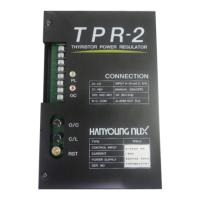
HANYOUNG NUX TPR-2 - User Manual

HANYOUNG NUX TPR-2
2 pages
Print Icon
To Next Page IconTo Next Page
Loading...
110 V AC, 220 V AC, 380 V AC, 440 V AC, 60Hz
(But, 25 A of TPR-2 are only available 110 V and
220 V)
25 A, 35 A, 50 A, 70 A, 100 A, 150 A, 200 A
0 ~ 50 (humidity below 90 %)
Above 100 A protected by high - speed breaking
fuse
Resistive Load
Current Input : 4 ~ 20 mA DC, Voltage
Input : 1 ~ 5 V DC
Contact Input : ON-OFF
Above 97 % of input voltage
Natural Cooling, forced cooling by fan for above
100 A
Above 200 (500 V mega)
Aspect Dimension
[Unit : mm]
Before you use, read safety precautions carefully, and use this product properly.
The precautions described in this manual contain important contents related with
safety; therefore, please follow the instructions accordingly. The precautions are
composed of DANGER, WARNING and CAUTION.
There is a danger of occurring electric shock in the input/output terminals so
please never let your body or conductive substance is touched.
1. If this product is used with the machinery which may be caused human injury
or serious property damage then use it after surely installing the protection
equipment for two or three times.
2. To prevent defection or malfunction of this product, apply a proper power
voltage in accordance with the rating.
3. To prevent electric shock or malfunction of product, do not supply the power
until the wiring is completed.
4. Do not decompose, modify, revise or repair this product. This may be a cause
of malfunction, electric shock or fire.
5. Reassemble this product while the power is OFF. Otherwise, it may be a
cause of malfunction or electric shock.
6. If you use the product with methods other than specified by the manufacturer,
there may be bodily injuries or property damages.
7. There is a possibility of occurring electric shock so please use this product
after installing it onto a panel while it is operating.
1. The place of operating this product affect to the its functions and life cycle so
that avoid to use it in the following circumstance.
A place of having high humidity and not circulating air
A place of piling up dust or impurity or having high ambient temperature or
high vibration
2. The contents of this manual may be changed without prior notification.
3. Before using the product you purchased, make sure that it is exactly what you
ordered.
4. Make sure that there is no damage or abnormality of the product during the
delivery.
5. After turning OFF power sources of all instruments, please wire them.
6. The Thyristor Power Regulator should be installed perpendicularly.
7. Install exhausting fan in internal and upside of the panel.
8. Tighten BOLT of the input and output wire enough.
9. Distribute the load equally.
10. Do not use this product at any place with corrosive (especially noxious gas or
ammonia) or flammable gas.
11. Do not use this product at any place with direct vibration or impact.
12. Do not use this product at any place with liquid, oil, medical substances, dust,
salt or iron contents. (Use at Pollution level 1 or 2)
13. Do not polish this product with substances such as alcohol or benzene. (Use
neutral detergent.)
14. Do not use this product at any place with a large inductive difficulty or
occurring static electricity or magnetic noise.
15. Do not use this product at any place with possible thermal accumulation due
to direct sunlight or heat radiation.
16. Install this product at place under 2,000 m in altitude.
17. When the product gets wet, the inspection is essential because there is
danger of an electric leakage or fire.
18. Do not connect anything to the unused terminals.
19. After checking the polarity of terminal, connect wires at the correct position.
20. For the continuous and safe use of this product, the periodical maintenance is
recommended.
21. Some parts of this product have limited life span, and others are changed by
their usage.
22. The warranty period for this product including parts is one year if this product
is properly used.
How to Operate
When installing the unit, the input and output terminals should be attached in
the direction of facing downward perpendicularly for the natural cooling.
Make sure that install high-speed breaking fuse between terminal R and power
source.
By the internal volume, the output voltage can be limited. (Only if the external
volume is not connected)
When the output voltage limitation setting is externally used, connect the
external volume (B 10
1 W) to VR1, VR2, VR3 terminals. At this time, make
sure that the internal volume should be set at max (INC side).
When using without the external signal (when a temperature controller is not
used), please connect ref terminal and C1 (+) terminal.
Safety information
WARNING
CAUTION
DANGER
Power Supply
Rated Current
Ambient temperature
Protection Circuit
Applied Load
Control Input
Output Voltage
Cooling Method
Insulation
Resistance
Ratings
HEAD OFFICE
1381-3, Juan-Dong, Nam-Gu Incheon, Korea
TEL:(82-32)876-4697 FAX:(82-32)876-4696
MAIN PRODUCTS
- DIGITAL : Temperature Controller, Counter, Timer,Speedmeter,
Tachometer, Panel Meter, Recorder
- SENSOR : Proximity Sensor/Photo Electric Sensor,
Rotary Encoder, Optical Fiber Sensor,
Pressure Sensor
- ANALOG : Timer, Temperature Controller
Thyristor Power Regulator
TPR-2
We appreciate you for purchasing HanYoung NUX Co.,Ltd
product. Before using the product you have purchased,
check to make sure that it is exactly what you ordered. Then,
please use it following the instructions below.
INSTRUCTION MANUAL
Model and Suffix code
Capacity
H
W
D
25 A
35 A, 50 A, 70 A
100 A, 150 A, 200 A
Dimension
130
190
305
86
126
165
63
116
170
MB0101E050907
Single Phase
Phase
Control
110 V
220 V
380 V
440 V
25 A
35 A
50 A
70 A
100 A
150 A
200 A
4 ~ 20 mA
Resistive Load
Model Name
Suffix Code
Description
2
P
TPR-
Phase
Control Method
Power Supply
(AC 60 Hz)
25A of TPR-2 are
only available 110 V
and 220 V.
Rated Current
Input Method
Load Characteristic
110
220
380
440
25
35
50
70
100
150
200
M
R

Question and Answer IconNeed help?

Do you have a question about the HANYOUNG NUX TPR-2 and is the answer not in the manual?

Summary

Safety Information

Model and Suffix Code

Ratings

Aspect Dimension

Wiring Diagram

Internal Structure

How to Operate

Temperature Controller for Current Output

Details how a temperature controller outputs 4-20mA DC based on set values for current control.

Thyristor Power Regulator Operation with 4-20 mA DC Signal

Explains the output power response of the Thyristor Power Regulator to a 4-20mA DC input signal.

Function Explanation

Detecting Over-current Function

Describes the electronic over-current detection circuit that stops the Thyristor's gate signal when over-current flows.

Control Methods of Thyristor Power Regulator

Explains ON-OFF, Continuous, Constant Voltage, and Constant Power control methods for Thyristor power regulators.

Overview

The Hanyoung NUX TPR-2 is a single-phase Thyristor Power Regulator designed for precise control of resistive loads. It offers various control methods and is suitable for applications requiring stable temperature or power regulation, especially in systems with high thermal capacity or slow response times, such as electric furnaces.

Function Description

The TPR-2 incorporates an electronic over-current circuit for safety. In the event of an over-current in the load, this circuit detects the condition and stops the gate signal to the Thyristor control element, effectively turning the Thyristor "OFF." When this occurs, the front over-current indicator (OC) on the regulator illuminates, and an alarm contact can be utilized to signal the condition. The operating time for over-current protection varies with the over-current setting value, with faster response times for higher over-currents. For example, at 200% over-current, the operating time is approximately 0.5 seconds, while at 100% over-current, it is about 1.5 seconds.

The device supports several control methods:

  • ON-OFF Control Method: This method operates by turning the power ON or OFF based on whether the current temperature is above or below a set temperature. It's a simple and economical approach, but it can lead to temperature fluctuations (up and down cycling) around the set point. While narrowing the adjusting sensitivity can reduce these fluctuations, it may introduce output tremble or susceptibility to noise. Conversely, a wider "Dead Band" improves stability but reduces accuracy. This method is applicable when the cycling is within acceptable temperature limits.
  • Continuous Control Method: This method is based on proportional operation, where the power supplied to the heating element is adjusted proportionally to the deviation between the furnace temperature and the set value. Pure proportional (P) control inherently has an unavoidable error due to circuit constants. To achieve more accurate control and faster response times, integral (I) and differential (D) operations are often combined, leading to P.I or P.I.D control.
  • Constant Voltage (Current) Control Method: This method is used for individual or batch control in applications where temperature detection is difficult. It maintains a constant average or effective voltage applied to the furnace, disregarding minor disturbances from the controller. Instead of using a return signal from a temperature controller, the furnace's temperature is detected and used as the signal for the power regulator to achieve constant voltage control. While controlling the effective power is more suitable for heating effects, it typically requires more advanced technology and higher cost. Therefore, for applications not requiring high accuracy, average value control is commonly used.
  • Constant Power Control Method: This method addresses the issue of resistance changes in heating elements like silundum or molybdenum, which can drastically affect their lifetime if overpowered or underpowered. It ensures a constant power output by detecting the effective power (calculated by multiplying apparent power and power factor) or by detecting both effective voltage and effective current. This method is similar to general control but integrates a power detector at the front of the gate control area.

Important Technical Specifications

  • Model Name: TPR-2 (Single Phase)
  • Control Method: P (Proportional Control)
  • Power Supply (AC 60 Hz): Available in 110 V, 220 V, 380 V, and 440 V AC. (Note: 25 A models are only available for 110 V and 220 V).
  • Rated Current: Available in 25 A, 35 A, 50 A, 70 A, 100 A, 150 A, and 200 A.
  • Load Characteristic: R (Resistive Load)
  • Input Method: M (4~20 mA DC)
  • Ambient Temperature: 0 ~ 50 °C (humidity below 90%)
  • Protection Circuit: Models above 100 A are protected by a high-speed breaking fuse.
  • Applied Load: Resistive Load
  • Control Input:
    • Current Input: 4 ~ 20 mA DC
    • Voltage Input: 1 ~ 5 V DC
    • Contact Input: ON-OFF
  • Output Voltage: Above 97% of input voltage.
  • Cooling Method: Natural Cooling for models up to 100 A. Forced cooling by fan for models above 100 A.
  • Insulation Resistance: Above 200 MΩ (500 V mega).
  • Dimensions (W x H x D):
    • 25 A: 86 x 130 x 63 mm
    • 35 A, 50 A, 70 A: 126 x 190 x 116 mm
    • 100 A, 150 A, 200 A: 165 x 305 x 170 mm

Usage Features

  • Installation: The unit should be installed perpendicularly with input and output terminals facing downward to facilitate natural cooling.
  • Safety: A high-speed breaking fuse must be installed between terminal R and the power source.
  • Output Voltage Limitation: The output voltage can be limited using the internal volume (if no external volume is connected). If an external volume (B 10 kΩ 1 W) is used for limitation, it should be connected to VR1, VR2, VR3 terminals, and the internal volume must be set to maximum (INC side).
  • Operation without Temperature Controller: If used without an external signal (e.g., without a temperature controller), connect the "ref" terminal and C1 (+) terminal.
  • Wiring: All wiring should be completed after turning OFF power sources of all instruments. Input and output wires must be tightened sufficiently.
  • Load Distribution: Loads should be distributed equally.
  • Environmental Considerations: Avoid installation in areas with high humidity, poor air circulation, excessive dust, high ambient temperature, strong vibration, corrosive or flammable gases, direct impact, liquids, oils, medical substances, salt, iron contents (Pollution level 1 or 2), large inductive difficulty, static electricity, magnetic noise, direct sunlight, or heat radiation. The product should be installed at altitudes under 2,000 m.
  • Terminal Polarity: Always check terminal polarity and connect wires to the correct positions.
  • Temperature Controller Integration: The TPR-2 can be integrated with a temperature controller that outputs a 4-20 mA DC signal. For example, if a temperature controller for 400 °C is set to 300 °C, it will output 20 mA DC up to 280 °C, 12 mA DC at 300 °C, and 4 mA DC beyond 320 °C. The TPR-2 will then output power proportionally: 4 mA (0% power), 8 mA (25%), 12 mA (50%), 16 mA (75%), and 20 mA (100%).

Maintenance Features

  • Periodical Maintenance: For continuous and safe use, periodical maintenance is recommended.
  • Limited Lifespan: Some parts of the product have a limited lifespan, and others may change due to usage.
  • Warranty: The warranty period for this product, including parts, is one year if the product is used properly.
  • Troubleshooting: If the product gets wet, inspection is essential due to the danger of electric leakage or fire.
  • No Unused Terminal Connections: Do not connect anything to unused terminals.

HANYOUNG NUX TPR-2 Specifications

General IconGeneral
BrandHANYOUNG NUX
ModelTPR-2
CategoryController
LanguageEnglish

Related product manuals