1.19SPARK PLUGS
INSPECTION
Disconnecting spark plug cable with engine running can
result in electric shock and death or serious injury.
(00464b)
1. After the engine has cooled to room temperature, discon-
nect cables from both spark plugs.
2. Remove spark plugs. If a plug has eroded electrodes,
heavy deposits or a cracked insulator, discard it.
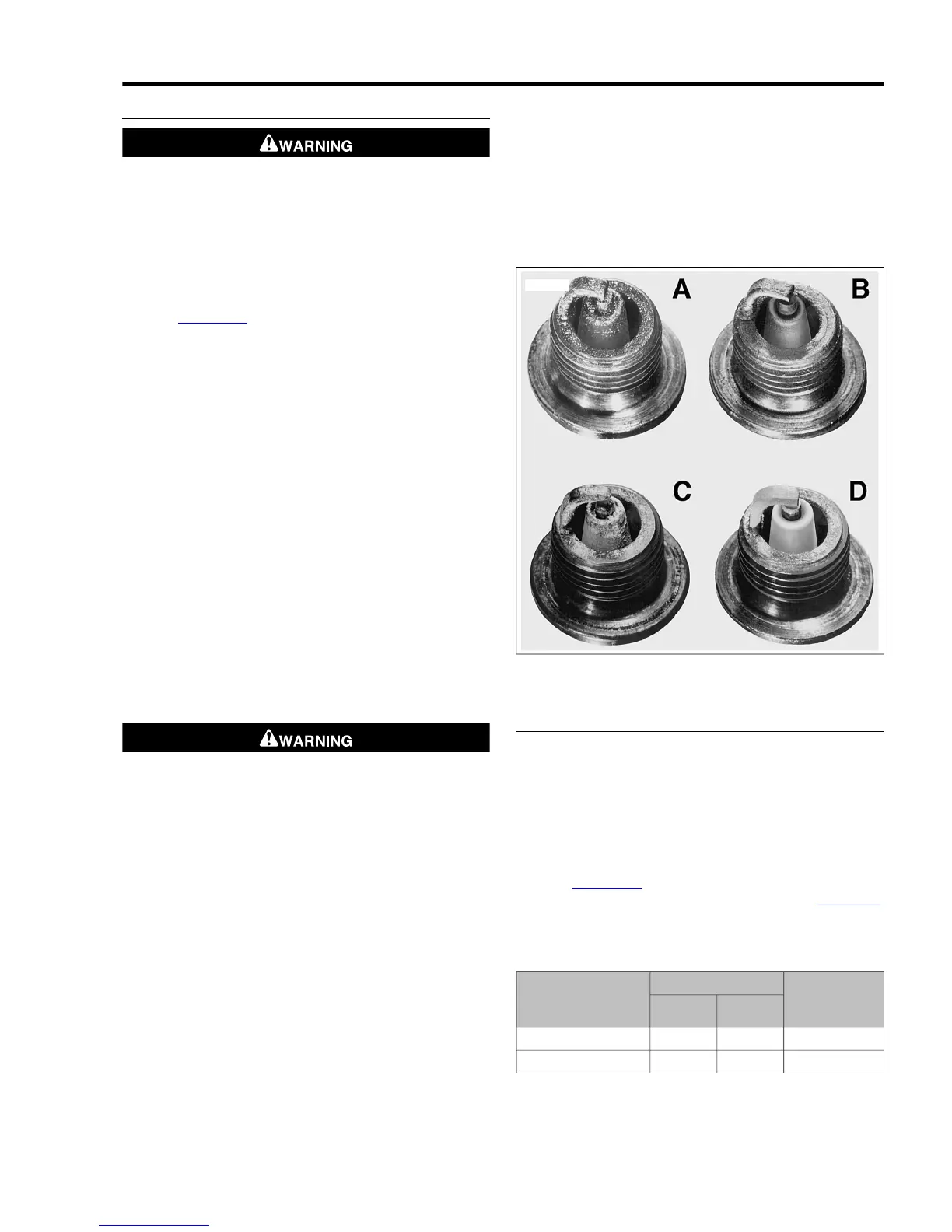
3. See Figure 1-43. Compare your observations of the plug
deposits with the descriptions provided below.
a. A wet, black and shiny deposit on plug base, elec-
trodes and ceramic insulator tip indicates an oil fouled
plug. The condition may be caused by one or more
of the following: worn pistons, worn piston rings, worn
valves, worn valve guides, worn valve seals, a weak
battery or a faulty ignition system.
b. A dry, fluffy or sooty black deposit indicates an air-
fuel mixture that is too rich.
c. A light brown, glassy deposit indicates an overheated
plug. This condition may be accompanied by cracks
in the insulator or by erosion of the electrodes and is
caused by an air-fuel mixture that is too lean, a hot-
running engine, valves not seating or improper ignition
timing. The glassy deposit on the spark plug is a
conductor when hot and may cause high-speed mis-
firing. A plug with eroded electrodes, heavy deposits
or a cracked insulator must be replaced.
d. A plug with a white, yellow, tan or rusty brown
powdery deposit indicates balanced combustion.
Clean off spark plug deposits at regular intervals.
Compressed air can pierce the skin and flying debris from
compressed air could cause serious eye injury. Wear
safety glasses when working with compressed air. Never
use your hand to check for air leaks or to determine air
flow rates. (00061a)
4. If the plugs require cleaning between tune-ups, proceed
as follows:
a. Degrease firing end of spark plug using ELECTRICAL
CONTACT CLEANER. Dry plug with compressed air.
b. Use a thin file to flatten spark plug electrodes. A spark
plug with sharp edges on its electrodes requires 25-
40% less firing voltage than one with rounded edges.
c. If the plugs cannot be cleaned, replace with new
spark plugs.
5. Check electrode gap with a wire-type feeler gauge. Bend
the outside of the electrode so only a slight drag on the
gauge is felt when passing it between electrodes. Proper
gap measurement is 0.038-0.043 in. (0.97-1.09 mm).
6. Check condition of threads on cylinder head and plug. If
necessary to remove deposits, apply penetrating oil and
clean out with a thread chaser.
7. Apply LOCTITE ANTI-SEIZE to the spark plug threads.
Install and tighten to 12-18 ft-lbs (16.3-24.4 Nm).
8. Connect spark plug cables. Rear cylinder plug cable
attaches to top coil terminal.Verify that cables are securely
connected to coil and spark plugs.
Figure 1-43.Typical Spark Plug Deposits
SPARK PLUG CABLE INSPECTION
1. Inspect spark plug cables. Replace cables that are worn
or damaged.
a. Check for cracks or loose terminals.
b. Check for loose fit on ignition coil and spark plugs.
2. Check cable boots/caps for cracks or tears. Replace
boots/caps that are worn or damaged.
3. See Figure 1-44. Check spark plug cable resistance with
an ohmmeter. Compare values from test with Table 1-15.
Replace cables not meeting resistance specifications.
Table 1-15. Spark Plug Cable Resistance Values: Dyna
RESISTANCE
VALUE
(OHMS)
LENGTHDESCRIPTION
mmIn.
4750-12,67548319.00Front cable
1813-48331847.25Rear cable
2008 Dyna Service: Maintenance 1-39


 To Next Page
 Loading...