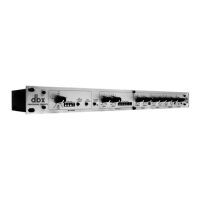
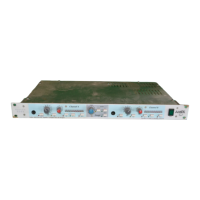
The System 9098 Dual Microphone Amplifier (DMA) is a high-quality audio device designed by Rupert Neve, offering two identical signal paths that can be used independently or as a stereo pair. It is particularly well-suited for use with stereo microphones or a "stereo" pair of microphones, featuring central WIDTH and M-S controls to enhance and manipulate the stereo image.
Function Description:
The DMA serves as a microphone preamplifier, boosting low-level microphone signals to line level for further processing or recording. Its dual-channel design allows for simultaneous amplification of two microphones. A key feature is its M-S (Mid-Side) matrixing capabilities, enabling the conversion of M-S microphone signals to conventional Left-Right (L-R) format for processing, and then back to M-S or outputting as L-R. This flexibility is crucial for stereo recording techniques and post-production manipulation of the stereo field. The device also includes essential features like phantom power, phase inversion, and a high-pass filter.
Important Technical Specifications:
- Gain: The DMA offers a switched gain control ranging from 0-66dB in 6dB steps. A variable trim control provides an additional +/-6dB fine adjustment, extending the overall gain range from -6dB to +72dB.
- Output Levels: Capable of high output levels exceeding +25dBu.
- DI Input: When the DI switch is engaged, the input impedance is greater than 100kOhm, suitable for instruments like guitars and synthesizers. In DI mode, the gain control is restricted to a maximum of +30dB.
- Phantom Power (48V): Provided for capacitor microphones, applied only to the rear panel mic input XLR. The DI jack socket is not affected.
- Phase Invert: A button for easy correction of phase anomalies.
- High Pass Filter: Attenuates signals below 120Hz at 18dB/Octave.
- Meter: An eight-segment lightmeter indicates output level. The top segment, marked O/L, indicates peak signal level activity, with a factory preset threshold of +22dBu (adjustable via internal jumpers).
- Noise (200R source, RMS rectifier, 22Hz - 22kHz filter):
- Equivalent input noise (66dB gain): -128dBu
- Output noise floor (0dB gain): -100dBu
- Frequency Response (150R source, open circuit load):
- 0dB Gain: 20Hz - 20kHz (-0.1dB), <10Hz and >110kHz (-1.5dB)
- 66dB Gain: 20Hz (-1.2dB), 20kHz (-0.5dB), 10Hz and >65kHz (-3dB)
- THD + Noise (66dB gain, +15dBu into 10k load):
- 0dB gain / 66dB gain: 20Hz (<0.01% / <0.03%), 10kHz (<0.005% / <0.04%)
- Crosstalk (CH A to CH B, CH A set to 0dB gain, +20dBu drive): Better than 100dB at 20Hz, 1kHz, and 20kHz.
- Audio Connections: Two identical sets of 3-pin XLR connectors per channel (female for inputs, male for outputs). All connectors follow the European wiring convention (Pin 1 = Screen, Pin 2 = Hot (+), Pin 3 = Cold (-)). Inputs are electronically balanced using Rupert's "TLA" transformer-like-amplifier design. Outputs are transformer balanced, coupled using Rupert Neve's "tertiary feedback" output stage design.
- Mechanical: 19" 1U rack unit (482 x 44.5mm), Depth including connectors 330mm, Weight 3.94kg.
- Power Consumption: 15W (typical).
- Voltage Operation: Selectable 115V/230V.
Usage Features:
- Stereo Image Manipulation: The WIDTH control allows modification of the stereo image when using stereo signals. Turning it clockwise merges signals into mono, while anti-clockwise widens the stereo image by manipulating the "difference" component.
- M-S Operation: The device facilitates M-S recording techniques. M-S signals can be derived acoustically using specific microphone types (e.g., a cardioid for the Mid signal and a figure-of-eight for the Side signal). The DMA's M-S matrix allows for decoding these signals into L-R format for processing or output, and encoding L-R signals back into M-S.
- Mono Compatibility: M-S audio offers advantages for mono compatibility, as the mono signal is always available without issues. The S signal can be reduced to increase mono compatibility.
- Robustness: M-S signals are less susceptible to disturbing image movement caused by gain or phase shifts between channels compared to L-R pairs.
- Rack Mounting: Designed for rack mounting, with supplied screws and washers to protect the facia panel. Additional rack-mount side supports are recommended for stability, especially in mobile or high-vibration environments.
Maintenance Features:
- Fuse Replacement: The unit uses 20mm anti-surge, IEC type fuses (200mA T for 230V, 400mA T for 115V). Instructions are provided for safe replacement.
- Cleaning: The product should be cleaned with a soft brush around controls. For dirty facia, a damp cloth with a little household soap can be used. Solvent cleaners should be avoided as they can permanently damage the facia and invalidate the warranty.
- Internal Jumpers: Jumpers are present for O/L indicator threshold adjustment and future limiter insert development (though the limiter is not currently an option).
- Trimmers: Trimmers are provided for optimizing Mid Band and HF common mode rejection ratio (CMRR). These are factory calibrated and should not be adjusted without special test equipment.
- Servicing: All maintenance and service should be carried out by AMEK or its authorized agents to avoid invalidating the warranty.

 Need help?


 To Next Page
 General