www.SteamPoweredRadio.Com
1.1.
Introduction
This Technical Manual provides informa-
tion necessary to install, operate, maintain,
and service the
HT
250FM,
HT
500FM,
or
HT lFMBROAOCAST TRANSMITI'ERS.
Sections
in
this
Technical
Manual
contain
the following information:
SECTION
I,
GENERAL DESCRIP-
TION, provides a description
of
equipment features, identifies major
components and lists operating pa-
rameters and specifications.
SECTION II, INSTALLATION, pro-
vides unpacking, inspection and in-
stallation information, preoperational
checks, and power-on checks to en-
sure correct operation.
SECTION
III, OPERATION, identi-
fies controls and indicators and pro-
vides equipment and operational pro-
cedures.
SECTION
IV,
PRINCIPLES
OF
OP-
ERATION, provides a functional de-
scription and detailed diagrams with
theory
of
operation.
SECTION
V,
MAINTENANCE, pro-
vides preventive and corrective main-
tenance information and trouble-
shooting with instructions for equip-
ment servicing.
SECTION VI, PARTS LIST, pro-
vides information for ordering re-
placement components and assem-
blies.
SECTION VII, DIAGRAMS, pro-
vides block, logic, schematic dia-
grams, and other drawings required
for operation and maintenance.
1.2. Equipment Purpose
The
HT
lFM
FM
BROADCAST
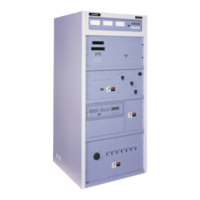
TRANSMITTER (refer to Figure 1-1) is a
1000-watt
FM
Transmitter (HT 250FM is a
250-watt
FM
Transmitter and
HT
500FM is
a 500-watt
FM
Transmitter) designed for
continuous broadcast operation in the 87.5
to 108
MHz
Commercial FM Broadcast
Band.
1.3.
Physical
Description
The entire unit, including the
FM
Exciter,
IPA, PA, associated power supplies, meter-
ing, and control circuitry is contained in one
cabinet. All required metering is provided
by a meter located
on
the front panel
of
the
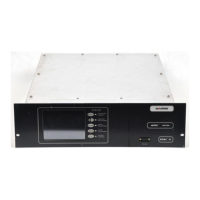
transmitter controller plus two meters lo-
cated
on
the from face
of
the FNi Exciter.
Circuit breakers are accessible on the front
panel
of
the individual transmitter sub-
assemblies.
SECTION I
DESCRIPTION
1.4. Functional Description
Refer to Figure 1-2 for a block diagram
of
the system.
1.4.1. FM Exciter
The
FM
Exciter produces a frequency
modulated output continuously variable
from 3 to
55 watts into a 50-ohm load for
any channel assignment within the 87.5 to
108 MHz Commercial
FM Broadcast Band.
Servicing is simplified as the
FM
Exciter is
modular in concept. The metering panel
contains a true peak-reading audio meter
with a times
10
expansion range and a mul-
timeter which monitors important
rf
and
control voltages.
Light
emitting diode
(LED) status indicators monitor critical
functions on the exciter. The exciter accepts
wideband composite stereo/mono inputs
and has separate inputs for up to two SCA
generators.
1.4.2. RF Circuits
The entire
rf
chain in the
FM
Transmitter
utilizes 50-ohm interfaces as follows:
a.
50 ohms Exciter to Splitter.
b. 50 ohms splitter to 500W
PA.
c.
50
ohms 500W PA to Combiner.
d.
50 ohms Combiner to Antenna Load.
The convenience
of
50-ohm interface al-
lows patching around any stage during an
emergency fault condition. For example,
should the final
PA
stage fail, the
FM
Ex-
citer can be patched directly into the an-
tenna, resulting in good local coverage. All
that is required is the disconnection
of
the
input line from the
PA
and the reconnection
to
the input
of
the Lowpass Filter.
1.4.3. Splitter (HT
lFM
ONLY)
The output
of
the Exciter is routed through
a two way power Splitter on the rear panel
of
the Controller. This provides equal
rf
drive for the two
SOOW
PAs.
1.4.4. 500 Watt Power Amplifier
The final amplifier stage is a conserva-
tively rated 500 Watt amplifier consisting
of
eight power MOSFET transistors operat-
ing in two push-pull parallel pairs. The am-
plifier
incorporates a controller which
protects itself from operational faults and
abuse. Sensors detect over temperature,
high VSWR, overdrive and over voltage
conditions and disable the module until the
condition is corrected. The internal power
supply provides a regulated 50 VDC at up
to25
A.
888-2312-001
1.4.5. 250 Watt Power Amplifier
The 250 Watt Power Amplifier is identical
to the 500 Watt PA but uses
half
the number
of
transistors in the amplifier module. All
other circuitry is the same.
1.4
.
6.
Lowpass Filter
The
FM
Transmitter incorporates a fixed
tuned multi-element lowpass filter to pre-
vent the emission
of
harmonic and spurious
energy. This filter covers
theentireFMband
and requires
no
field or factory tuning for
any operating frequency, 87 .5 to 108 MHz.
1.4.
7.
Directional Coupler
A dual element Directional coupler is used
for
monitoring
of
forward and reverse
power and to provide inputs for the auto-
matic power control and VSWR foldback
circuitry.
1.4.8. Controller
The
Controller provides the following
functions:
a.
Transmitter On/Off.
b. Raise/Lower Power.
c. Automatic VSWR Foldback.
d. Automatic Power Control.
e. AC Restart.
f.
Remote Control Interface.
g. Overload Detection, Protection, and
Display.
1.4.9. Multimeter
Metering
of
the essential operating pa-
rameters
of
the
FM
Transmitter is accom-
plished with a multimeter located
on
the
CONTROLLER front panel. A pushbutton
selector switch, mounted next to the Mul-
timeter selects the following:
a.
PAE
(PA Drain voltage) 0-60 volts
b. PA I (PA Drain current) 0-30 A, 0-60 A
for
HT
lFM
c.
FWDPWR(ForwardPower)0-125%of
TPOWatts
d.
SWR to 2.2: 1
e.
APC voltage 0-125%
f.
BAT TEST 0-30V
The PA Voltage reading is
the
drain
volt-
age on the final amplifier.
In
the case
of
the
HT
lFM,
the average voltage
of
the two
amplifiers is displayed.
The
PA
Current reading is the drain cur-
rent
of
the final amplifier. In the case
of
the
HT
lFM, the sum
of
the currents for both
amplifiers is displayed.
FORWARD Power is a true indication
of
power being supplied to the antenna sys-
tem. The Output Power sample is taken
from the Directional Coupler which is the
1-1
WARNING: Disconnect primary power
prior
to
servicing.


 To Next Page
 Loading...