Need help?
Do you have a question about the Hasler IM-350 and is the answer not in the manual?
Outlines the content and structure of the user manual, detailing each section.
Covers essential safety precautions for power connection, environment, and general operation.
Provides step-by-step instructions on safely disconnecting the mailing system.
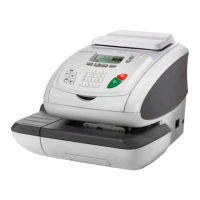
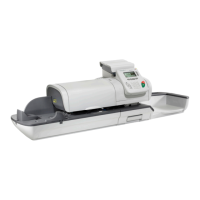
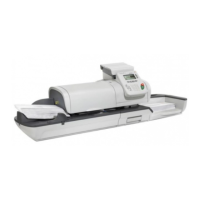
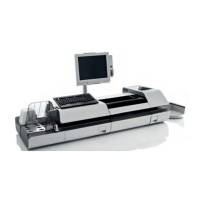
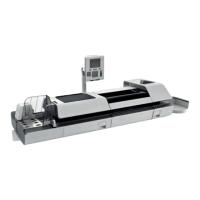
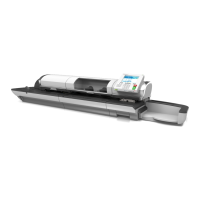
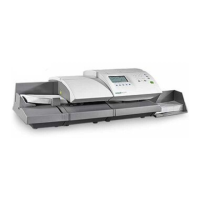
Details the physical components and their functions within the mailing system.
Describes optional accessories like report printers and barcode scanners.
Explains the display areas, keys, and shortcut functions on the control panel.
Illustrates and details the various connection ports for modems, printers, and PCs.
Covers system power management, including Sleep and OFF modes, and Energy Star compliance.
Guides users on selecting and customizing stamp types for different mailing needs.
Details mail preparation, sorting, and the process of starting a work session.
Explains how to apply standard postage and perform re-dating operations on mail.
Instructs on how to print dates or 'Received' marks on incoming mail.
Describes processing mail for sealing or counting purposes without printing postage.
Covers detailed settings for accounts, rates, weighing, dates, text, and imprint offsets.
Details advanced operations like emergency stops and batch counter management.
Explains the Postage Security Device (PSD) and its role in managing funds.
Guides on checking available funds and adding new postage funds to the system.
Details the process for manually connecting to postal services for security regulation.
Introduces postage tracking by account and access control features for security.
Explains the different 'Account Modes' and their functional access control.
Provides guidance on setting up the 'No Account' mode for system access.
Details how to display and change the selected 'Account Mode' on the system.
Covers the essential tasks of creating, editing, activating, and deleting accounts.
Provides a comprehensive list of available reports for system usage and data.
Explains the procedure for generating and displaying various reports as user or supervisor.
Details the Batch Data Report for outgoing mail counters and postage spent.
Covers Daily and Monthly Usage Reports for tracking mail volume and postage costs.
Explains the Funds Summary Report for tracking fund usage since system installation.
Details reports related to account data, including lists and expenditures.
Describes the Machine Configuration Report, showing all supervisor settings.
Outlines the features and benefits of using online services for updates and reporting.
Explains automatic and manual connection procedures to online services servers.
Details how to upload statistical report data to the online services server.
Describes system services like ink management, rate protection, and account upgrades.
Covers eConfirmation services for tracking parcels and managing delivery status.
Differentiates between user settings and supervisor settings for system configuration.
Explains the procedure for logging into and out of supervisor mode for system configuration.
Guides on changing the current display language and setting the default language.
Details how to enable or disable system beeps for keys, warnings, and errors.
Explains how to adjust the display contrast for different working environments.
Covers system time-outs for start, stop, sleep, and Smart Start functionality.
Describes setting up warnings for high postage values and low funds, plus funding PIN codes.
Covers settings for default weighing type, zeroing, taring, and GEO codes.
Explains setting default stamp elements like rate, text, ad die, date advance, and offset.
Details how to create, edit, modify, and delete imprint memories for stamp types.
Guides on setting up postal/online service connections via LAN or analog modem.
Explains Daylight Savings Time transitions and how to check/adjust machine time and date.
Explains how to access the menu for updating system options and software.
Describes how to read and delete messages received through the mailbox.
Guides on displaying the list of available options and loading new ones.
Details how to manage custom text messages for the stamp imprint.
Explains how to manage ad dies, including displaying, modifying, and downloading them.
Covers checking and downloading new postal rate tables to calculate postage accurately.
Provides instructions on how to download and update the mailing system's software.
Covers checking ink levels, aligning print heads, cleaning, and changing the ink cartridge.
Details the process of adding water to the moistener unit for envelope sealing.
Explains how to clean the mail path, including moistener brushes and sponges.
Describes maintenance processes like installation, base/PSD swaps, and registration updates.
Provides instructions on how to clear mail jams from the system's base.
Offers solutions for issues where the weighing device is not functioning correctly.
Explains how to access diagnostic data, system software, hardware, events, and counters.
Details the dimensions, weight, and thickness specifications for envelopes and mail pieces.
Outlines the recommended temperature, humidity, and weighing accuracy conditions.
Provides general specifications including dimensions, weight, and power requirements.
Lists operating specifications for envelope sizes, weights, and account limits.
 General
| Type | Digital Mailing System |
|---|---|
| Model | IM-350 |
| Manufacturer | Hasler |
| Max Envelope Size | 229 x 324 mm (C4) |
| Min Envelope Size | 110 x 220 mm (DL) |
| Sealing Capability | Automatic |
| Print Technology | Inkjet |
| Power Supply | 50/60 Hz |


 To Next Page