4
GENERAL
The information contained in this manual has been prepared to assist in the proper
installation, operation and maintenance of the air conditioning system. Improper
installation, or installation not made in accordance with these instructions, can result
in unsatisfactory operation and/or dangerous conditions, and can cause the related
warranty not to apply.
Read this manual and any instructions packaged with separate equipment required
to make up the system prior to installation. Retain this manual for future reference.
To achieve optimum efficiency and capacity, the indoor cooling coils listed in the
condensing unit specification sheet should be used.
IMPORTANT: We recommend replacement of any HVAC equipment that has been
subjected to flooding in order to avoid any risk of injury or harm.
IMPORTANT: Use all available safety precautions during the installation and servic-
ing of any HVAC equipment.
APPLICATION
Before installing any air conditioning equipment, a duct analysis of the structure and
a heat gain calculation must be made. A heat gain calculation begins by measuring
all external surfaces and openings that gain heat from the surrounding air and
quantifying that heat gain. A heat gain calculation also calculates the extra heat
load caused by sunlight and by humidity removal.
There are several factors that the installers must consider:
• Outdoor unit location • Proper equipment evacuation
• System refrigerant charge • Indoor unit airflow
• Indoor unit blower speed • Supply and return air duct design and sizing
• System air balancing • Diffuser and return air grille location and sizing
LOCATING UNIT
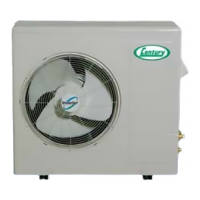
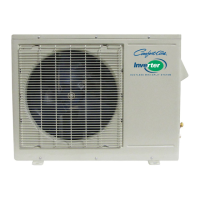
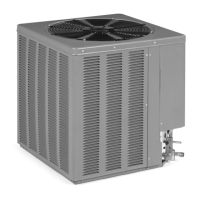
CONDENSER LOCATION
Consult local and national building codes and ordinances for special installation
requirements. Following location information will provide longer life and simplified
servicing of the outdoor condenser.
NOTE: These units must be installed outdoors. No ductwork can be attached, or
other modifications made, to the discharge grille. Modifications will affect perfor-
mance or operation.
OPERATIONAL ISSUES
• IMPORTANT: Locate the condenser in a manner that will not prevent, impair or
compromise the performance of other equipment horizontally installed in prox-
imity to the unit. Maintain all required minimum distances to gas and electric
meters, dryer vents, exhaust and inlet openings. In the absence of National
Codes, or manaufacturers’ recommendations, local code recommendations
and requirements will take presidence.
• Refrigerant piping and wiring should be properly sized and kept as short as
possible to avoid capacity losses and increased operating costs.
• Locate the condenser where water run off will not create a problem with the
equipment. Position the unit away from the drip edge of the roof whenever pos-
sible. Units are weatherized, but can be affected by water pouring into the unit
from the junction of rooflines, without protective guttering.
!
WARNING
THE MANUFACTURER’S WAR-
RANTY DOES NOT COVER ANY
DAMAGE OR DEFECT TO THE
AIR CONDITIONER CAUSED BY
THE ATTACHMENT OR USE OF
ANY COMPONENTS. ACCES-
SORIES OR DEVICES (OTHER
THAN THOSE AUTHORIZED BY
THE MANUFACTURER) INTO,
ONTO OR IN CONJUNCTION
WITH THE AIR CONDITIONER.
YOU SHOULD BE AWARE THAT
THE USE OF UNAUTHORIZED
COMPONENTS, ACCESSORIES
OR DEVICES MAY ADVERSELY
AFFECT THE OPERATION
OF THE AIR CONDITIONER AND
MAY ALSO ENDANGER LIFE
AND PROPERTY. THE MANUFAC-
TURER DISCLAIMS ANY
RESPONSIBILITY FOR SUCH
LOSS OR INJURY RESULTING
FROM THE USE OF SUCH
UNAUTHORIZED COMPONENTS,
ACCESSORIES OR DEVICES.
MATCH ALL COMPONENTS:
• OUTDOOR UNIT
• INDOOR COIL/METERING DEVICE
• INDOOR AIR HANDLER/FURNACE
• REFRIGERANT LINES



 To Next Page