Need help?
Do you have a question about the Heatit Z-TRM3 and is the answer not in the manual?
Notes on sensor mode changes and initial adaptation period for the thermostat.
Instructions for connecting electrical wires to the thermostat terminals.
Guidance on positioning, fastening, and attaching the front cover.
Steps to add or remove the thermostat from a Z-Wave home automation system.
Details on protocol, power, sensors, temperature, IP code, and certifications.
The Heatit Z-TRM3 is an advanced electronic thermostat designed for precise control of electrical floor heating systems. It is engineered for seamless integration into standard flush boxes, offering a discreet and modern aesthetic. At its core, the Z-TRM3 incorporates a Z-Wave chip, enabling it to communicate wirelessly with various Home Automation systems. This connectivity transforms a conventional thermostat into a smart device, allowing users to manage their heating remotely and integrate it into broader smart home scenarios.
The primary function of the Heatit Z-TRM3 is to regulate electrical floor heating, maintaining a desired temperature within a room or specific area. It achieves this through a single-pole switch mechanism, capable of handling a substantial load of up to 16A or 3600W at 230V. This robust capacity makes it suitable for a wide range of heating installations.
Beyond electrical floor heating, the Z-TRM3 offers versatility by supporting water-based heating systems when linked with the Heatit Z-Water. This expands its application possibilities, making it a flexible solution for different heating setups.
The thermostat is equipped with sensor inputs to accurately measure temperature. It supports NTC type floor sensors (10, 12, 15, 22, 33, or 47kΩ, with 10kΩ being the default) and external sensors of the same NTC types. This allows for precise temperature monitoring, whether directly from the floor or from a remote location.
A notable feature is the room sensor compensation process. When the sensor mode is set to A (internal sensor) or AF (internal and floor sensor), the thermostat initiates a compensation process that limits the maximum power output to 75%. This intelligent adaptation helps the thermostat learn and optimize its performance within its environment over a few days, ensuring efficient and stable heating. During this initial adaptation period, it is recommended to avoid internal sensor calibration to allow the system to self-optimize.
The Z-TRM3 also includes power metering capabilities. To utilize this feature, the heating load must be connected to both the "Heating L" and "Heating N" terminals, allowing the thermostat to accurately monitor energy consumption.
The Heatit Z-TRM3 is designed for user-friendly operation and integration into smart home ecosystems.
Installation: The installation process is straightforward, requiring the removal of the front cover by gently pushing release springs. Wires are connected to clearly labeled terminals, accommodating 1.5mm² or 2.5mm² cables depending on the load. Once wired, the thermostat is secured into a standard wall mounting box using screws, followed by reattaching the frame and front cover until it snaps firmly into place. This modular design ensures a secure fit and a clean finish.
Z-Wave Connectivity: As a Z-Wave Plus device, the Z-TRM3 offers enhanced range, battery life, and bandwidth compared to earlier Z-Wave versions. It supports SmartStart for easier inclusion into Z-Wave networks and S2 Security for improved data encryption and protection.
Adding/Removing to a Z-Wave Network: The process for including or excluding the thermostat from a Z-Wave network is intuitive. Users press the Center button for 10 seconds until "OFF" appears on the display. Then, pressing the Right button five times navigates to "Con." The home automation software is then initiated for add/remove device mode. Finally, pressing the Center button for approximately 2 seconds puts the thermostat into adding/removing mode, indicated by rotating LED segments on the display. Confirmation messages like "Inc" (included) or "EcL" (excluded) appear, and the device is ready for use with default settings.
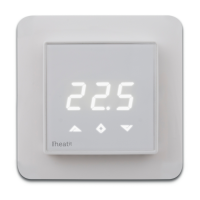
Display and Controls: The thermostat features a clear display that shows temperature readings and menu options. The physical buttons (Left, Center, Right) provide direct control for adjusting settings, navigating menus, and initiating Z-Wave inclusion/exclusion. The intuitive interface allows users to easily set desired temperatures, change modes, and access various functions without needing complex instructions.
System 55 Frame Compatibility: The Z-TRM3 is designed to fit into System 55 frames, a common standard for electrical installations. This ensures aesthetic consistency with other switches and outlets in a room, providing a cohesive look.
Remote Control and Automation: Through its Z-Wave integration, the thermostat can be controlled remotely via a smartphone app or a central home automation hub. This allows users to adjust heating schedules, change temperature settings, and monitor energy consumption from anywhere, enhancing convenience and energy efficiency. It can also be integrated into automated scenes, such as turning off heating when no one is home or adjusting it based on external weather conditions.
The Heatit Z-TRM3 is designed for minimal maintenance, focusing on reliability and long-term performance.
Self-Optimization: The room sensor compensation process, which limits power output to 75% during initial adaptation, is a key self-maintenance feature. It allows the thermostat to automatically adjust to its environment, optimizing heating performance and efficiency without requiring manual calibration during the first few days of operation.
Robust Design: The thermostat is built to withstand typical operating conditions, with an IP21 rating, indicating protection against solid objects over 12.5mm and vertically falling water drops. This contributes to its durability and reduces the need for frequent servicing.
Firmware Updates: While not explicitly detailed as a user-accessible feature, Z-Wave devices often support over-the-air (OTA) firmware updates. This capability allows for future enhancements, bug fixes, and compatibility improvements, ensuring the thermostat remains up-to-date and performs optimally throughout its lifespan. Such updates typically require interaction with the Z-Wave gateway.
Diagnostic Indicators: The display provides visual feedback during operation, such as rotating LED segments during add/remove mode and confirmation messages. These indicators help users understand the device's status and troubleshoot minor issues without needing specialized tools.
In summary, the Heatit Z-TRM3 is a sophisticated and user-friendly thermostat that combines robust heating control with advanced smart home connectivity. Its design emphasizes ease of installation, intuitive operation, and intelligent self-optimization, making it an excellent choice for modern electrical floor heating systems.
 General
| Frequency | 868.4 MHz |
|---|---|
| Interface | Z-Wave |
| Product color | Black |
| Memory function | - |
| Smart thermostat | Yes |
| Units of measurement | °C |
| Suitable for wet areas | No |
| International Protection (IP) code | IP21 |
| Sustainability certificates | CE, RoHS |
| Power source | AC |
| AC input voltage | 230 V |
| AC input frequency | 50 - 60 Hz |

 To Next Page