Need help?
Do you have a question about the HEINE mini 3000 and is the answer not in the manual?
Instructions for detaching and reattaching the contact plate, including the small plate.
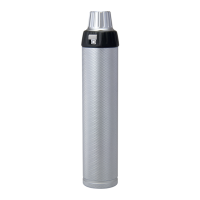
Guidance on cleaning the battery handle with a damp cloth and appropriate detergents.
Information that the LED light source cannot be changed by the user.
Manufacturer's declaration regarding RF and harmonic emissions and voltage fluctuations.
Manufacturer's declaration on immunity to electrostatic discharge, transients, surges, and magnetic fields.
Recommended separation distances for portable and mobile RF communication equipment.
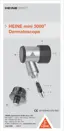
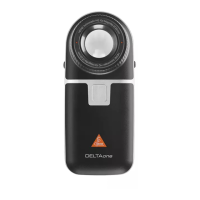
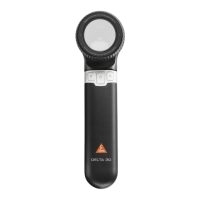
The HEINE mini 3000® LED Dermatoscope is an epiluminescence microscope designed for non-invasive visual examination of intact skin (dermatoscopy) by medical professionals. It is a precise optical instrument that should be handled with care and cleaned at regular intervals.
The dermatoscope utilizes an LED light source for illumination and provides approximately 10x magnification (depending on distance) for detailed skin examination. It features a focusing ring (3) to adjust the image clarity and can be used with either a standard contact plate (1a) or a small contact plate (1b) for examining inaccessible lesions. The device is powered by two AA/LR6 alkaline batteries or one HEINE mini 2Z rechargeable battery.
To set up the device, the instrument thread (8) is screwed onto the handle head (5). Batteries are inserted by unscrewing the end cap (7) and placing two AA/LR6 alkaline cells with the plus contact facing the handle head. The device is switched on by sliding the switch (6) down to position "1" and off by sliding it up to "0" or clipping it over a coat pocket. Upon activation, the brightness softly increases to 100% and then adjusts based on the battery charge. A significant drop in brightness or flashing indicates the need for battery replacement.
For operation, the affected skin should be moistened with HEINE dermatoscopy oil or a comparable substance. The device is placed gently over the lesion with the contact plate (1a) centered. The examiner's eyes should be close to the ocular (2), and the focusing ring (3) is adjusted with a free hand to obtain a clear image. The focusing ring's adjustment can be controlled using the scale on top of the dermatoscope.
The contact plate (1a) is attached by a bayonet fitting and can be removed by rotating the knurled ring counter-clockwise. The small contact plate (1b) is a push-fit and can be used for inaccessible lesions; it is removed by holding the knurled housing and pulling off without twisting. When replacing, ensure the light-port (4) faces the bulb/LED.
The device does not require any regular maintenance. The LED light source is integrated and cannot be changed. Repairs should only be performed by qualified personnel, and the device should not be opened or modified.
The contact plate (1a) can be removed and sterilized or disinfected using routine methods such as disinfectant solution, washing, boiling, or autoclaving (up to 134°C for 5min). Sterilization should be reserved for risk patients as it reduces durability. The small contact plate (1b) and the dermatoscope can be cleaned by wiping with a damp cloth soaked in alkaline or pH-neutral cleaning agents. For disinfection of the outer surface of the instrument, wipe disinfection with medical device-approved detergents is recommended. The battery handle can be cleaned with a damp cloth (e.g., alkaline or pH-neutral detergent), and wipe disinfection with medical device-approved detergents is recommended for its outer surface. Disinfection by spraying or immersion, as well as sterilization, is not allowed for the instrument itself as it will cause damage.
The product must be recycled as separated electrical and electronic devices, observing relevant state-specific disposal regulations.
 General
| Brand | HEINE |
|---|---|
| Model | mini 3000 |
| Category | Medical Equipment |
| Language | English |


 To Next Page