Page 9For technical questions, please call 1-888-866-5797.Item 57735
Note: The most common error when waxing/
polishing a vehicle is applying too much wax. If the
Pad becomes saturated with wax, applying wax
will be more difficult and will take longer. Applying
too much wax may also reduce the life of the Pad.
If the Pad continually comes off the Backing Pad
during use, too much wax may have been applied.
11. After the wax has been applied to the
vehicle’s surface, turn off the tool.
12. Remove the Pad from Backing Pad. Using
the Pad, apply wax to any hard-to-reach
areas of the vehicle such as around lights,
door handles, under bumpers, etc.
13. Allow sufficient time for the wax to dry.
14. Place a clean Buffing Pad securely
onto the Backing Pad.
15. Start the tool and begin buffing off the dried wax.
16. When as much wax as possible has
been removed with the tool, turn off the
tool. Remove the tool’s Battery Pack.
17. Remove the Pad from Backing Pad. Using
the Polishing Pad, remove the wax from
all hard-to-reach areas of the vehicle.
18. Clean, then store the tool indoors
out of children’s reach.
SANDING INSTRUCTIONS
TO PREVENT SERIOUS INJURY: Grip
the tool firmly in both hands.
1. Wipe the work surface clean of all dirt and debris,
especially that of previous
coarser sanding sessions, which will scratch
the surface of a finer grit sanding session.
2. Attach the desired twist and lock Sanding Disc
(sold separately) onto the Backing Pad.
3. Make sure that the Trigger is in the off
position, then connect the battery pack.
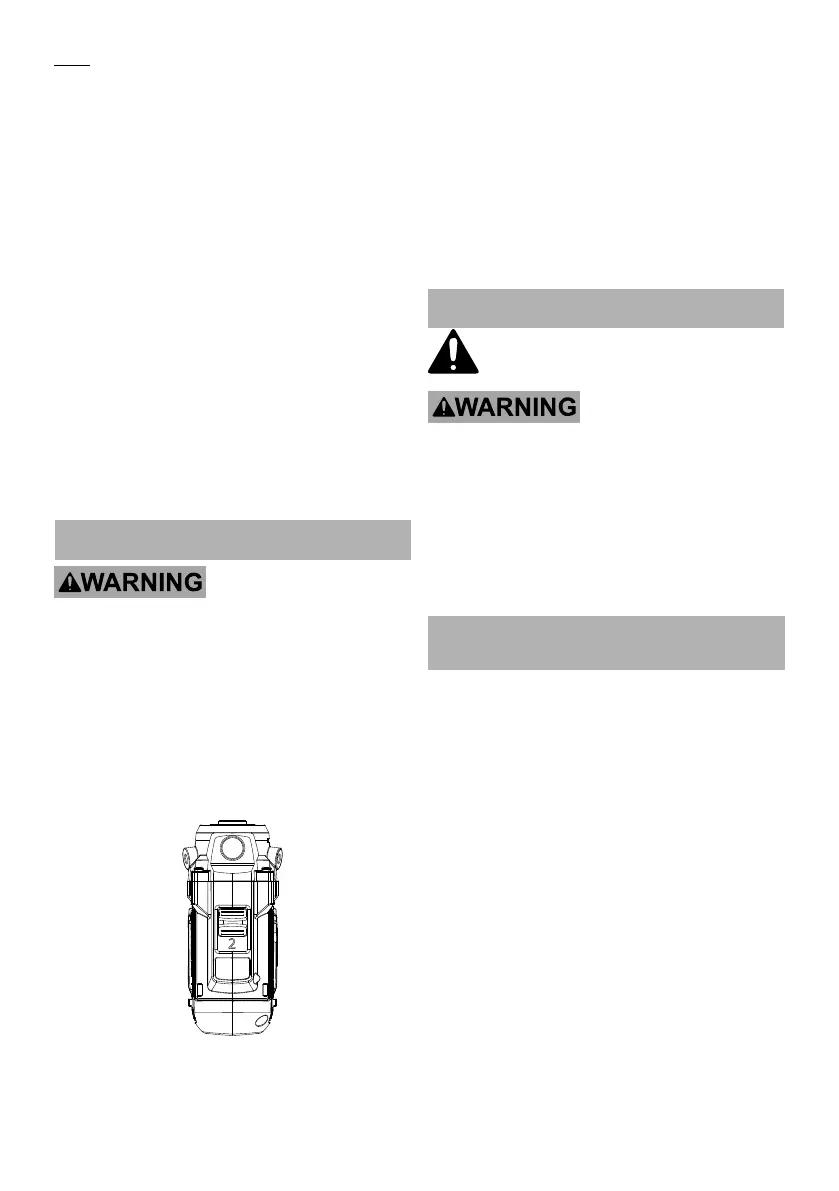
4. Set Speed Switch to 2.
5. Press the Trigger to start the tool.
6. Wait until the tool has reached full speed,
then gently contact the surface.
7. Keep heavy pressure off of the tool when operating.
Allow the tool to do the work.
8. Move the tool in a uniform pattern up and down or
side to side while sanding to ensure even sanding.
9. Periodically, stop the tool and check for disc wear.
Replace worn sanding discs as needed.
10. TO PREVENT ACCIDENTS, AFTER USE:
Turn off the tool.
WARNING! TO PREVENT SERIOUS INJURY:
Allow the tool to come to a complete stop before
setting it down.
Remove the tool’s Battery Pack. Clean, then
store the tool indoors out of children’s reach.
MAINTENANCE AND SERVICING
Procedures not specifically explained
in this manual must be performed
only by a qualified technician.
TO PREVENT SERIOUS INJURY FROM
ACCIDENTAL OPERATION:
Make sure that the Trigger is in the off
position and remove its Battery Pack before
performing any procedure in this section.
TO PREVENT SERIOUS INJURY
FROM TOOL FAILURE:
Do not use damaged equipment.
If abnormal noise or vibration occurs, have
the problem corrected before further use.
Cleaning, Maintenance,
and Lubrication
1. BEFORE EACH USE, inspect the general
condition of the tool. Check for:
• leaking, swollen, or cracked battery pack,
• loose hardware,
• misalignment or binding of moving parts,
• cracked or broken parts, and
• any other condition that may
affect its safe operation.
2. AFTER USE, wipe external surfaces
of the tool with clean cloth.
3. Li-Ion BATTERY MUST BE RECYCLED OR
DISPOSED OF PROPERLY.
Do not short, incinerate or open battery.
4. Periodically, wear ANSI-approved safety goggles
and NIOSH-approved breathing protection
and blow dust and grit out of the motor
vents using dry compressed air.
5. Disconnect battery pack and store battery pack,
charger, and tool in dry, indoor area out of
reach of children and away from metal objects
(i.e., paperclips, coins) to prevent shorting.



 To Next Page