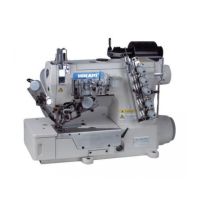
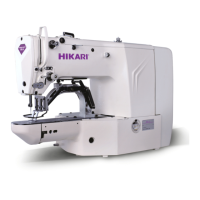
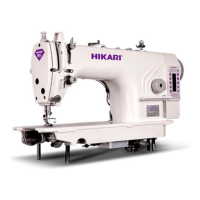
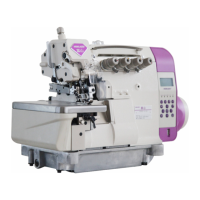
The H93S is an industrial sewing machine designed for various sewing applications, with specific models tailored for different material weights and sewing speeds.
Function Description
The H93S is an industrial sewing machine used for stitching various materials. It features automatic thread trimming, and some models include automatic backstitch and automatic thread clamping functionalities. The machine is designed for efficient and precise sewing operations, with adjustable settings for stitch length, presser foot pressure, and thread tension. It also incorporates safety features and maintenance guidelines to ensure reliable operation and longevity.
Important Technical Specifications
The H93S series offers several models with varying specifications:
-
H93SF-7D (General fabrics, light-weight materials):
- Max. Sewing speed: 5000 rpm
- Max. Stitch length: 5 mm
- Needle: DB×1 #9~#11
- Presser foot lift: 10 mm (standard), 13 mm (Max.)
- Lubricating oil: White oil 10
-
H93S-7D (Medium-weight materials):
- Max. Sewing speed: 5000 rpm
- Max. Stitch length: 5 mm
- Needle: DB×1 #11~#18
- Presser foot lift: 10 mm (standard), 13 mm (Max.)
- Lubricating oil: White oil 10
-
H93SH-7C (Heavy-weight materials):
- Max. Sewing speed: 4500 rpm
- Max. Stitch length: 7 mm
- Needle: DB×1 #19~#22
- Presser foot lift: 10 mm (standard), 13 mm (Max.)
- Lubricating oil: White oil 10
The model designation includes features like:
- Normal presser foot lifting or Auto presser foot lifting (AK).
- Auto trimmer (1), Auto trimmer + Auto backstitch (2), or Auto trimmer + Auto backstitch + Auto thread clamp (5).
- Knife types: Circle knife (C), Plane knife (P), or Double knife (D).
- Rotary hook types: Imports or Homemade.
- Lubrication system: Complete dry type (D), Needle pole have oil and rotary hook contain oil (S), Needle pole have not oil and rotary hook contain oil (N), or Lubricating oil pump.
- Table types: General table-board or Stainless steel table-board (B).
The machine weighs over 48 kg, requiring two or more people for installation.
Usage Features
The H93S sewing machine offers several features for enhanced usability and control:
- Knee Lifter Adjustment: The standard height of the presser foot lifted using the knee lifter is 10 mm, adjustable up to 13 mm. Users must ensure the needle bar does not hit the presser foot when adjusted to higher lifts.
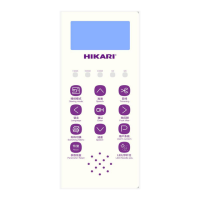
- Stitch Length Adjustment: Stitch length can be adjusted electronically via the control box.
- Presser Foot Pressure Adjustment: The pressure of the presser foot can be adjusted to suit different materials and sewing requirements.
- Presser Bar Height Adjustment: The height and angle of the presser bar can be adjusted by loosening a setscrew.
- Thread Tension Adjustment:
- Needle Thread Tension: Adjusted by turning thread tension nuts. Clockwise rotation shortens the thread remaining on the needle after trimming and increases tension; counter-clockwise rotation lengthens the thread and decreases tension.
- Bobbin Thread Tension: Adjusted by turning a tension adjust screw. Clockwise rotation increases tension; counter-clockwise rotation decreases tension.
- Thread Take-up Spring Adjustment: The stroke and pressure of the thread take-up spring can be adjusted to optimize thread handling.
- Needle-to-Hook Relationship: Critical for stitch quality, the relationship between the needle and the hook can be adjusted by setting the needle bar height and the hook's installation position. A clearance of 0.04 mm to 0.1 mm between the hook blade point and the needle is recommended to prevent damage or skipped stitches.
- Feed Dog Height and Tilt Adjustment:
- Height: The feed dog height can be adjusted by loosening a screw on the crank and moving the feed bar up or down.
- Tilt: The feed dog tilt can be adjusted to prevent puckering or uneven material feed. Tilting the front up prevents puckering, while tilting the front down reduces material skew.
- Feed Timing Adjustment: The feed timing can be advanced to prevent uneven material feed or delayed to increase stitch tightness. This is done by adjusting the feed eccentric cam.
- Pedal Operation: The pedal operates in four stages:
- Lightly depressing the front part for low sewing speed.
- Further depressing the front part for high sewing speed (or automatic reverse feed stitching followed by high speed).
- Returning the pedal to its original position to stop the machine (with the needle up or down).
- Fully depressing the back part for thread trimming.
- For models with an auto-lifter, an additional step lifts the presser foot before thread trimming.
- One-Touch Reverse Feed Stitching: A switch lever allows for immediate reverse feed stitching when pressed, and normal feed stitching resumes when released.
- Thread Trimmer Mechanism: The position of the trimmer cam and the upper and lower knives can be adjusted to ensure precise thread cutting. The gap between the cam and rolling wheel should be 0.6-0.8 mm (or 0.5 mm for the right side). The upper knife blade should be 2 mm higher than the lower knife blade.
- Tool Carrier Adjustment for Shears Length: The length of the thread head after trimming can be adjusted to less than 3 mm by rotating an eccentric pin.
Maintenance Features
Proper maintenance is crucial for the H93S sewing machine's performance and longevity:
- Safety Precautions: Always turn off the power switch and disconnect the power cord before performing any maintenance, adjustments, or cleaning to prevent accidents. Wait at least 5 minutes after turning off the power before opening the control box to avoid high voltage areas.
- Installation: Machine installation should only be carried out by a qualified technician. Ensure casters on work tables are secured to prevent movement.
- Lubrication:
- Oil Pan: Pour specified white oil 10 into the oil pan until the buoy height is between the high and low indicator lines. Refill when the buoy height drops below the low indicator line.
- Oil Splashes: After lubrication, operate the machine to ensure oil splashes are visible through the oil sight window, indicating adequate lubrication. The amount of splashing oil is not related to the amount of lubricating oil.
- Break-in Period: When first operating a new machine or one that has been disused for a long time, run it at 1,500 to 2,500 rpm for about 10 minutes for break-in.
- Grease Application: Use HIKARI-specified greases (103.20-108). Remove screws or rubber stoppers, add grease to holes or lubrication grooves until slightly overflowing, then tighten screws. Turn the hand wheel to distribute the grease evenly and wipe off excess.
- Cleaning: Turn off the power before cleaning. Use both hands when tilting the machine head back or returning it to its original position to prevent injury.
- Protective Gear: Wear protective goggles and gloves when handling lubricating oil and grease to prevent eye or skin irritation. Do not ingest oil or grease.
- Professional Maintenance: Maintenance and inspection should only be carried out by trained technicians. Electrical system maintenance should be performed by a qualified electrician.
- Replacement Parts: Use only proper replacement parts specified by HIKARI. Unauthorized modifications will void the warranty.
- Warning Labels: Adhere to all instructions on warning labels. If labels are removed or unreadable, contact your HIKARI dealer for replacements.
- Troubleshooting: If the machine malfunctions, makes abnormal noises, or emits unusual smells, immediately turn off the power and contact a HIKARI dealer or qualified technician.
- Feed Dog Maintenance: After adjusting the feed dog, reconfirm its height. Be careful not to move the feed eccentric cam too far, as this can cause needle breakage.

 Need help?
 General

 To Next Page