
 Need help?
Do you have a question about the Hill-Rom Resident and is the answer not in the manual?
Explains the operation of the bed controls, including pendant and siderail panels.
Details how to operate the head section, knee section, hilow, and automatic contour features.
Outlines the steps for cleaning the Resident® LTC Bed, including materials and areas to focus on.
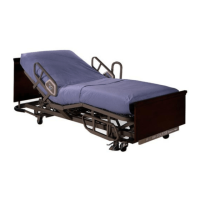
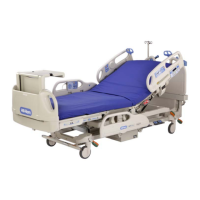
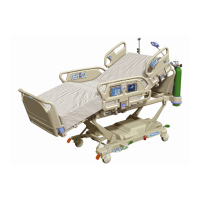
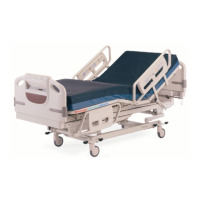
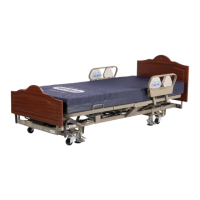
The Resident® LTC Bed, manufactured by Hill-Rom, Inc., is a long-term care bed designed to offer a unique combination of function, aesthetics, durability, and value. It aims to enhance the relationship between the patient and the long-term care facility by providing a comfortable work height for caregivers and easy access for the patient. This user manual, Product No. P870, provides detailed information for the normal operation, safety, and maintenance of the bed.
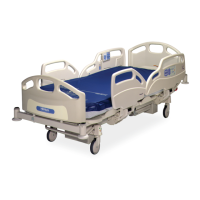
The Resident® LTC Bed is an electrically operated bed with three adjustable sections: head, knee, and foot. These sections can be articulated separately to provide personalized comfort for the patient. The bed features an automatic contour function, which automatically lifts the knee section to approximately 15° as the head section is elevated from a flat position. This contouring can be temporarily disabled if needed. The bed's height (hilow) can also be adjusted to an applicable sleep height or an entry/exit height, facilitating patient transfers and caregiver tasks.
The bed is designed for patients who are 54" (137 cm) to 74" (188 cm) tall and whose width is no more than 36" (91 cm). The safe working load (SWL) of the bed is 400 lb (181 kg), which includes the patient's weight, mattress, IV pumps, poles, bags, and other accessories.
The Resident® LTC Bed offers easy-to-see and use operation controls, which can be accessed via an optional pendant control or optional control panels located on the two head-end siderails. The pendant control provides electrical control over the head, knee, and hilow elevation. The siderail control panels, which may vary in appearance but operate similarly, also allow electrical control of the head and knee sections and hilow elevation. These panels can be installed on either the inside (for patient use) or the outside (for caregiver use) of the bed.
A foot-end lockout panel is included, allowing specific bed functions (head up/down, knee up/down, automatic contour, and bed hilow) to be locked out. An indicator light on the lockout control shows when a function is locked.
The bed is equipped with 3" (8 cm) casters, with stationary casters at the foot section and swivel casters at the head section. Floor brakes are provided on the two sides of the swivel caster frame assembly at the foot end of the bed. Some models have individually operated brakes that require separate pressing and releasing of pedals. It is crucial to set the brakes when the bed is occupied or during patient transfers to prevent injury or equipment damage.
Siderails are present on both sides of the head and foot sections of the bed. These siderails operate independently and can be raised to a latched position or stowed safely below the sleep surface frame when not in use. Siderails serve as a reminder of the bed's edges and are not intended as patient-restraining devices.
Other features include a wall bumper, a head angle indicator (either a mechanical mechanism showing the angle from 0° to 70° or decals with marks for 15° increments up to 60°), and four IV rod sockets, one at each outside corner of the bed. A mattress stop is installed on the foot end of the spring frame to keep the mattress in position.
The bed offers sleep surface frame options, including a spring fabric frame (36" x 80" / 91 cm x 203 cm with 90 helical springs) and a hard pan sleep deck frame (36" x 80" / 91 cm x 203 cm). Headboards and footboards, available in Century- or Hearthside-style with laminate options, can be easily removed and installed by lifting or aligning mount plates with the IV rod sockets. Drainage bag hooks are located on each side of the bed below the sleep surface frame near the seat section.
Optional accessories include half-length head-end rails, an assist bar, headboard extender and bracket kits, a trapeze support bracket with roller bumpers, a fracture frame adapter, an ISS transfer pole, an infusion support system offset bar, a telescopic IV pole, a trend adapter, mattress retainers, and a 12" (30 cm) bed extender. Mattress options include the PRIMA® Prevention Mattress Series and PRIME-AIRE® Therapy Surface, with recommended dimensions of 36" to 37" (91 cm to 94 cm) width and 5" to 6" (13 cm to 15 cm) thickness.
An optional battery backup (auxiliary power supply) allows bed operation during a power failure. A fully charged battery can provide up to 15 full cycles of hilow and head section operation and charges through a 120 V AC, 60 Hz outlet in 24 hours.
Regular cleaning and disinfection of the Resident® LTC Bed are recommended between patient use and during extended patient stays, following facility policies and the guidelines provided in the manual. Before cleaning, the bed must be unplugged from its power source, and if equipped with battery backup, lockouts should be activated to prevent accidental operation. The bed should not be exposed to excessive moisture, steam cleaned, or power washed, as this can damage the mattress and electrical components. Harsh or abrasive cleansers, solvents, or scouring pads should not be used.
For cleaning, a soft cloth soaked in warm water and a facility-approved general cleaning soap/detergent solution is recommended. A soft brush can be used for resistant soil. Special attention should be given to high-touch areas such as the headboard, footboard, siderails (including releases, pendants, and patient controls), latch areas, latch pins, bed frame, casters, and other bed components. If the mattress is turned for cleaning, care must be taken to prevent cleaning solution from pooling or flowing into air outlets and zipper closures. The mattress should be inspected for holes, tears, or deterioration, and replaced if damaged.
For disinfection, all surfaces should be wiped down with a facility-approved disinfectant, used according to the manufacturer's instructions. High-touch areas like siderails, pendants, patient controls, and headboards require particular attention.
Wood headboards and footboards, prepared with a resin-based sealer for resistance to abrasion, stains, fluids, and fire, should be cleaned with a soft cloth dampened with a suitable solution, followed by a dry cloth. Diluted ammonia, detergent, and bleach solutions can be used. Caution is advised against using high concentrations of disinfectant cleaners, which can soften painted or sealed surfaces. Any liquid spills on wooden surfaces should be immediately wiped up to prevent damage. Applying a liquid furniture polish can provide surface protection.
Only authorized persons should service the bed, and only Hill-Rom® parts and accessories should be used for replacement. Modifications to the bed without Hill-Rom's authorization are not permitted. For service calls, the serial number from the product identification label on the bed frame should be provided to Hill-Rom for quicker assistance.
 General
| Category | Medical Equipment |
|---|---|
| Manufacturer | Hill-Rom |
| Model | Resident |
| Adjustable Height | Yes |
| Wheels | Yes |
| Power Options | Electric |
| Side Rails | Yes |


 To Next Page