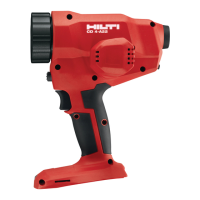
The Hilti CD 4-A22 is a cordless dispenser designed for professional use, specifically for emptying Hilti foil packs and cartridges. This tool is intended to be operated, serviced, and maintained only by trained and authorized personnel who are fully informed about potential hazards. It is crucial to read the operating instructions thoroughly before initial operation to ensure safe and trouble-free handling. The manual emphasizes the importance of observing all safety instructions and warnings provided in the documentation and on the product itself. These instructions should always be kept with the product and transferred to any new users.
The CD 4-A22 is versatile, capable of processing Hilti 300 ml or 600 ml foil packs and 300 ml or 310 ml cartridges. It can be operated with either a cartridge holder set, which includes a piston rod for processing Hilti cartridges, or an aluminum tube set, also with an included piston rod, for processing Hilti foil packs. For optimal performance and safety, the dispenser must only be used with Hilti Li-ion batteries from the B22 series and charged with Hilti battery chargers from the C4/36 series.
Usage Features:
The dispenser is equipped with several features to enhance usability and control. It has a speed control wheel that allows the user to vary the output speed of the compound, providing greater precision for different applications. An LED light is integrated to illuminate the working area, ensuring clear visibility during operation. The battery charge-status and fault indicator on the Li-ion battery provides real-time feedback on the battery's condition. This status can be checked by pressing one of the two battery release buttons. A full charge is indicated by four illuminated LEDs, while fewer LEDs or flashing lights indicate lower charge levels or potential malfunctions such as overheating or complete discharge.
For ease of handling and transport, the CD 4-A22 includes a scaffold hook, which can be installed as an accessory. The tool also features an ergonomic grip, designed for comfortable and secure handling. The piston-rod release button is a key component for inserting and removing cartridges or foil packs, allowing the piston rod to be pulled back or pushed forward manually.
Preassembly and Cartridge Insertion:
Before use, the appropriate setup for either cartridges or foil packs must be assembled. For cartridges, the short piston rod is guided into the power tool with the toothing at the bottom, and an ergonomic grip is fixed in place with a screw. The cartridge holder is then screwed onto the connecting sleeve. When using an aluminum tube for foil packs, the long piston rod is used, and it's essential to ensure the piston attachment for foil packs is mounted. If using the aluminum tube for cartridges, the foil pack piston attachment must be removed to prevent damage to the cartridge.
Inserting a cartridge involves pressing the release button, pulling the piston rod back, opening the cartridge with a cutter knife, and mounting the included nozzle. The cartridge is then inserted with its base facing the piston, tilted downward until locked, and the piston rod is manually pushed forward to ensure it's well-seated. For foil packs, the process is similar: press the release button, pull the piston rod back, unscrew the front panel, open and insert the foil pack, mount the cover with the nozzle, and screw the front panel back on. It is recommended to push the piston rod forward until resistance is felt, ensuring it rests on the cartridge for quick application.
Operation and Safety:
Operating the dispenser involves pressing the switch to press out the compound. The speed can be adjusted using the speed control wheel. Throughout operation, users must comply with all safety instructions, especially regarding chemical hazards. Before using any product, the safety data sheet, packaging instructions, and foil pack instructions must be read and followed. Personal protective equipment, including eye protection, is mandatory, and the work area must be clean and well-lit. The tool should never be pointed at oneself or others.
Maintenance Features:
Regular care and maintenance are crucial for the safe and reliable operation of the CD 4-A22. Before any maintenance tasks, the battery must always be removed to prevent accidental starting. The tool should be kept clean by carefully removing stubborn dirt and cleaning air vents with a dry brush. The casing can be wiped with a slightly damp cloth, but cleaning agents containing silicone should be avoided as they can damage plastic parts.
Li-ion batteries also require care; they should be kept free from oil and grease, cleaned with a slightly damp cloth (avoiding silicone-based agents), and protected from moisture. All visible parts and controls should be checked regularly for damage and proper function. If any damage or malfunction is found, the tool must not be operated and should be repaired immediately by Hilti Service. After cleaning and maintenance, all guards and protective devices must be refitted and checked for correct function. Only genuine Hilti spare parts and consumables should be used to ensure safe and reliable operation.
Transport and Storage:
For transport, batteries must always be removed from the product and never transported in bulk (loose, unprotected). The tool and batteries should be checked for damage after long periods of transport. Storage also requires the batteries to be removed. The tool and batteries should be stored in a cool, dry place, away from direct sunlight, heating units, or windows. They should be kept out of reach of children and unauthorized persons. As with transport, the tool and batteries should be checked for damage before use after extended storage periods. If a battery becomes too hot to touch, it may be defective and should be placed in a non-flammable location, away from flammable materials, to cool down under observation, and Hilti Service should be contacted.


 To Next Page
 General