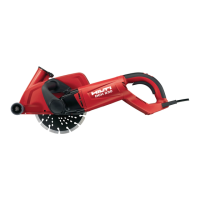
The Hilti DCH 300 and DCH 300-X are electric cutters designed for professional use, primarily for cutting mineral materials with diamond cutting discs. The DCH 300-X model offers the additional capability of cutting with or without water, providing versatility for various applications. These tools are intended for operation, servicing, and maintenance exclusively by trained and authorized personnel who are aware of potential hazards.
Function Description
The core function of the DCH 300 and DCH 300-X is to perform precise cuts in mineral materials using diamond cutting discs. The DCH 300-X can also be used with synthetic resin-bonded abrasive cutting discs for metal-cutting without water, requiring special accessories like an 80 mm diameter flange assembly. The product is designed for push mode operation, where the cutting disc rotates in a counter-clockwise direction.
Key electronic features enhance the tool's performance and safety:
- Starting Current Limitation: The electronic starting current limiter reduces the initial current drawn by the power tool, preventing mains fuse blowing and ensuring a smooth start without a jolt.
- Restart Interlock: This safety feature prevents the diamond cutter from restarting automatically after an interruption in the electric supply. The on/off switch must be released and then pressed again after approximately 1 second to resume operation.
- Electronic Overload Protection: The cutter is equipped with a system that monitors current input. If the motor draws too much current, for example, due to excessive pressure from the user, the system will switch the power tool off. To restart, the on/off switch must be released and pressed again. Users are encouraged to work continuously without activating this automatic cut-out by applying moderate pressure.
- Service Indicator: A visual LED service indicator provides information about the tool's status. A red light indicates that the service interval has been reached, and servicing is due. The tool can still be used for several hours before an automatic cut-out is activated, allowing time to arrange for service. A blinking red light signifies a defect, requiring the product to be repaired by Hilti Service.
For dry-cutting mineral materials, a dust removal system with an appropriate filter, such as the Hilti VC 300–17 X universal industrial vacuum cleaner, is mandatory. An anti-static suction hose should be used with the vacuum cleaner to prevent electrostatic effects.
Usage Features
Operating the DCH 300 and DCH 300-X requires adherence to specific procedures to ensure safety and optimal performance.
- Power Supply: The tool must be connected to a power source providing voltage and frequency in compliance with the type identification plate. When using a generator or transformer, its power output must be at least twice the tool's rated input power, and the voltage must remain within +5% and -15% of the rated voltage. The power source should also have automatic voltage regulation and starting boost. It is crucial not to operate other power tools or appliances simultaneously from the same generator or transformer to avoid voltage fluctuations that could damage the cutter.
- Extension Cords: Only approved extension cords with adequate cross-section should be used to prevent performance issues and overheating. Regular checks for damage and prompt replacement of damaged cords are essential. For outdoor work, only approved and marked outdoor extension cords should be used.
- PRCD (Portable Residual Current Device) Check (DCH 300-X): Before use, the PRCD must be checked. After plugging in the tool and pressing the ON button, the indicator should show. Pressing the Test button should cause the indicator to go out. If it does not go out, the tool should not be used and must be repaired by a qualified specialist.
- Cutting Disc Installation: Proper selection and installation of cutting discs are critical. Users must observe instructions regarding suitable cutting discs and their dimensions. The clamping flange and clamping nut must be clean. The reversible flange should be fitted correctly onto the arbor, ensuring it centers the cutting disc. The arbor lock button is used to secure the disc during tightening with a wrench. After tightening, the arbor lock button should disengage, and the arbor should be free to rotate.
- Cutting Disc Removal: Before removing the disc, the supply cord must be unplugged. If a depth gauge is fitted, it must be removed first. The spindle lock button should only be pressed when the spindle has stopped rotating to prevent damage. The clamping nut is loosened with a hex key, and the clamping nut, clamping flange, cutting disc, and reversible flange are removed in sequence.
- Depth Gauge (Optional): The depth gauge, available as an accessory, allows for setting the desired maximum cutting depth using its scale. It also enhances dust removal performance. It should not be fitted when working on metal due to the risk of damage from flying sparks.
- Guard Adjustment: The guard can be adjusted to the desired position by slackening the clamping screw with a hex key, rotating the guard, and then tightening the screw.
- Water Supply Connection (DCH 300-X): For wet cutting, a water hose is connected to the water supply connector. The maximum permissible water supply pressure is 3 bar. Hoses should be regularly checked for damage. The water regulator valve controls the water flow rate.
- Switching On/Off: To switch on, plug in the supply cord, press the ON button on the PRCD (for DCH 300-X), hold the tool firmly with both hands, press the switch-on safety lock to unlock the on/off switch, then press the on/off switch. The cutting disc will begin to rotate. Release the safety lock and reposition the thumb firmly around the rear grip. To switch off, release the on/off switch; the motor will stop, and the safety lock will re-activate.
- Working Safely: Avoid bringing the cutting disc into contact with the working surface in the indicated area to prevent kickback. Always bring the guide wheels into contact with the working surface/workpiece before starting the cut. Allow the tool to reach full speed before cutting. Apply moderate pressure, adjusting the rate of advance to suit the material. If cutting progress decreases, the diamond segments may be blunt and can be resharpened by making cuts in an abrasive material. Guide the tool smoothly without applying lateral pressure. If the diamond disc overheats (indicated by a trail of sparks), stop cutting and cool the disc by running the tool under no load. Use a suitable vacuum cleaner with an antistatic suction hose to minimize dust and help cool the disc.
Maintenance Features
Regular care and maintenance are crucial for the longevity and safe operation of the DCH 300 and DCH 300-X.
- Safety First: Always unplug the supply cord before performing any care or maintenance tasks to prevent electric shock and burns.
- Cleaning: Keep the product, especially grip surfaces, clean and free from oil and grease. Do not use silicone-containing cleaning agents. Never operate the tool with blocked air vents; clean them carefully with a dry brush. Avoid using sprayers, steam pressure cleaning equipment, or running water, as this can compromise electrical safety. Prevent foreign matter from penetrating inside the product. Clean the exterior with a slightly damp cloth at regular intervals.
- Dust Accumulation: Under extreme conditions, conductive dust can accumulate inside the tool when used on metal, potentially impairing protective insulation. In such cases, use a stationary dust extraction system if possible and clean the air vents frequently. For the DCH 300, connect a portable residual current device (PRCD) between the power tool and the power source in these situations.
- Inspections: Regularly check all external parts and accessories for signs of damage and ensure controls function correctly. Do not use the tool if parts are damaged or controls are faulty; have it repaired by Hilti Service.
- Electrical Repairs: Repairs to the electrical section of the tool should only be carried out by trained electrical specialists to prevent serious injuries.
- Carbon Brushes: If the tool doesn't start or the service indicator lights red, worn carbon brushes could be the cause. These should be checked and replaced by a trained electrical specialist.
- Extension Cord: If the tool doesn't achieve full power, the extension cord conductor cross-section may be too small. Use an extension cord with adequate cross-section.
- Transport and Storage: Allow the product to cool down completely before packing or loading it to prevent fire hazards from hot parts. Remove the cutting disc before transporting the tool to prevent damage. Store cutting discs according to the manufacturer's recommendations.
Disposal
Hilti products are designed with recyclable materials. Users are encouraged to separate materials correctly for recycling. Old tools, machines, or appliances can be returned to Hilti for recycling.
Cutting Slurry Disposal: Disposing of cutting slurry directly into natural water bodies or sewerage systems without pretreatment is an environmental concern. Local public authorities should be consulted for regulations. Recommended pretreatment includes:
- Collecting the cutting slurry (e.g., using a wet-type vacuum cleaner).
- Allowing the slurry to stand or adding a flocculation agent to help fine particles settle and separate from the water.
- Disposing of the solid portion at a construction waste disposal location.
- Neutralizing the remaining alkaline water (pH > 7) by adding an acidic agent or diluting it with a large quantity of water before discharge into the sewerage system.



 To Next Page
 General