EasyManua.ls Logo

Hilti VC 20 - User Manual

Hilti VC 20
24 pages
Print Icon
To Next Page IconTo Next Page
Loading...
VC 20 / VC 40
English
Printed: 29.08.2018 | Doc-Nr: PUB / 5370888 / 000 / 01

Other manuals for Hilti VC 20

Questions and Answers

  • T
    Tina ParsonsAug 17, 2025
    Why is my Hilti Vacuum Cleaner making an acoustic warning signal?
    • M
      Mrs. Robin RamirezAug 17, 2025
      The acoustic warning signal and reduced suction power in your Hilti Vacuum Cleaner can be due to several reasons. First, check if the dust bag is full and change it if necessary. Second, the filter element might be clogged; if your vacuum has an automatic filter cleaning system, activate it for 30 seconds. Third, the suction hose or dust hood could be blocked, so clean them. Finally, the hose diameter setting may be incorrect; adjust it, setting it to 15 mm for applications with a hollow drill bit.
  • J
    Jason FrankAug 19, 2025
    What to do if the motor of my Hilti VC 20 doesn’t restart?
    • A
      Allison HorneAug 19, 2025
      If the motor of your Hilti Vacuum Cleaner doesn't restart, there could be several causes: 1. The mains circuit breaker may have tripped. Try resetting it. If it trips again, investigate the cause of the overload current. 2. The waste material container might be full. Switch off the appliance and empty the container. 3. The motor overheating protection cut-out may have been activated. Turn off the appliance and allow it to cool down for about 5 minutes. If it still doesn’t start, return it to Hilti Service. 4. The motor might be repeatedly switched off by its thermal cut-out. Clean the air vents carefully using a dry brush.
  • L
    larryphamAug 22, 2025
    Why is my Hilti VC 20 blowing out dust?
    • S
      Stephen GonzalesAug 22, 2025
      If dust is being blown out of your Hilti Vacuum Cleaner, it's likely due to one of two issues. Either the filter element is not fitted correctly, in which case you should refit it, or the filter element is damaged, requiring you to replace it with a new one.
  • T
    Tamara WoodAug 25, 2025
    Why does my Hilti VC 20 Vacuum Cleaner switch itself off and on, or discharge static electricity?
    • D
      Diane LangAug 26, 2025
      If your Hilti Vacuum Cleaner switches itself off or on, or if you're experiencing static electricity discharges, it's likely due to electrostatic charge not being conducted away because the appliance is connected to an ungrounded power outlet. To resolve this, connect the appliance to a grounded power outlet and use an antistatic suction hose.
  • S
    Samuel BerryAug 27, 2025
    What to do if my Hilti VC 20 doesn’t start or switches off quickly?
    • M
      Melissa MullinsAug 28, 2025
      If your Hilti Vacuum Cleaner doesn’t start or switches off shortly after starting, the water level cut-out may have been activated. Clean the sensors and the area around them with a brush.
  • T
    Terri GregoryAug 30, 2025
    Why doesn’t the motor run on “AUTO” on my Hilti VC 20 Vacuum Cleaner?
    • N
      nchenAug 30, 2025
      If the motor of your Hilti Vacuum Cleaner doesn’t run when set to “AUTO”, ensure that the supply cord plug is fully plugged in and check that the appliance functions correctly.
  • K
    kbowenSep 2, 2025
    How to fix the automatic filter element cleaning system on my Hilti Vacuum Cleaner?
    • R
      Riley FordSep 2, 2025
      If the automatic filter element cleaning system on your Hilti Vacuum Cleaner isn’t working, make sure that the suction hose is connected.
  • K
    Kaitlyn Hines MDSep 5, 2025
    Why does my Hilti VC 20 have an acoustic warning signal and reduced suction power?
    • A
      Anna HurstSep 5, 2025
      The acoustic warning signal and reduced suction power in your Hilti Vacuum Cleaner may be due to several reasons: the dust bag might be full (change the dust bag), the filter element could be clogged with dirt or dust (activate the automatic filter cleaning system and let the vacuum run for 30 seconds), the suction hose or dust hood on the electric tool may be blocked (clean them), or the hose diameter setting could be incorrect (set the correct hose diameter, using 15 mm for hollow drill bits).
  • A
    Amy JimenezSep 7, 2025
    What to do if my Hilti Vacuum Cleaner doesn’t restart?
    • S
      sherryfletcherSep 8, 2025
      If the motor of your Hilti Vacuum Cleaner doesn’t restart, check the following: the mains circuit breaker may have tripped (reset it, and identify the reason if it trips again), the waste material container may be full (switch the appliance off and empty it), the motor overheating protection cut-out may have been activated (switch the appliance off and let it cool down for about 5 minutes; if it still doesn’t start, return it to Hilti Service), or the motor might be repeatedly switched off by its thermal cut-out (clean the air vents carefully using a dry brush).
  • J
    Joseph RodgersSep 12, 2025
    What to do if my Hilti VC 20 Vacuum Cleaner blows out dust?
    • J
      John YoungSep 12, 2025
      If your Hilti Vacuum Cleaner is blowing out dust, it could be that the filter element is not fitted correctly (refit it correctly) or the filter element is damaged (replace it with a new one).

Summary

Documentation and Symbols

1.1 About this Documentation

Read before operation for safe handling and use.

1.2 Explanation of Symbols and Warnings

Explains signal words and symbols used in the manual.

Product Information

1.3 Product-Dependent Symbols

Lists symbols found on the product itself.

1.4 Special Stickers

Identifies special stickers applied to the product.

1.5 Product Information

Details product designation, serial number, and models.

1.6 Declaration of Conformity

States compliance with applicable directives and standards.

Safety Guidelines

2.1 General Safety Instructions

General safety points to be observed at all times during operation.

2.2 Personal Safety and Workplace

User safety, protective gear, and safe work environment guidelines.

2.3 Appliance Use and Care

Safe operation, maintenance, and handling procedures for the appliance.

Safety (Continued)

2.4 Electrical Safety

Precautions for safe use of electrical components and connections.

2.5 Workplace Safety

Ensuring a safe environment for operation, including lighting and hazards.

2.6 Material Handling Safety

Safe handling of materials picked up, including dust and liquids.

Product Description

3.1 Product Overview

Visual identification of appliance parts and features.

Intended Use and Items Supplied

3.2 Intended Use

Proper applications and limitations for the vacuum cleaner.

3.3 Possible Misuse

Identifies improper uses that are not permitted.

3.4 Items Supplied

Lists the components included with the vacuum cleaner.

Technical Data

4.1 Vacuum Cleaner Specifications

Physical dimensions, weight, capacity, and operating parameters.

4.2 Rated Voltage and Power

Electrical specifications, voltage, and power input details.

4.3 Flow Rate and Vacuum Data

Performance metrics for volumetric flow and vacuum pressure.

Operation and Setup

4.4 Noise and Vibration Information

Information on emission sound pressure and vibration levels.

5 Use of Extension Cords

Guidelines for selecting and using extension cords safely.

6 Before Use

Pre-operation checks, safety warnings, and initial appliance setup.

Operation

7 Operation

Instructions for operating the vacuum cleaner for various tasks.

7.1 Hose Diameter Setting

Adjusting the hose diameter setting on UM and UME models.

7.2 Operation without Electric Tool Power Outlet

How to operate the vacuum cleaner independently.

7.3 Operation with Appliance Power Outlet

Using the appliance's outlet for electric tools.

Specific Operations

7.4 Picking up Dry Dust

Procedures for safely picking up dry dust.

7.5 Picking up Liquids

Procedures for safely picking up liquids.

7.6 After Use of the Vacuum Cleaner

Steps to take after completing vacuum cleaner operation.

7.7 Emptying Waste Container

Procedures for emptying dry dust or liquids from the container.

Care and Maintenance

8.1 Care and Maintenance of the Appliance

General procedures for cleaning and maintaining the appliance.

8.2 Automatic Filter Cleaning

Information on the automatic filter cleaning system.

8.3 Changing the Filter Element

Steps for replacing the filter element.

8.4 Checking Container Level Monitoring

How to check the container level monitoring system.

Troubleshooting and Disposal

10.1 Troubleshooting Table

Common malfunctions and their solutions.

11 Disposal

Guidelines for environmentally sound disposal of the appliance.

12 Manufacturers Warranty

Information regarding warranty conditions and support.

Overview

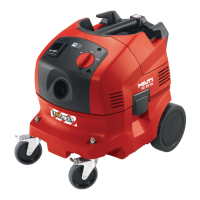
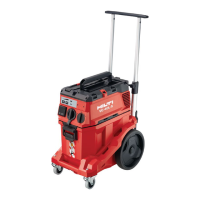
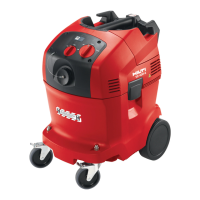
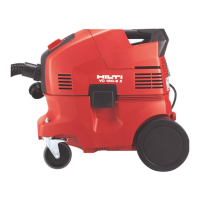
This document provides operating instructions for the Hilti VC 20 and VC 40 wet/dry industrial vacuum cleaners, designed for universal commercial use. These models are suitable for both wet and dry applications, but not for cleaning persons or animals, or for underwater use.

Function Description:

The Hilti VC 20 and VC 40 are industrial wet/dry vacuum cleaners equipped with an automatic filter cleaning system. This system removes most of the dust adhering to the filter element, activating automatically when the vacuum cleaner is switched on. It can also be manually switched on or off via a dedicated button. The filter cleaning system functions only when a suction hose is connected. These vacuum cleaners are designed for collecting large quantities of dust from Hilti diamond grinders, cutters, rotary hammers, and core drilling machines using dry-cutting core bits. They can also pick up drilling slurry (mineral materials) from Hilti diamond core bits or saws, and other liquids up to 60°C (140°F). Additionally, they are suitable for wet and/or dry cleaning of wall and floor surfaces. For UM and UME vacuum cleaners, an audible warning tone is emitted if the air speed in the hose drops below 20 m/s, indicating reduced suction power, often due to a full dust bag or clogged filter. The hose diameter setting must be correctly adjusted to ensure this warning functions properly.

Important Technical Specifications:

The VC 20 and VC 40 models have varying specifications depending on the exact variant (U, UL, UM, UME) and power input (950 W, 1100 W, 1200 W).

VC 20:

  • Dimensions (L x W x H): 505 x 380 x 500 mm
  • Weight (EPTA procedure 01): 13.0 kg
  • Container capacity: 21 l
  • Effective dust capacity: 23 kg
  • Water capacity: 13.5 l
  • Operating temperature: -10 °C to 40 °C
  • Automatic filter cleaning: 15 s
  • Protection class: I (IP X4)
  • AC frequency: 50 Hz ... 60 Hz
  • Rated power input: 950 W (VC 20-U), 1100 W (VC 20-U, UL, UM, UME), 1200 W (VC 20-U, UL, UM, UME)
  • Maximum load on built-in power outlet: Up to 2400 W depending on voltage and region.
  • Maximum volumetric flow rate (air):
    • 950 W: 68 l/s (VC 20-U)
    • 1100 W: 68 l/s (VC 20-U, UL, UM, UME) or 138 m³/h (VC 20-UL, UM, UME)
    • 1200 W: 74 l/s (VC 20-U) or 150 m³/h (VC 20-UL, UM, UME)
  • Maximum partial vacuum:
    • 950 W: 235 hPa (VC 20-U)
    • 1100 W: 230 hPa (VC 20-U) or 209 hPa (VC 20-UL, UM, UME)
    • 1200 W: 253 hPa (VC 20-U, UL, UM, UME)
  • Emission sound pressure level (LPA): 73 dB(A)
  • Uncertainty for sound pressure level (KPA): 2.5 dB(A)
  • Vibration emission value: < 2.5 m/s²

VC 40:

  • Dimensions (L x W x H): 505 x 380 x 610 mm
  • Weight (EPTA procedure 01): 14.7 kg
  • Container capacity: 36 l
  • Effective dust capacity: 40 kg
  • Water capacity: 25 l
  • Operating temperature: -10 °C to 40 °C
  • Automatic filter cleaning: 15 s
  • Protection class: I (IP X4)
  • AC frequency: 50 Hz ... 60 Hz
  • Rated power input: 950 W (VC 40-U), 1100 W (VC 40-U, UL, UM, UME), 1200 W (VC 40-U, UL, UM, UME)
  • Maximum load on built-in power outlet: Up to 1800 W depending on voltage and region.
  • Maximum volumetric flow rate (air):
    • 950 W: 68 l/s (VC 40-U)
    • 1100 W: 68 l/s (VC 40-U, UL, UM, UME) or 138 m³/h (VC 40-UL, UM, UME)
    • 1200 W: 74 l/s (VC 40-U) or 150 m³/h (VC 40-UL, UM, UME)
  • Maximum partial vacuum:
    • 950 W: 235 hPa (VC 40-U)
    • 1100 W: 230 hPa (VC 40-U) or 209 hPa (VC 40-UL, UM, UME)
    • 1200 W: 253 hPa (VC 40-U, UL, UM, UME)
  • Emission sound pressure level (LPA): 73 dB(A)
  • Uncertainty for sound pressure level (KPA): 2.5 dB(A)
  • Vibration emission value: < 2.5 m/s²

Usage Features:

  • Power Outlet for Electric Tools: The vacuum cleaner includes an electric tool power outlet (1) for direct connection of electric tools. This allows the vacuum cleaner to operate in "Auto" mode, starting automatically when the connected tool is switched on and continuing to run for a short period after the tool is switched off to clear the suction hose.
  • Automatic Filter Cleaning: The "Automatic filter cleaning ON/OFF" button (3) and status indicator (4) manage the filter cleaning system, which uses blasts of air to clean the filter element.
  • Control Switch: A control switch (5) allows selection of "ON," "OFF," or "Auto" modes.
  • Hose Diameter Setting (UM/UME models): For UM and UME models, a switch allows adjustment of the hose diameter setting to match the suction hose in use, ensuring correct warning tone emission and optimal performance. For Hilti hollow drill bit systems, the smallest hose diameter setting should be used.
  • Dust Collection: The vacuum cleaners can be used with various dust bags: PE synthetic dust bags for mineral materials (wet and dry), paper dust bags for wood, and different filter types (dry, universal, performance) depending on the application and dust class (L or M).
  • Mobility: Equipped with wheels (8) and a grip (11), the vacuum cleaner is designed for easy movement. Wheel brakes should be engaged to secure the unit during operation.
  • Safety Features: Includes warnings for hot surfaces and restrictions against crane transport. Special stickers indicate suitability for hazardous dusts (Class L or M) and require trained personnel and protective equipment for emptying and maintenance.
  • Cord Management: Features a supply cord hook (12) for organized storage.

Maintenance Features:

  • Filter Element Replacement: The filter element should be replaced at least every six months, or more frequently with intensive use. The process involves opening catches, lifting the suction head, removing the old filter, cleaning the sealing surface, and fitting a new filter.
  • Container Cleaning: The waste material container (7) can be easily emptied by opening catches, lifting the suction head, and tipping out contents. For wet applications, the container should be rinsed with water, and electrodes cleaned with a brush.
  • General Cleaning: The appliance, especially grip surfaces, should be kept clean and free from oil and grease. Outer surfaces can be cleaned with a damp cloth. Air vents should be cleaned with a dry brush.
  • Container Level Monitoring System: This system should be checked regularly, and its cut-out contacts cleaned with a brush if necessary.
  • Hose Inlet Socket Cap (UM/UME models): For UM and UME models, the hose inlet socket should be closed with a cap during transport and when not in use to prevent hazardous material escape.
  • Regular Inspections: For UL, UM, and UME vacuum cleaners, a technical inspection by Hilti Service or a trained person is recommended at least once a year to check for filter damage, air leakage, and proper function of controlling devices.
  • Disposal: Hilti products are recyclable. Old tools and appliances should be returned to Hilti for environmentally compatible recycling. Drilling slurry and dust should be disposed of according to local regulations, with pretreatment for slurry (settling, neutralization) before discharge.

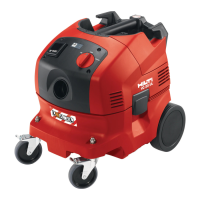
Hilti VC 20 Specifications

General IconGeneral
BrandHilti
ModelVC 20
CategoryVacuum Cleaner
LanguageEnglish

Related product manuals