The HINAESS PowerGem PLUS is a Li-ion (LFP) battery energy storage system designed to provide energy to users through parallel combination. It is not intended for use in series. This user manual details its basic structure, parameters, and procedures for installation, operation, and maintenance.
Function Description:
The PowerGem PLUS battery system is a standard 14.336 kWh battery unit. Customers can combine multiple PowerGem PLUS units in parallel to create a larger capacity battery pack, suitable for energy storage applications requiring high operating temperatures, limited installation space, long power backup times, and extended service life. The system utilizes lithium iron phosphate (LiFePO4) as the positive electrode material, managed by a high-performance Battery Management System (BMS).
Important Technical Specifications:
- Rated Voltage: 51.2V
- Work Voltage Range: 44.8V ~ 57.6V
- Rated Capacity: 280Ah
- Rated Energy: 14.336 kWh
- Recommend Charge/Discharge Current: 140A
- Max. Continuous Charge/Discharge Current: 140A
- Peak Charge Current (15s): 160A
- Peak Charge Current (500ms): 180A
- Peak Discharge Current (300s): 160A
- Peak Discharge Current (500ms): 200A
- Charge Voltage: 56.5V
- Max. Charge Voltage: 56.5V
- Recommend Cut off Voltage: 49V
- Dimensions: 900 × 475 × 237.5 mm
- Weight: ≈113 kg
- Operating Temperature Range: -20°C to +55°C (discharge), 0°C to +55°C (charge)
- Storage Temperature: -10°C to +35°C
- Relative Humidity: 5% ~ 85%RH
- Elevation: No more than 4000m
- Continuous Current Limit (per power cable pair): 200A
Usage Features:
- Safety and Environmental Compliance: Complies with European ROHS, certified SGS, and uses non-toxic, non-polluting, environment-friendly battery materials.
- Enhanced Safety: Lithium iron phosphate (LiFePO4) provides a safer chemistry with a longer lifespan.
- Advanced BMS: Features over-discharge, over-charge, over-current, and abnormal temperature protection. Includes self-management for charging and discharging, and balancing functions.
- Flexibility: Supports flexible configurations for parallel connection of multiple batteries to extend standby time.
- Remote Capabilities: Offers flexible remote upgrade and remote monitoring.
- Quiet Operation: Self-ventilation design results in lower system noise.
- Protection Features: Includes short circuit and reverse connection protection.
- Low Self-Discharge: The battery has a low self-discharge rate, allowing for a recharging period of up to 10 months during storage.
- No Memory Effect: Can be charged and discharged shallowly without memory effect.
- High-Temperature Performance: Good cycle performance even at high temperatures.
- Fast Charging/Discharging: Supports 0.5C charge and discharge rates.
- Installation: Designed for indoor installation, avoiding direct sunlight, conductive dust, and corrosive gas. Requires a flat and level ground for arrangement.
- LED Indicators: RUN, ALM, and SOC LEDs provide status information, including normal operation, various alarms (high temp, high current, low voltage), and protection states (over-charge, over-current, short circuit, over-discharge, MOS failure). SOC LEDs indicate 25% increments of charge.
- Buttons: Includes a SW button to wake up/sleep the BMS and a RESET button to wake up the battery from a force sleep state.
- Communication Ports: Equipped with CAN port, 485 Port, COM IN, COM OUT for communication between batteries and with inverters.
- DIP Switch: Generally kept at 000000 for master and slave units, only adjusted for special protocols.
Maintenance Features:
- BMS Protection Mechanisms:
- Low Voltage Protection: Activates when cell or total voltage drops below rated protection value, cutting off output. Resets when charge current increases voltage to rated value.
- Over Voltage Protection: Activates when total or max cell voltage reaches rated protection value during charge, stopping charging. Resets when voltage decreases to rated value.
- Charge Limit Current Function: Limits charge current to 10A if 150A ≤ charge current < 160A. BMS retests every 10 minutes. Can be released by discharge/full charge/no-charge for 2.5 minutes or SW restart. If charge current ≥ 160A, over-charge current protection activates.
- Over-charge Current Protection: Activates if 160A ≤ charge current < 180A (cuts off after 15s) or if charge current ≥ 180A (cuts off after 500ms). Restores after 1 minute delay or SW restart.
- Over-discharge Current Protection: Activates if 160A ≤ charge current < 200A (cuts off after 300s) or if discharge current ≥ 200A (cuts off after 500ms). Restores after 3 minute delay or immediately with charge current, or SW restart.
- Temperature Protection: Stops charging/discharging if cell temperature is outside 0°C~+55°C (charge) or -20°C~+55°C (discharge). Resets when temperature returns to rated range.
- Short Circuit Protection: BMS recovers automatically after 1 minute. After 4 occurrences, it locks, requiring connection check and SW restart or battery charge to release.
- Reverse Connect Protection: Generally protects the BMS, but reverse connection should be avoided to prevent irreversible damage in extreme cases.
- Long-Term Storage: For long-term storage, the battery should be recharged every 6 months to maintain SOC at 50%.
- Post-Discharge Recharge: Recharge the battery within 24 hours after it is fully discharged or if over-discharge protection activates.
- Troubleshooting: The manual provides a detailed alarm description and processing guide, as well as analysis and treatment of common faults, including no response after power on, no DC output, short DC power supply time, inability to fully charge, power cable sparks, and communication faults.
- Buzzer Alarm: The buzzer sound alarm can be manually turned off via monitor software; it is on by default.

 Need help?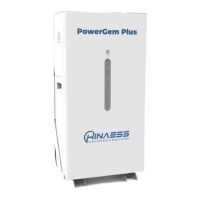

 To Next Page
 General