EasyManua.ls Logo

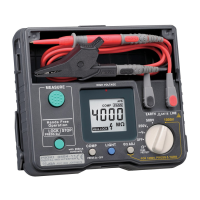
Hioki 3454-11 - User Manual

Hioki 3454-11
10 pages
Print Icon
To Next Page IconTo Next Page
Loading...
Introduction
Thank you for purchasing the HIOKI “3454-11 DIGITAL MΩ HiTESTER”. To
obtain maximum performance from the instrument, please read this manual
first, and keep it handy for future reference.
Initial Inspection
When you receive the instrument, inspect it carefully to ensure that no damage
occurred during shipping. In particular, check the accessories, panel switches,
and connectors. If damage is evident, or if it fails to operate according to the
specifications, contact your dealer or Hioki representative.
Preliminary Checks
Before using the instrument the first time, verify that it operates normally to
ensure that the no damage occurred during storage or shipping. If you find
any damage, contact your dealer or Hioki representative.
Before using the instrument, make sure that the insulation on the test leads
and connection cords is undamaged and confirm that the white or red portion
(insulation layer) inside the cable is not exposed. If a color inside the cable is
exposed, do not use the cable. Using the product in such conditions could
cause an electric shock, so contact your dealer or Hioki representative for
replacements (Model L9787).
Maintenance and Service
To clean the instrument, wipe it gently with a soft cloth moistened with water or
mild detergent. Never use solvents such as benzene, alcohol, acetone, ether,
ketones, thinners or gasoline, as they can deform and discolor the case.
If the instrument seems to be malfunctioning, confirm that the batteries are
not discharged, and that the test leads and fuse are not open circuited before
contacting your dealer or Hioki representative.
When an indication Err.9 appears, send the instrument for repair.
General Specifications
rdg. :reading value (The value currently being measured and indicated on the
measuring instrument)
dgt. :resolution (The smallest displayable unit, i.e., the input value that causes
the digital display to show a "1".)
Insulation Resistance Measurement
* Resistances of 1000 MΩ or higher are indicated in increments of 10 MΩ i.e.,
1010 MΩ, 1020 MΩ, etc.
Operation uncertainty B: ±18% (1st effective measurement range)
Measurement terminal voltage characteristic.
Effect of radiated radio-frequency electromagnetic field: 3 V/m, within +10%rdg.
Resistance Measurement
Short circuit current: 200 mA or more, open circuit voltage: 5 VDC±1 V
Operation uncertainty B: ±30% (0.2 to 400 Ω)
AC Voltage Measurement
Input resistance: 100 kΩ or more, Frequency range: 50 to 60 Hz
Measurement Categories
This instrument complies with CAT III safety requirements. To ensure safe
operation of measurement instruments, IEC 61010 establishes safety stan-
dards for various electrical environments, categorized as CAT
II
to CAT IV, and
called measurement categories.
CAT II: Primary electrical circuits in
equipment connected to an AC electri-
cal outlet by a power cord (portable
tools, household appliances, etc.)
CAT II covers directly measuring electri-
cal outlet receptacles.
CAT III: Primary electrical circuits of
heavy equipment (fixed installations)
connected directly to the distribution
panel, and feeders from the distribution
panel to outlets.
CAT IV:The circuit from the service drop to the service entrance, and to the
power meter and primary overcurrent protection device (distribution panel).
Using a measurement instrument in an environment designated with a higher-
numbered category than that for which the instrument is rated could result in a
severe accident, and must be carefully avoided.
Use of a measurement instrument that is not CAT-rated in CAT II to CAT IV
measurement applications could result in a severe accident, and must be care-
fully avoided.
Safety Symbol
This manual contains information and warnings essential for safe operation of
the instrument and for maintaining it in safe operating condition. Before using it,
be sure to carefully read the following safety precautions.
The following symbols in this manual indicate the relative importance of cau-
tions and warnings.
Indicates that incorrect operation presents an extreme hazard that could
result in serious injury or death to the user.
Indicates that incorrect operation presents a significant hazard that could
result in serious injury or death to the user.
Indicates that incorrect operation presents a possibility of injury to the user or
damage to the instrument
Indicates advisory items related to performance or correct operation of the
instrument.
Follow these precautions to ensure safe operation and to obtain the full bene-
fits of the various functions.
To avoid battery depletion, turn the function selector OFF after use (the Auto
Power Save feature consumes a small amount of current).
The safety sleeve is attached to the test lead plug. Remove the sleeve before
connecting to the instrument.
1. Function Selector: Selects among power ON/OFF, the output voltage for
insulation resistance measurement, ACV, or resistance (Ω).
2. MEASURE Key: Used to measure resistance and insulation resistance.
This key remains ON while it is held down.
3. LOCK Key: Used to measure resistance and insulation resistance. This key
switches ON if held down for more than 2 seconds. Press the key again to
turn it OFF.
4. COMP Key: Used for the comparator function
5. LIGHT Key: Turns the display light ON/OFF. The light automatically
switches OFF after 30 seconds.
6. 0ΩADJ Key: Used for the zero-adjust function in resistance measurement
Used when "1000 V" is selected in insulation-resistance measurement
Used to select the buzzer sound in the comparator function
7. High-voltage warning lamp: Begins flashing if the input voltage exceeds AC
70 V10 V) and during insulation resistance measurement.
8. EARTH Measurement Terminal: Connect the black test lead to this terminal.
9. LINE Measurement Terminal: Connect the red test lead to
this terminal.
10.Strap Hole: Pass the strap through this hole.
11.Test lead Housing: Houses the test leads. The test leads may be
housed without disconnecting them from the terminals after use.
12.Sleeve stand: Attach the sleeve removed from the tip of the
test lead.
Display Block
: Lights up when the measured value is less than the criterion for the comparator
function during insulation-resistance measurement, or when the measured value
is greater than the criterion during resistance measurement.
Specifications
Guaranteed accuracy
period
1 year at
23°C
±
5°C (73°F
±
9°F) and 90% RH
Display Max. 4000 LCD
Sampling rate twice/second
Response time
Insulation resistance ( 0, center value),
resistance: Within 5 s, ACV: Within 2 s
Operating Temperature
&Humidity
0 to 40
°C (32 - 104°F)
, 90%RH or lower
(non-condensating)
Storage Temperature
&Humidity
-20 to 50
°C (-4 - 122°F)
, 90%RH or lower
(non-condensating)
Operating Environment
Indoors, altitude up to 2000 m (6562-ft.) ASL,
Pollution Degree 2
Effect of temperature
0 to 18
°C
, 28 to 40
°C
(32 to 64
°F
, 82 to
104
°F
)
±2% of reading ±5 dgt,
plus basic allowance
(Resistance Measurement 4 MΩ range: ±5% of reading
plus basic allowance)
Influence quantity
E
1
(Position) : 0%
E
2
(Supply voltage) : Twice of the intrinsic uncertainty
E
3
(Temperature) : ±2%±5d
gt.
(Influencing factor non-applicable for E
4
to E
10
)
Degree of protection IP40 (condition which the test lead is connected)
Power source
Rated power voltage: 1.5 V DC × 4,
R6P manganese battery × 4 or LR6 alkaline battery × 4
Maximum rated power 3 VA
3454-11
DIGITAL MΩ HiTESTER
Instruction Manua
January 2012 Revised edition 13
Printed in Japan
3454A981-13 12-01H
Continuous operating
time
Insulation measurement at 250 V and 500 V for
about 10 hours, at 1000 V for about 10 hours (with
manganese battery)
Possible number of
measurements
250 V at 0.25 MΩ 300 times (R6P battery), 1600 times
(LR6 battery)
500 V at 0.5 MΩ 250 times (R6P battery), 1400 times
(LR6 battery)
1000 V at 1.0 MΩ 200 times (R6P battery), 1000 times
(LR6 battery)
Ω at 1.0 Ω 1000 times (R6P battery), 1000 times (LR6
battery)
Additional function
Automatic power-saving mode, Comparator, High-volt-
age warning, Warning indication of false voltage input,
Data hold, Display lighting, 1000 V output error protec-
tion, Zero adjustment
Dielectric strength
5550 V AC 50/60 Hz for one minute
Between electric circuit and case
Maximum input voltage
Maximum rated voltage
to earth
600 V AC,
Measurement Category III
(Anticipated Transient Overvoltage: 6000 V)
Input error protection
for 10 second
(overvoltage protection)
600 V AC
(ACV function: 800 V AC)
(MΩ-1000 V function: 1200 V AC)
Dimensions
(excluding protrusions)
175W × 148H × 56D mm approx.
6.89"W × 5.83"H × 2.20"D approx.
Mass 530 g, 18.7 oz. approx. (including batteries)
Accessories
L9787 Test Lead, Instruction Manual,
R6P manganese battery × 4, Strap
Options
L9787-91 Breaker Pin, 9804-02 Magnetic Adapter,
L9787 Test Lead
Standards applying
Safety EN61010
EMC EN61326
EN 61557-1/-2/-4
Rated output voltage (DC) Max. effective reading Center scale reading
250 V / 500 V 500 MΩ 10 MΩ
1000 V 4000 MΩ 100 MΩ
Rated output voltage Display range Max. reading Resolution
250 V / 500 V / 1000 V
4 MΩ range 4.000 MΩ 0.001 MΩ
40 MΩ range 40.00 MΩ 0.01 MΩ
400 MΩ range 400.0 MΩ 0.1 MΩ
250 V / 500 V 500 MΩ range 500 MΩ 1 MΩ
1000 V 4000 MΩ range 4000 MΩ 1 MΩ*
Rated output
voltage
Name of measurement
range
Measurement range
Accuracy & Intrinsic
uncertainty A
250 V / 500 V
1st effective
measurement range
0.200 to 50.0 MΩ ±3%rdg. ±4dgt.
2nd effective
measurement range
50.1 to 500 MΩ
±5%rdg. ±5dgt.
other measurement range
0 to 0.199 MΩ
1000 V
1st effective
measurement range
0.200 to 200.0 MΩ ±3%rdg. ±4dgt.
2nd effective
measurement range
200.1 to 4000 MΩ
±5%rdg. ±5dgt.
other measurement range
0 to 0.199 MΩ
Rated
output
voltage
Open circuit
voltage
Lower limit measurement
resistance value to be maintained
rated output voltage
Rated
current
Short circuit
current
250 V 1 to 1.2
times of
nominal
test voltage
0.25 MΩ
1 to 1.2 mA
1.2 mA
max.
500 V 0.5 MΩ
1000 V 1 MΩ
Display range Max. reading Resolution
Accuracy & Intrinsic
uncertainty A
(After 0 Ω Adjustment)
40 Ω range 40.00 Ω 0.01 Ω
±3%rdg. ±6dgt.
400 Ω range 400.0 Ω 0.1 Ω
4 kΩ range 4.000 kΩ 0.001 kΩ
40 kΩ range 40.00 kΩ 0.01 kΩ
400 kΩ range 400.0 kΩ 0.1 kΩ
±5%rdg. ±6dgt.
4 MΩ range 4.000 MΩ 0.001 MΩ
Display range Max. reading Resolution
Accuracy
(
Guaranteed at 600 V or less)
600 V range 750 V 1 V ±3%rdg. ±6dgt.
Safety
This instrument is designed to comply with IEC 61010 Safety Standards,
and has been thoroughly tested for safety prior to shipment. However,
mishandling during use could result in injury or death, as well as damage
to the instrument. Using the instrument in a way not described in this
manual may negate the provided safety features.
Be certain that you understand the instructions and precautions in the
manual before use. We disclaim any responsibility for accidents or inju-
ries not resulting directly from instrument defects.
In the manual, the symbol indicates particularly important
information that the user should read before using the instrument.
The symbol printed on the instrument indicates that the user
should refer to a corresponding topic in the manual (marked with
the symbol) before using the relevant function.
Indicates that dangerous voltage may be present at this terminal.
Indicates a double-insulated device.
Indicates AC (Alternating Current).
Indicates DC (Direct Current).
Usage Notes
Observe the following precautions to avoid electric shock.
Be sure to disconnect the test lead from the object to be measured
and turn the function switch OFF before connecting or disconnecting
the test lead from the MΩ HiTESTER.
Always verify the appropriate setting of the function selector before
connecting the test leads.
Disconnect the test leads from the measurement object before
switching the function selector.
Do not use the instrument where it may be exposed to corrosive or com-
bustible gases. The instrument may be damaged or cause an explosion.
Do not allow the instrument to get wet, and do not take measurements
with wet hands. This may cause an electric shock.
Do not use any other electrical source other than the batteries. The
use of any other sources may result in damage of the instrument or
the object to be measured and also may cause electric shock.
Before using the instrument, make sure that the insulation on the test
leads and confirm that the white or red portion (insulation layer) inside
the cable is not exposed. If a color inside the cable is exposed, do not
use the cable. Using the product in such conditions could cause an
electric shock, so contact your dealer or Hioki representative for
replacements (Model L9787).
Do not use the instrument where it may be exposed to oil, chemicals, or
solvents. Contact with these substances may cause cracking in the
instrument, resulting in damage or electric shock.
If the protective functions of the instrument are damaged, either remove it
from service or mark it clearly so that others do not use it inadvertently.
This instrument is designed for use indoors. It can be operated at temper-
atures between 0 and 40°C without degrading safety.
Do not store or use the instrument where it could be exposed to direct sun-
light, high temperature or humidity, or condensation. Under such condi-
tions, the instrument may be damaged and insulation may deteriorate so
that it no longer meets specifications.
For safety reasons, when taking measurements, only use the L9787 Test
Lead (or optional) provided with the instrument.
To avoid damage to the instrument, protect it from physical shock when
transporting and handling. Be especially careful to avoid physical shock
from dropping.
Calibration and repair of this
instrument should be performed only under
the supervision of qualified technicians knowledgeable about the dangers
involved.
Removable sleeves are attached to the metal pins at the ends of the test
leads. To prevent a short circuit accident, be sure to use the test leads with
the sleeves attached when performing measurements in the CAT III mea-
surement category. Remove the sleeves from the test leads when perform-
ing measurements in the CAT I and CAT II measurement categories. For
details on measurement categories, see "Measurement categories" in the
instruction manual.
Names and Functions of Parts
3.
2.
11.
10.
4. 5.
6.
1.
10.
9.
8.
7.
12.
12.
: Lights up when the measured value is held during
the resistance/insulation-resistance measurement.
: Lights up when 0Ω adjustment is made during
resistance measurement.
: Indicates that battery power is low. (during which
time accuracy cannot be guaranteed).
: Lights up when auto power save is enabled.
: Lights up when the comparator function is enabled.
Question and Answer IconNeed help?

Do you have a question about the Hioki 3454-11 and is the answer not in the manual?

Summary

Instrument Specifications

General Specifications

Provides general technical specifications for the instrument, including accuracy, display, and operating conditions.

Insulation Resistance Measurement Specifications

Details rated output voltages, measurement ranges, accuracy, and uncertainty for insulation resistance.

Resistance Measurement Specifications

Outlines display ranges, resolution, accuracy, and uncertainty for resistance measurements.

AC Voltage Measurement Specifications

Specifies the display range, resolution, and accuracy for AC voltage measurements.

Safety Information

Measurement Categories and Safety

Explains measurement categories (CAT II, CAT III, CAT IV) and their implications for safe usage.

Understanding Safety Symbols and Warnings

Details safety symbols used in the manual and instrument, and explains warning/danger levels.

Instrument Overview and Operation

Names and Functions of Parts

Identifies and describes the function of each key component and terminal on the instrument.

Display Block Indicators Explained

Explains the meaning of various indicators and symbols displayed on the instrument's screen.

Measurement Procedures

Pre-measurement Inspection and Setup

Ensures test leads are properly connected and the instrument is ready before starting measurements.

Performing Insulation Resistance Measurement

Step-by-step guide on how to perform insulation resistance measurements using the instrument.

Performing AC Voltage Measurement

Instructions on how to connect the instrument and read AC voltage measurements.

Performing Resistance Measurement

Step-by-step guide on how to perform resistance measurements using the instrument.

Advanced Functions and Maintenance

Zero-Adjustment and Comparator Functions

Explains zero-adjustment for accuracy and how to use the comparator for PASS/FAIL results.

Automatic Power-Saving and Battery Replacement

Details power-saving features, how to disable them, and procedures for replacing batteries and fuse.

Overview

The HIOKI 3454-11 DIGITAL MΩ HITESTER is a robust and versatile instrument designed for a range of electrical measurements, primarily focusing on insulation resistance, but also capable of AC voltage and low resistance measurements. This instruction manual provides comprehensive guidance for its safe and effective operation, emphasizing initial inspection, preliminary checks, and ongoing maintenance to ensure optimal performance and longevity.

Function Description

The core function of the HIOKI 3454-11 is to measure insulation resistance, a critical parameter for assessing the integrity of electrical systems and components. It achieves this by applying a specified DC voltage (250 V, 500 V, or 1000 V) to the test object and measuring the resulting leakage current. The instrument then calculates the insulation resistance based on these values. The manual details how to select the appropriate output voltage using the function selector, with a special procedure for selecting 1000 V while simultaneously pressing the 0ΩADJ key to ensure correct operation. The display indicates "OF" (overflow) when the measured resistance exceeds the instrument's effective maximum range, similar to an "infinity" reading on analog testers. This feature is crucial for identifying highly insulated components.

Beyond insulation resistance, the device also offers AC voltage measurement. This function allows users to determine the voltage present in a circuit, converting the current flowing from the voltage source through the instrument into a voltage value. The function selector is used to switch to the "~V" setting for this measurement. A high-voltage warning lamp flashes if the input voltage exceeds AC 70 V (±10 V), providing an important safety alert during operation.

Additionally, the HIOKI 3454-11 can perform low resistance measurements. In this mode, the instrument supplies a specific current to the test object and measures the voltage drop across its terminals. The resistance is then calculated using these values. The "Ω" setting on the function selector is dedicated to this measurement. A key feature for low resistance measurement is the 0Ω Adjustment Function, which allows the instrument to store and deduct the resistances of the test leads and fuse from subsequent measurements, ensuring a more accurate reading of the object's intrinsic resistance. This adjustment is performed by short-circuiting the test lead tips and pressing the 0ΩADJ key, resulting in a "0.00 Ω" display.

The instrument also incorporates a Comparator Function, which enhances its utility by allowing users to compare measured values against a preset criterion. This function is particularly useful for pass/fail testing in manufacturing or maintenance environments. When activated by pressing the COMP key, the display shows the criterion-setting screen, allowing users to cycle through various preset resistance values for insulation resistance or low resistance. The 0ΩADJ key is used to switch between "PASS" and "FAIL" conditions for the buzzer sound, providing immediate audible feedback on the measurement result. Once a criterion is set, the instrument indicates "PASS" if the measurement meets or exceeds the criterion (for insulation resistance) or meets or is less than the criterion (for resistance), and "FAIL" otherwise.

Usage Features

The HIOKI 3454-11 is designed with several features to facilitate ease of use and ensure safety during operation. The function selector is the primary control for switching between different measurement modes and turning the device ON/OFF. The MEASURE key is used to initiate measurements, remaining active as long as it is held down. For continuous measurements, the LOCK key can be pressed for more than two seconds, allowing the instrument to measure without requiring the user to hold the key. Pressing the LOCK key again or the MEASURE key will stop the continuous measurement.

A display light function, activated by the LIGHT key, illuminates the LCD for better visibility in dimly lit environments, automatically turning off after 30 seconds to conserve battery life. The instrument also features an Automatic Power-Saving Mode, which activates approximately 10 minutes after the last operation, turning off all displayed values to conserve power. This mode is indicated by the "APS" light. To disable this feature, the user must hold down the LIGHT key while turning the function switch ON.

Safety is paramount in the design and operation of the HIOKI 3454-11. The manual strongly emphasizes the importance of preliminary checks, such as inspecting test leads for damage and ensuring proper insulation. It adheres to IEC 61010 Safety Standards and is rated for Measurement Category III, indicating its suitability for measurements on primary electrical circuits of heavy equipment and feeders from distribution panels. Users are warned against using the instrument in environments with higher-numbered categories to prevent severe accidents. The device includes an input error protection mechanism for up to 600 V AC, and a high-voltage warning lamp that flashes if the input voltage exceeds AC 70 V (±10 V) during insulation resistance measurement.

The manual also details the "Discharge Function," which is crucial when measuring insulation resistance of capacitive elements. After a measurement, a charge proportional to the test voltage can accumulate in the object. The built-in discharge circuit automatically dissipates this charge, with the high-voltage warning lamp and indicator flashing until the voltage drops below approximately 30 V, preventing electric shock hazards.

Maintenance Features

Maintaining the HIOKI 3454-11 is straightforward, with clear instructions provided in the manual to ensure its long-term reliability and accuracy. For cleaning, users are advised to gently wipe the instrument with a soft cloth moistened with water or mild detergent, explicitly warning against the use of solvents like benzene, alcohol, or acetone, which can deform and discolor the case.

Battery replacement is a key maintenance task. The instrument operates on four 1.5 V DC R6P manganese or LR6 alkaline batteries. The manual provides a step-by-step guide for safe battery replacement: first, setting the function selector to OFF and disconnecting the test leads, then loosening the screw on the back cover to access the battery compartment, replacing all four batteries, and finally reinstalling the cover and screws. Users are cautioned against mixing old and new batteries or different types, and to observe correct polarity to prevent damage or leakage. The "B" indicator on the display signals low battery power, indicating when replacement is needed.

Fuse replacement is also covered, with specific instructions to use only the specified fuse type (7012540, 0.5 A/700 V AC, very fast-acting) to avoid life-threatening hazards. The procedure for fuse replacement is similar to battery replacement, requiring the same safety precautions.

The manual also advises on storage, recommending that batteries be removed if the instrument is to be stored for a long time to prevent corrosion from battery leakage. It also emphasizes that calibration and repair should only be performed by qualified technicians to ensure safety and maintain accuracy. If an "Err.9" indication appears, the instrument should be sent for repair. These maintenance guidelines are crucial for ensuring the continued safe and accurate operation of the HIOKI 3454-11 DIGITAL MΩ HITESTER.

Hioki 3454-11 Specifications

General IconGeneral
DisplayLCD
Operating Temperature0°C to 40°C
Power SupplyAC 100 V to 240 V, 50/60 Hz
Measurement CategoryCAT II 300V
Measurement Frequency1 kHz
Current Ranges1 mA, 10 mA
Frequency Range45 Hz to 5 kHz
Resistance Range0.0001 Ω to 99.99 MΩ
Capacitance Range1 pF to 10 mF
Safety StandardsIEC61010-1

Related product manuals