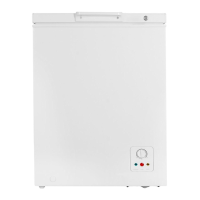
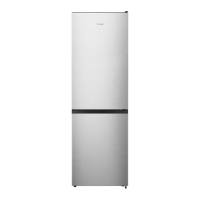
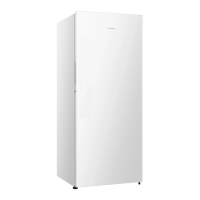
This document is the User's Operation Manual for the Hisense FUV124D4AW1 refrigerator, designed to provide comprehensive information on its installation, operation, and maintenance.
Function Description
The Hisense FUV124D4AW1 is a household refrigerating appliance intended for storing fresh and frozen food. It features a freezer compartment for long-term storage of frozen and deep-frozen food, as well as an ice-cube tray for making and storing ice. The appliance is designed for domestic household use and is suitable for various applications such as staff kitchen areas, farmhouses, hotels, motels, bed and breakfast establishments, and catering.
Important Technical Specifications
- Model: FUV124D4AW1
- Power Supply: Single phase alternating current of 220~240V/50Hz.
- Refrigerant: Isobutene (R600a), a natural gas with high environmental compatibility, which is flammable.
- Insulation Blowing Gas: Flammable.
- Climate Class: The appliance performs well from SN to ST.
- SN: +10°C to +32°C
- N: +16°C to +32°C
- ST: +16°C to +38°C
- T: +16°C to +43°C
- Energy Efficiency: Designed for optimal energy efficiency, especially when shelves, drawers, and baskets are in their original positions.
- Dimensions of Mounting Slot:
- Width: 600 mm
- Min Depth: 550 mm
- Height: 820-900 mm
- Ventilation Area: >200cm² (at the rear, 80-100 mm from the wall, 100-180 mm from the floor)
Usage Features
- Temperature Control: The appliance features a controller part with buttons for POWER, SUPER, and TEMP.
- POWER: Press and hold for 3 seconds to turn the power function on or off. When off, the refrigerator stops cooling, and no food should be stored inside.
- SUPER: Activates the super freeze function, rapidly lowering the freezer temperature to -24°C for faster freezing and preservation of vitamins and nutrients. It automatically switches off after 52 hours.
- TEMP: Allows setting the freezer temperature between -14°C and -24°C in a sequence (-18°C → -17°C → -16°C → -15°C → -14°C → -19°C → -20°C → -21°C → -22°C → -23°C → -24°C).
- ALARM: An icon lights up and flashes with a buzzing sound in case of an alarm (e.g., if the fridge temperature is above -8°C for 4 hours after being plugged in for 15 hours).
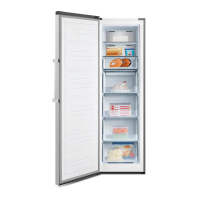
- Freezer Compartment: Located in the upper part of the appliance, it is used for freezing fresh food and storing frozen and deep-frozen food.
- Freezer Drawer: For storing frozen food. Can be removed by pulling it out to its maximum extension and lifting it up.
- Glass Shelf: For storing frozen food. Can be removed by lifting up and pulling out.
- Ice-cube Tray: For making and storing ice cubes.
- Door Reversal: The door opening side can be changed from right to left, if required by the installation site. This process involves removing hinges and covers, turning the hinge over, and re-attaching the door, ensuring proper alignment and seal security.
Maintenance Features
- Cleaning:
- Exterior: Clean regularly with a mild detergent and soft cloth. Avoid sharp objects, thinners, car detergents, bleach, ethereal oil, abrasive cleansers, or organic solvents.
- Interior: Clean regularly, especially when food stocks are low, using a weak solution of baking soda and water. Rinse with warm water and dry thoroughly.
- Defrosting: The appliance manually defrosts. If frost becomes too thick, remove food, unplug the appliance, leave doors open, and ventilate the room. Do not use sharp objects to remove frost.
- Door Seals: Keep door seals clean with a mild detergent and warm water to prevent sticking and tearing. Ensure seals are completely dry before powering on the appliance.
- Troubleshooting: The manual provides a troubleshooting guide for common issues such as the appliance not working, odours, noise, frost accumulation, incorrect temperature, and door closure problems.
- Disposal: The appliance and its packaging materials are recyclable. It must not be disposed of as household waste but taken to an authorized waste disposal center. The refrigerant and insulation blowing gas must be disposed of professionally.
- Food Storage Recommendations:
- Fridge (+2~+8°C): Eggs, cooked food, packaged food, fruits and vegetables, dairy products, cakes, drinks, and other non-freezable foods.
- 0-star (-6~0°C): Fresh pork, beef, fish, chicken, some packaged processed foods (consume within the same day, preferably not later than 3 days). Partially packed/wrapped up encapsulated processed foods (non-freezable).
- Chill (-2~+3°C): Fresh/frozen pork, beef, chicken, freshwater aquatic products (7 days below 0°C, 2 days above 0°C). Seafood (less than 0°C for 15 days).
- Fresh Food (0~+4°C): Fresh pork, beef, fish, chicken, cooked food (consume within the same day, preferably not later than 3 days).
- Wine (+5~+20°C): Red wine, white wine, sparkling wine, etc.
- Freezer Compartments ()-Freezer (≤-18°C), ***-Freezer (≤-18°C), *-Freezer (≤-12°C), -Freezer (≤-6°C): Seafood (fish, shrimp, shellfish), freshwater aquatic products, and meat products. Recommended storage times vary from 1 to 3 months depending on the star rating. 0-star, one-, two-, and three-star compartments are not suitable for freezing fresh food.
- Energy Saving Tips: Avoid keeping the door open for long periods, keep the appliance away from heat sources, do not set the temperature colder than necessary, avoid storing warm food or evaporating liquids, ensure proper ventilation, and place food properly for free air circulation.
- Switching Off for Extended Periods: Remove all food, unplug the appliance, clean and dry the interior, and leave doors slightly wedged open to prevent mold.
The manual emphasizes several safety warnings:
- The appliance is intended for household and similar applications.
- Do not store explosive substances or aerosol cans with flammable propellants.
- The supply cord must be replaced by the manufacturer or qualified persons if damaged.
- Keep ventilation openings clear of obstruction.
- Do not use mechanical devices or other means to accelerate defrosting other than those recommended by the manufacturer.
- Do not damage the refrigerant circuit.
- Do not use electrical appliances inside food storage compartments unless recommended by the manufacturer.
- Refrigerant (R600a) and insulation blowing gas are flammable; dispose of the appliance at an authorized waste disposal center.
- Ensure the supply cord is not trapped or damaged when positioning the appliance.
- Do not locate multiple portable socket-outlets or power supplies at the rear.
- The appliance must be fixed in accordance with instructions to avoid instability.
- Illuminating lamps must not be replaced by the user; contact customer helpline if damaged.
- Avoid opening flames and sources of ignition if the refrigerant circuit is damaged.
- The power cord must not be lengthened, and the power plug must not be crushed or damaged.
- Ensure access to the main plug.
- Do not pull the main cable to unplug.
- Do not insert the power plug into a loose socket.
- Do not operate without the interior lighting lamp cover.
- The fridge requires a special power socket with a ground wire.
- Do not store flammable gas or liquids.
- Do not operate any electrical appliances inside the fridge.
- Always pull the plug from the mains socket when unplugging.
- Do not place hot items near plastic components or food directly against the rear wall air outlet.
- Store pre-packed frozen food according to manufacturer's instructions.
- Do not place carbonated or fizzy drinks in the freezer compartment.
- Frozen food can cause frost burns if consumed straight from the freezer.
- Do not place the appliance in direct sunlight.
- Keep burning candles, lamps, and other items with naked flames away from the appliance.
- Do not remove or touch items from the freezer compartment with damp/wet hands.
- Never use the base, drawers, or doors as supports.
- Frozen food must not be refrozen once thawed.
- Do not consume ice popsicles or ice cubes straight from the freezer.
- Do not overload door racks or crisper drawers.
- Before maintenance, switch off and disconnect the mains plug.
- Do not clean with metal objects, steam cleaner, ethereal oils, organic solvents, or abrasive cleansers.
- Use a plastic scraper for frost removal.
- Wait at least four hours before connecting the appliance to allow oil to flow back to the compressor.
- Ensure adequate air circulation around the appliance.
- The back of the product should not be too close to a wall.
- Do not locate near radiators or cookers.
- Ensure the mains plug is accessible after installation.
- Any electrical work should be carried out by a qualified electrician or competent person.
- This product must be serviced by an authorized Service Center using genuine spare parts.
- Children aged 3 to 8 years are allowed to load and unload refrigerating appliances (EU region only).
- Never close the door while drawers are extended.
- Food needs to be packed in bags before putting into the refrigerator, and liquids in bottles or capped containers to avoid cleaning difficulties.


 To Next Page
 General