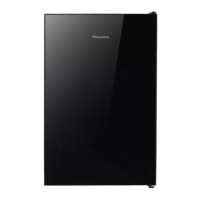
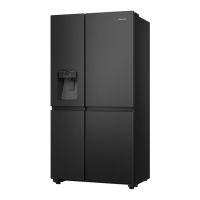
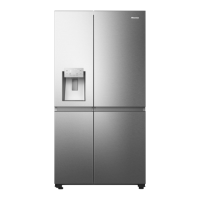
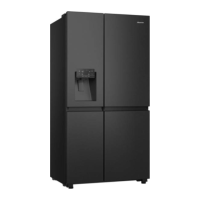
This document is the User's Operation Manual for Hisense Refrigerator models RS741N4WBE and RS741N4WCE. It provides comprehensive guidance on the installation, operation, and maintenance of the appliance, emphasizing safety and correct usage.
Function Description:
The Hisense refrigerator is designed for household and similar applications, including staff kitchen areas, farmhouses, hotels, motels, bed and breakfast environments, and catering. It features a refrigerator compartment for storing fresh foods like meat, vegetables, fruits, dairy products, and cooked items, and a freezer compartment for freezing and storing foods such as meat, ice cream, and other items requiring freezing. Some models include an ice maker for producing and storing ice cubes. A water dispenser is integrated into the fridge door for easy access to chilled drinking water without opening the main compartment. The appliance is equipped with LED lighting in both the freezer and fresh zones.
Important Technical Specifications:
The refrigerator operates on a single-phase alternating current power supply of 220-240V/50Hz. For areas with significant voltage fluctuations, an A.C. Automatic voltage regulator of more than 350W is recommended. The appliance uses isobutene (R600a) as a refrigerant, a natural gas with high environmental compatibility, which is flammable. The insulation blowing gas is also flammable.
The climate classes supported are SN (+10°C to +32°C), N (+16°C to +32°C), ST (+16°C to +38°C), and T (+16°C to +43°C).
Ventilation requirements for installation include 50-70mm of space from the back to the wall, at least 100mm from the top, and at least 100mm from the sides to the wall. A clear space upfront is needed to allow doors to open 130° (refrigerator door 135°).
The water dispenser tank has a capacity of up to 4L.
The manual specifies target storage temperatures for different compartments: Fridge (+2°C to +8°C), (**)-Freezer (<-18°C), ***-Freezer (<-18°C), **-Freezer (<-12°C), *-Freezer (<-6°C), 0-star (-6°C to 0°C), Chill (-2°C to +3°C), Fresh Food (0°C to +4°C), and Wine (+5°C to +20°C).
Usage Features:
The refrigerator features an intuitive display control panel with temperature settings for both fridge and freezer compartments, mode selection, and an unlock function.
- Temperature Control: Users can set the fridge temperature between 2°C and 8°C and the freezer temperature between -15°C and -25°C.
- Modes:
- Super Cool: Rapidly refrigerates food to keep it fresh longer. The icon illuminates when active. Can be switched off by pressing "Fridge" or "Freezer" buttons.
- Super Freeze: Quickly lowers freezer temperature for faster freezing, preserving vitamins and nutrients. The icon illuminates when active. Automatically switches off after 26 hours. Can be switched off by pressing "Fridge" or "Freezer" buttons.
- Holiday Function: Automatically switches the refrigerator temperature to 15°C to minimize energy consumption when the user is away for a long period. No food should be stored in the fridge during this time. The icon illuminates when active. Can be switched off by pressing "Fridge" or "Freezer" buttons.
- Alarm System:
- Door Alarm: Sounds if the fridge or freezer door is open for over 2 minutes, sounding 3 times every minute for 10 minutes.
- General alarm icon illuminates with a buzzing sound in case of other alarms.
- Interior Layout: Features glass shelves and door racks that can be adjusted to different heights. Crispers on telescopic slides are provided for storing vegetables and fruits. A bottle holder can be moved side to side on the middle and lower door racks.
- Ice Maker (Optional): A removable accessory for making and storing ice cubes. Water is poured into the ice tray up to the top line, and once frozen, cubes can be dropped into the storage box.
- Water Dispenser: Allows access to chilled water without opening the fridge door. The water tank, lids, and head are removable for cleaning. Water should be filled up to 4L, not exceeding the level to prevent overflow.
Maintenance Features:
- Cleaning: The appliance, including its exterior and interior accessories, should be cleaned regularly (at least every two months).
- Exterior Cleaning: Digital and display panels should be wiped with a clean, soft cloth. Doors, handles, and cabinet surfaces can be cleaned with a mild detergent and soft cloth. Avoid sharp objects, thinners, car detergent, Clorox, ethereal oil, abrasive cleansers, or organic solvents.
- Interior Cleaning: The interior should be wiped with a weak solution of bicarbonate of soda, rinsed with warm water, and thoroughly dried. Shelves and baskets should be removed and dried.
- Defrosting: The appliance automatically defrosts, but if frost builds up, food and accessories should be removed, the appliance unplugged, and doors left open to thaw. The interior should be cleaned and dried completely before plugging back in. Avoid sharp objects for frost removal.
- Door Seal Cleaning: Door seals should be kept clean to prevent sticking and tearing. Wash with mild detergent and warm water, rinse, and dry thoroughly before powering on the appliance.
- Water Dispenser Cleaning: Water tanks should be cleaned if not used for 48 hours. The water system connected to a supply should be flushed if water has not been drawn for 5 days. The tank, lid, and head are removable for cleaning.
- LED Light Replacement: The illuminating lamps are not user-replaceable. If damaged, contact the customer helpline for assistance. The manual outlines steps for service personnel to replace the LED light.
- Troubleshooting: The manual provides a troubleshooting section with common problems and their possible causes and solutions, such as appliance not working, odours, noise, frost, and temperature issues. Users are advised to perform these checks before calling for service.
- Disposal: The appliance must not be disposed of as household waste. Packaging materials are recyclable. For appliance disposal, the mains plug should be removed, the power cord cut, and the appliance taken to an authorized waste disposal centre due to the flammable refrigerant and insulation gases.



 To Next Page
 General