BATTERY
SAFETY
GUIDELINES
ALWAYS ALWAYS
ALWAYS ALWAYS NEVER
NEVER ALWAYS ALWAYS
ALWAYS ALWAYS ALWAYS
Used correctly, domestic batteries are a safe and dependable source
of portable power. Problems can occur if they are misused or abused
– resulting in leakage or, in extreme cases, re or explosion.
Here are some simple guidelines to safe battery use designed to
eliminate any such problems.
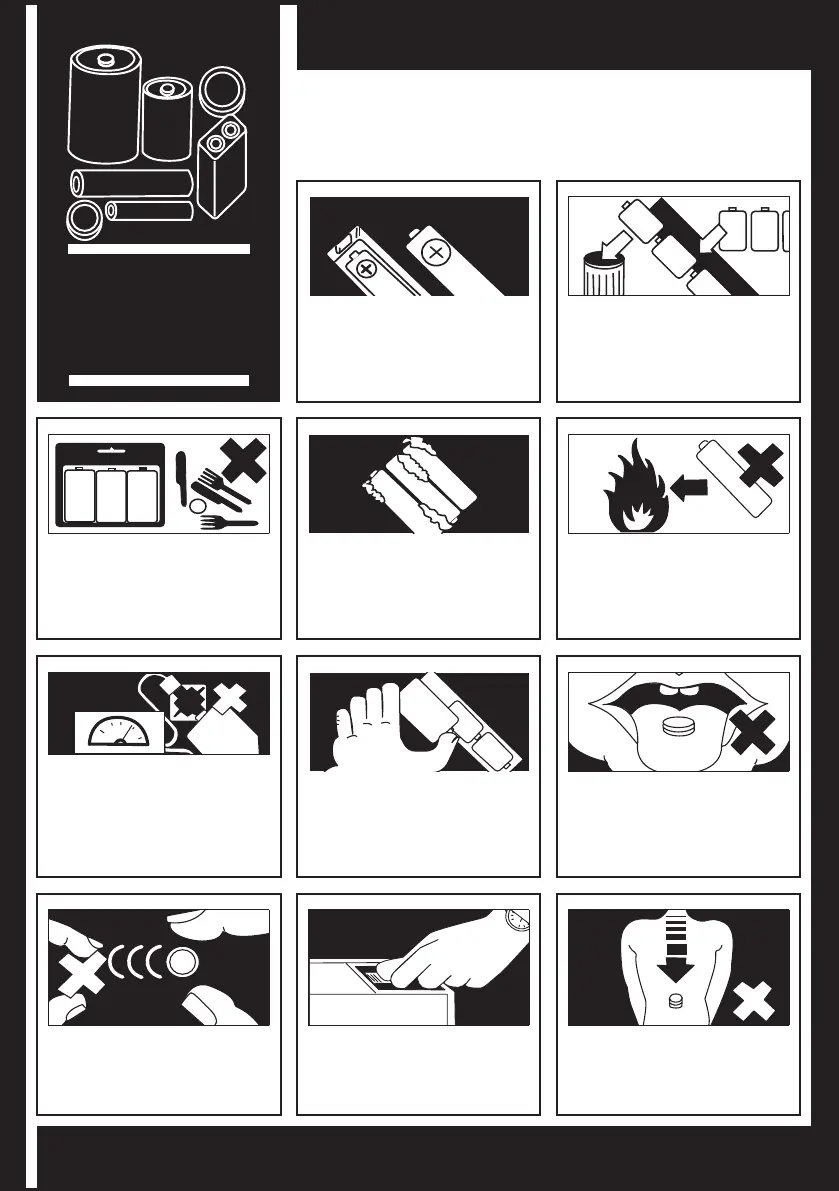
Take care to t your batteries correctly,
observing the plus and minus marks
on the battery and appliance. Incorrect
tting can cause leakage or, in extreme
cases, re or even an explosion.
Remove dead batteries from
equipment and all batteries from
equipment you know you are not
going to use for a long time. Otherwise
the batteries may leak and cause
damage.
Make sure battery compartments are
secure.
Supervise children if they are replacing
batteries themselves in order to ensure
these guidelines are followed.
Store unused batteries in their
packaging and away from metal
objects which may cause a short-
circuit resulting in leakage or, in
extreme cases, re or even an
explosion.
Keep loose button cells away from
young children.
Never attempt to recharge ordinary
batteries, either in a charger or by
applying heat to them. They may leak,
cause re or even explode. There are
special rechargeable batteries which
are clearly marked as such.
Replace the whole set of batteries
at one time, taking care not to mix
old and new batteries or batteries of
dierent types, since this can result
in leakage or, in extreme cases, re or
even an explosion.
Never dispose of batteries in re
as this can cause them to explode.
Please recycle dead batteries; do
not put with the normal household
waste.
Seek medical advice if you believe a
cell has been swallowed.
Remember that small button cell
batteries such as used in some
hearing aids, toys, games and other
appliances, are easily swallowed
by young children and this can be
dangerous.
GB-5
Hitachi KC95E_IB_GB_RC_Final130313.indd 5 14/03/2013 3:39 AM


 To Next Page