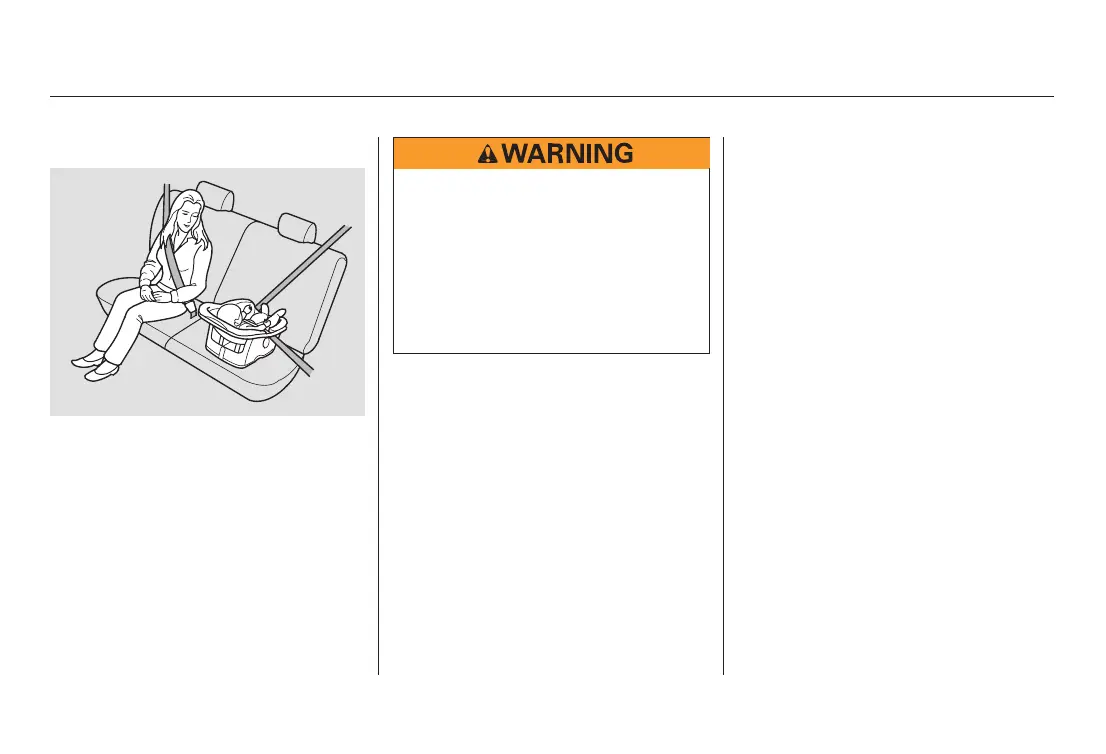
In this vehicle, a rear-facing child
seatcanbeplacedinanyseating
position in the back, but not in the
front seat.
If the passenger’s
front airbag inflates, it can hit the
back of the child seat with enough
force to kill or seriously injure an
infant. If an infant must be closely
watched, we recommend that
another adult sit in the back seat
with the baby.
If placed
facing forward, an infant could be
very seriously injured during a
frontal collision.
Only a rear-facing child seat provides
proper support for a baby’s head,
neck, and back.
We recommend that an infant be
restrained in a rear-facing child seat
until the infant is at least one year
old, reaches the seat maker’s weight
or height limit, and is able to sit up
without support.
Two types of seats may be used: a
seat designed exclusively for infants,
or a convertible seat used in the rear-
facing, reclining mode.
Protecting Infants
Child Seat Type
Rear-Facing Child Seat Placement
Never put a rear-facing child seat in
the front seat.
Do not put a rear-f acing child seat in
a forward-facing position.
Protecting Children
Driver and Passenger Safety
34
Placing a rear-facing child seat
in the front seat can result in
serious injury or death if the
passenger’s front airbag inflates.
Always place a rear-facing child
seat in the back seat, not the
front.
03/03/04 19:30:58 31SCV600 0039



 To Next Page